Acids and bases
Proton transfer
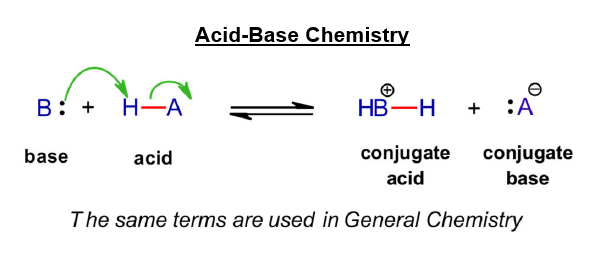
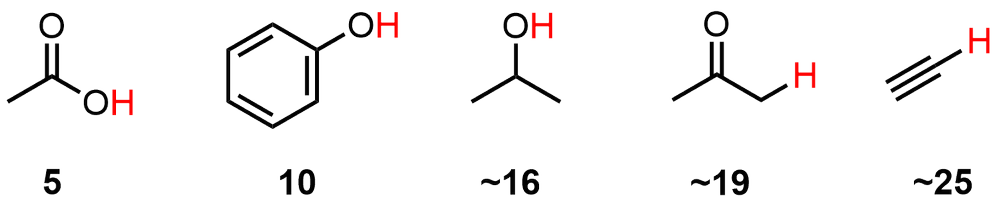
Proton transfer is the first mechanism you learn and the one you will use most. A simple process involving two arrows, a source of electrons and an electron-poor proton. The pKa table helps us organize the typical acids seen in many organic processes.
Proton transfer
Donors, acceptors, and what sets their strength
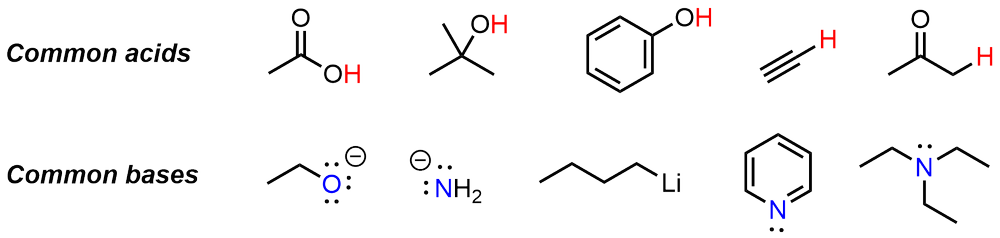
Organic acid-base chemistry focuses on the behavior of molecules that can donate or accept protons (H+) in organic systems. Like in General Chemistry, acids are species that donate protons, while bases accept them, according to the Brønsted–Lowry definition. Common organic acids include carboxylic acids, phenols, and alcohols, while amines and alkoxides are often used as bases. The strength of an acid or base is quantified by its pKa value: a lower pKa (< 0) indicates a strong acid, while a higher pKa corresponds to a weaker acid.
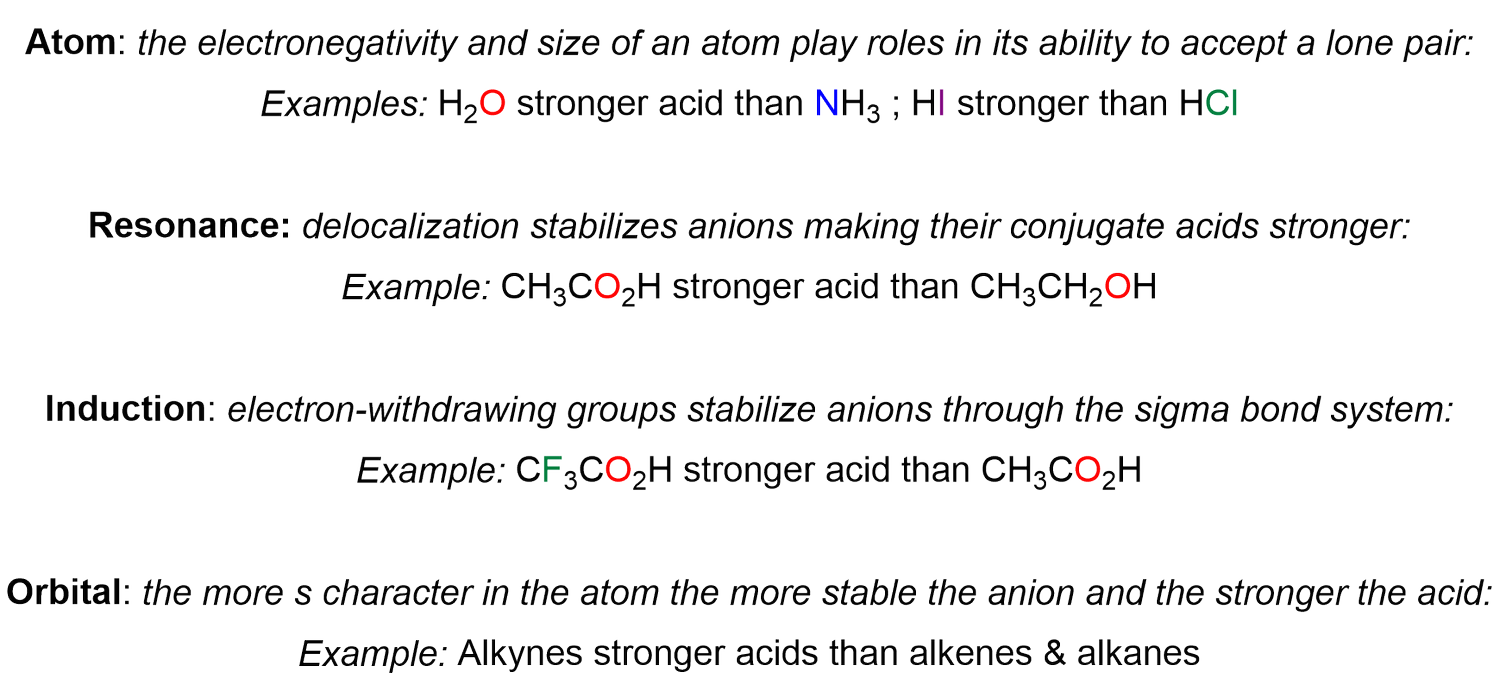
Acid-base reactions in organic chemistry are influenced by several factors: electronegativity of the atom attached to H, which affects how electron-poor the proton is; resonance stabilization in the conjugate base, which stabilizes the negative charge through delocalization; and inductive effects, where electron-withdrawing groups enhance acidity by pulling electron density from the proton while also stabilizing the conjugate base. Solvent polarity also plays a critical role, with polar solvents helping to stabilize charged species. The same terms are used from General Chemistry, where the base and acid react to give the related conjugate acid and conjugate base.
The mechanism arrows
Two arrows, one concerted step
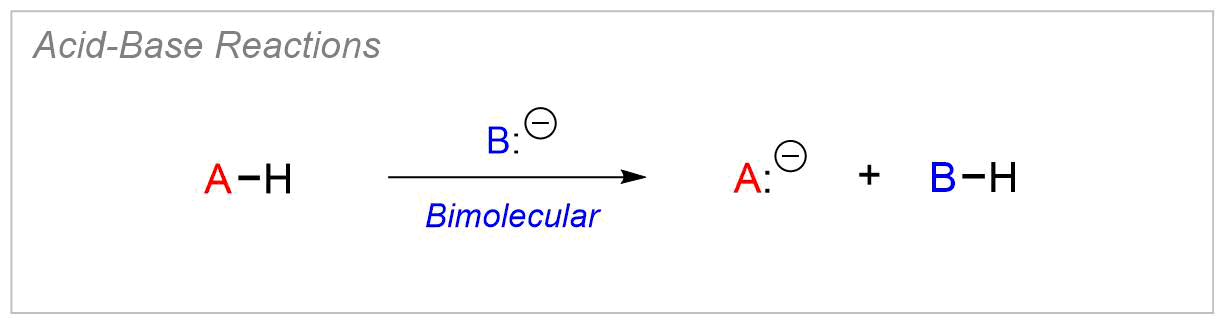
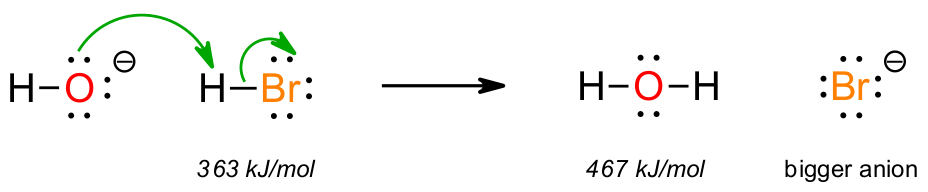
The mechanism arrows used in acid-base chemistry are simple: one arrow to show a bond forming between base and proton, in which the lone pair from the base becomes a bond pair, and a second arrow to show the bond between proton and conjugate base breaking. This describes a simple bimolecular concerted process, which is often the first mechanism studied in the Organic courses.
Important pKa values
Electron-poor protons, electron-rich atoms
Brønsted–Lowry acids have an electron-poor proton, which is usually attached to an electronegative element. In organic chemistry we greatly expand the acid collection beyond what you have seen before in General Chemistry. Brønsted–Lowry bases have an electron-rich atom, which has at least one lone pair associated with it. The lone pair is able to be donated to the electron-poor proton so that the system may become more stable overall.
From Ka to pKa
Why the log scale is worth memorizing
Any acid will have an acid constant, the Ka, which is a measure of its ability to give up a proton. These numbers are difficult to work with, so we convert them to pKa, a log derivative. You will find that knowing these numbers is very helpful when solving problems later. The basic ideas behind pKa values, and examples of applications, are given below.
What makes an acid stronger
Comparing conjugate bases
Acidity always comes back to the stability of the conjugate base. Work through the factors in order; the atom carrying the charge, resonance available to spread it, induction from nearby electron-withdrawing groups, and the orbital the lone pair ends up in. Working through these factors allows us to discuss relative acid strength.
Reference
pKa values worth knowing
Approximate values — enough to predict which way a proton transfer will run. Lower pKa means the stronger acid, and its conjugate base is the weaker one.
Self-check
Six questions before you move on
Work out an answer on paper, then reveal to check. If your reason is right but the answer is wrong, you are closer than you think.
A carboxylic acid is about twelve pKa units more acidic than an alcohol. Why?
The carboxylate spreads its negative charge over two equivalent oxygens by resonance. An alkoxide has to carry the whole charge on one oxygen.
How many arrows does a proton transfer need, and what does each one do?
Two. The first takes the base's lone pair to the proton, forming a bond; the second breaks the old bond, sending that pair onto the conjugate base. Both happen in one concerted step.
Hydroxide is mixed with a terminal alkyne (pKa ~25). Does the deprotonation work?
No; water is pKa 15.7, so the equilibrium sits far to the left. You need a stronger base such as NaNH2 (pKa ~38).
Trifluoroacetic acid is far more acidic than acetic acid. What is responsible?
Induction. The three electron-withdrawing fluorines pull density away through the sigma bonds, making the proton more electron-poor and the conjugate base more stable.
What has to be true of an atom for it to act as a Brønsted–Lowry base?
It must be electron-rich; carrying at least one lone pair it can donate to an electron-poor proton.
Why do we bother converting Ka into pKa at all?
Because Ka values span dozens of orders of magnitude and are awkward to compare. The log scale turns them into small numbers you can remember and subtract easily.