Resonance patterns
Electron delocalization
Spreading electron density lowers the energy of a system. Learn to spot the source and the sink, and nearly every resonance structure you will ever need falls into one of three patterns.
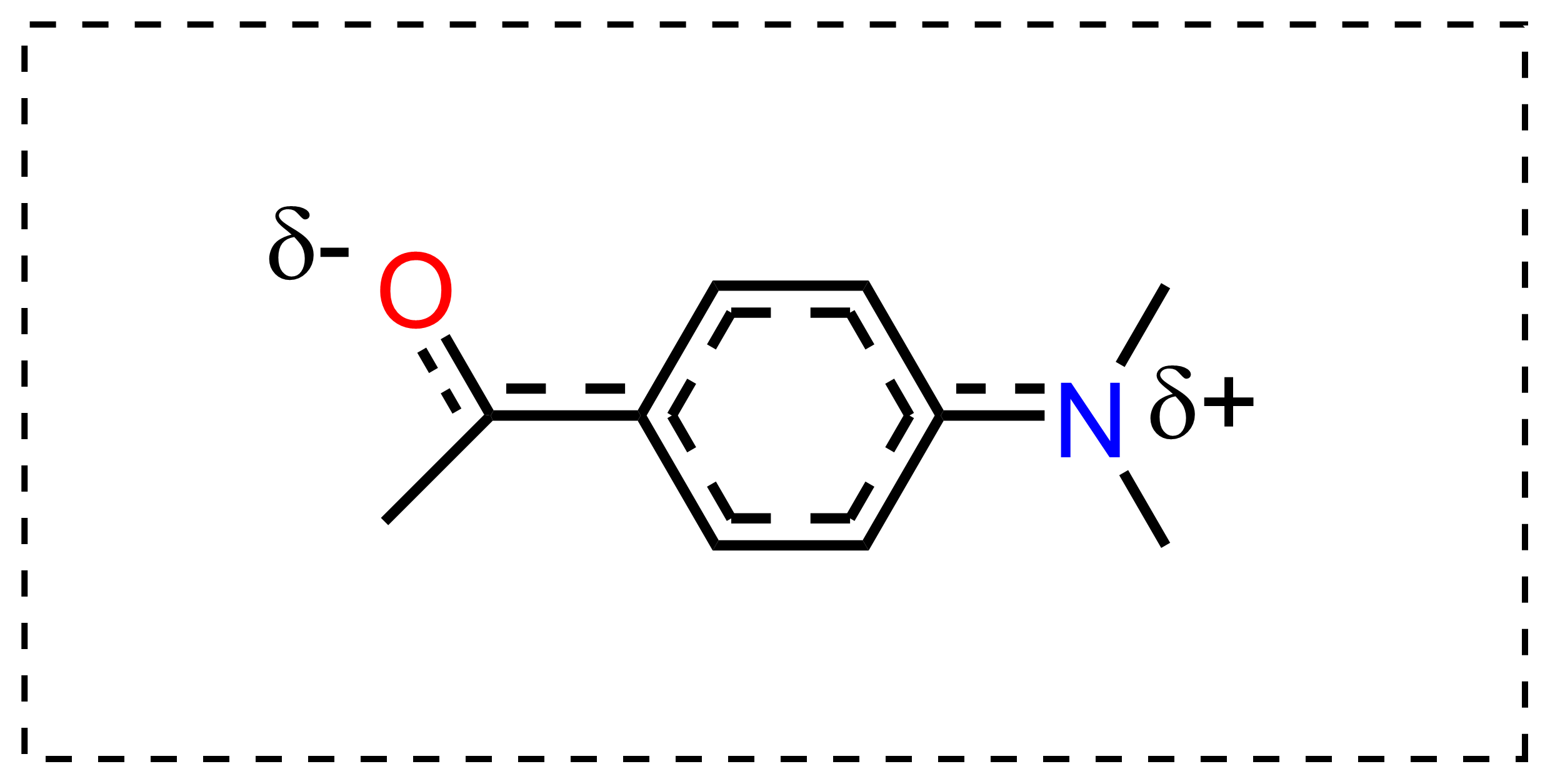
Electron delocalization
One molecule, several contributing structures
Resonance is a concept in chemistry used to describe molecules that cannot be represented by a single Lewis structure. Instead, they are depicted as a hybrid of two or more contributing structures, which differ only in the placement of electrons, not atoms. This phenomenon occurs when electrons, particularly π-electrons or lone pairs, are delocalized over adjacent atoms, creating stability through charge distribution. Electron delocalization reduces potential energy by spreading electron density across multiple bonds or atoms, resulting in equalized bond lengths and enhanced molecular stability.
In certain types of organic molecule, electrons are able to spread out over multiple atoms in order to stabilize the overall system. This requires conjugation, in which orbitals are aligned in patterns that allow for extended interaction — for example between non-bonding electrons and pi bonds, or pi bonds and empty p orbital(s). The examples below show a localized lone pair (left), where the non-bonding electrons are located only on the O atom, and a delocalized system (right) where the lone pair is shared between O and C. The presence of the pi system is essential for resonance delocalization, and spreading the electron density stabilizes both the charge and the molecule.

Source, sink, and Pattern A
Lone pair into an adjacent pi bond
There are really only three patterns involved with delocalizing a pair of electrons; here we will call them Pattern A, Pattern B, and Pattern C. To recognize resonance in a charged molecule it must contain an electron source and an electron sink. The former is either a non-bonded lone pair or a pi bond; the latter is usually an atom capable of accepting a lone pair, for example a second-row element or an empty p orbital. Typical examples are shown below for allyl-type anions, with the electron source being a lone pair and the sink being the terminal atom of the pi bond. The double-headed arrows may be used to describe the spreading of electron density in each case. This will be referred to as Pattern A.

Pattern B is the opposite: a carbocation next to a spare pair of electrons that help to stabilize the positive charge. The allylic carbocation is the simplest example, but it goes a long way in explaining a lot of second-semester chemistry. A heteroatom-stabilized cation, featuring O, N, S, etc. with a spare lone pair, will be essential in many mechanisms in Organic 2.

The allyl radical
One electron moves, and the other must be accounted for
The allyl radical is a related species that features a half-filled p orbital on carbon, such that C has seven electrons. Having a neighbouring pi bond will stabilize this species in a similar way to the allyl cation, except that only one electron is needed to help stabilize the radical; the second pi bond electron must therefore be accounted for in the second resonance structure by placing it on the third carbon of the allyl system. The typical allyl radical resonance structures are shown below (left), along with an orbital representation showing how the conjugated p orbitals interact.

Reference
Recognizing the patterns
Find the source, find the sink, then draw the arrow. Every entry below is the same move applied to a different pair.
Self-check
Six questions before you move on
Work out an answer on paper, then reveal to check. If your reason is right but the answer is wrong, you are closer than you think.
What must be true of two structures for them to be resonance forms rather than two different molecules?
They differ only in the placement of electrons. Every atom stays exactly where it was; move an atom and you have made a different compound.
An alcohol oxygen has two lone pairs but shows no resonance. What is missing?
A sink. There is no adjacent pi bond or empty p orbital for the lone pair to delocalize into, so the electrons stay localized on oxygen.
In the allyl anion, why are the two C–C bond lengths equal when neither drawn structure shows them that way?
The real species is the hybrid, not either drawing. Electron density is spread evenly over both bonds, so both are intermediate between single and double.
The allyl radical needs only one electron to stabilize its half-filled orbital. Where does the pi bond's second electron end up?
On the third carbon of the allyl system, which is why the second structure carries the radical there. We single-headed arrows to describe such one electron processes.
Why must the p orbitals be aligned for delocalization to happen at all?
Overlap requires parallel orbitals. Twist the system so the orbitals are perpendicular and the conjugation, and hence the stabilization, is lost.
Given a charged species, what two things do you look for before drawing any resonance structure?
An electron source, a lone pair or a pi bond, and an electron sink, an atom able to accept that pair or an empty p orbital. No source and sink, no resonance.