Mechanism Clues
What general clues do products give us about how they were formed?
Environment pH Clues
The pH of a reaction mixture is one of the most important indicators or what can and cannot happen in a reaction mechanism. Knowing if the environment is basic, acidic, or neutral will limit the kind of species present in solution. For example, in acids there are no strong bases present, and in base there are no strong acids. This is important in deciding the course of events when bonds are formed and broken on organic substrates. Consider the following three situations.
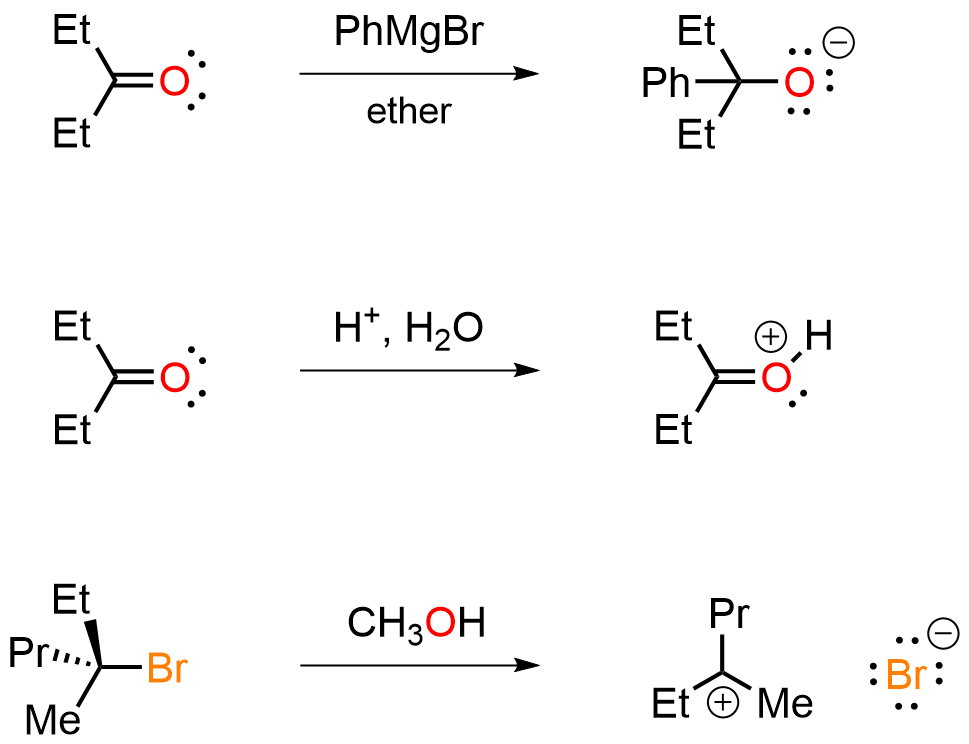
In the first equation the conditions are very basic since a Grignard reagent is employed. This means no acids are present since they would react immediately and quench the Grignard species. No water, no alcohol, no acids of any kind can survive at this pH. A polar aprotic solvent such as ether must be used and all species involved other than metals will be negatively charged. Basic pH also means that the reagent, in this case the Grignard, will attack the organic substrate and not the other way around.
In the second equation the environment is acidic so no strong bases will be present. If the substrate contains a lone pair, for example on O or N, it will attack the acid and activate the organic material as a positively charged species. This makes the material more reactive in general with positively charged O or N being able to accept electrons in subsequent steps. There will be no highly basic species present here, only weak and typically unreactive conjugate bases.
In the third equation the reaction mixture is neutral so there are no strong acids or strong bases present. This typically means the conditions are mild, the organic substrate is neither attacked nor attacks and may react differently than in acidic or basic conditions. For example, tertiary alkyl halides may dissociate in neutral polar protic solvents to give both positive and negative ions.
Stereochemical Clues
Stereochemical changes as a consequence of an organic molecule reacting are one of the most important clues as to how that reaction happened. Whether the result shows all possible stereochemical outcomes or a limited few is really helpful in beginning to map out how the changes occurred and whether the pathway was concerted or stepwise. For example, in the substitution reactions encountered early on, what does “inversion” versus “racemic mixture” formation tell us about the processes involved? Consider the two reactions below and what their differing stereochemical outcomes infer about how the products were formed.
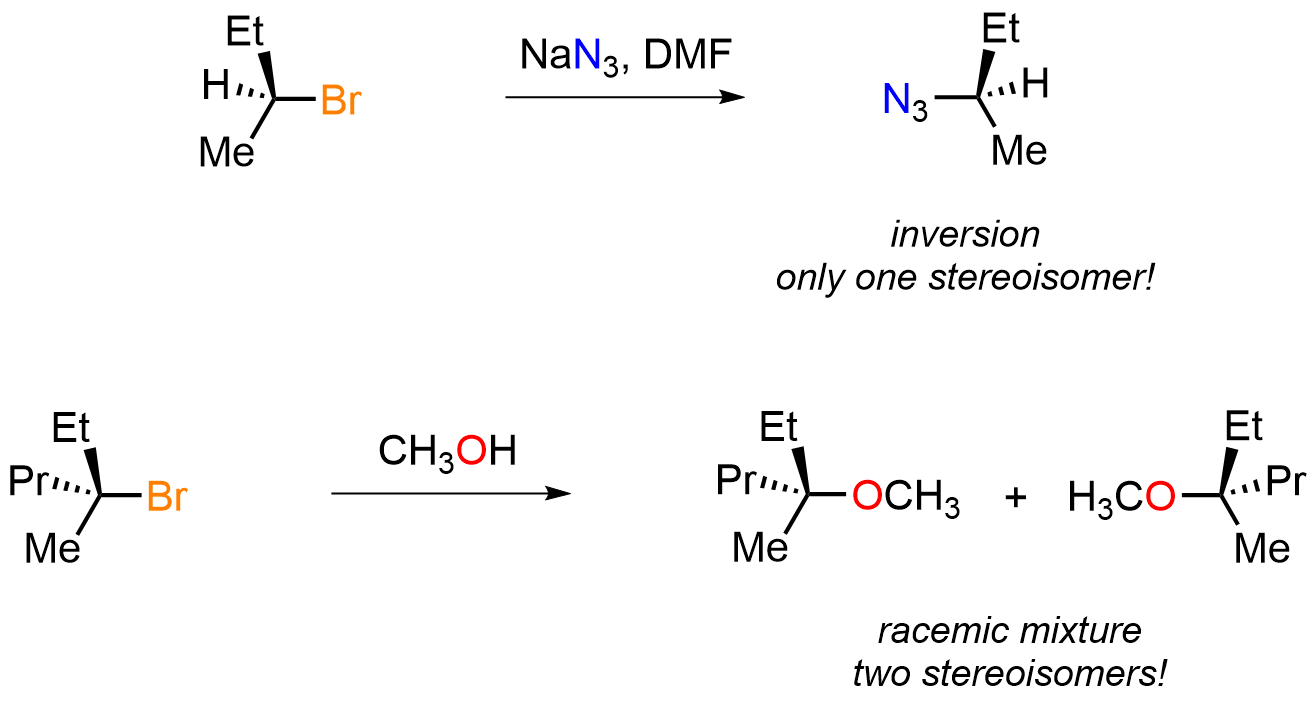
In the first reaction we only get one product from a stereochemically pure secondary alkyl bromide and that product’s stereochemistry is the opposite of the starting material. Only one stereochemical outcome means the reaction is specific for one stereochemistry and not selective, which is where the term stereospecific comes from. The second reaction gives two stereoisomers in equal amounts from a stereochemically pure tertiary starting alkyl halide so that reaction is neither specific or selective.
The first reaction is somehow defined by the direction from which the incoming species (the nucleophile) approaches the electron-poor carbon (the electrophile) while the second reaction is not. Firstly, this tells us that the products cannot be formed in the same way in each reaction. To work out mechanisms we need to consider when bonds are formed and broken and what consequence that event (or events) will have on the molecule’s shape. Here the C to Br bond must break and the nucleophile to C bond must form in both cases.
In the first reaction the incoming group (nucleophile) is only attacking from one side while in the second reaction it is attacking from both sides. This means the bromine must still be attached as the nucleophile bonds in the first reaction but the bromine must be gone in the second process. That suggests a 3-valent, trigonal planar species is formed in the second reaction, which we know to be a carbocation that may then be attacked equally from either side to give a racemic mixture. In the first reaction the nucleophile must be kicking out the leaving group and forcing the attached alkyl groups to move in space, which we know to be the inversion process.
Regiochemical Clues
Regiochemistry relates to where (i.e. which region) in a molecule a reaction happens or where a functional group is placed. Knowing which products are formed as major and minor under various conditions helps us decide how they were formed mechanistically. The main factors involved will be steric and/or electronic in terms of concepts like crowding in transition states (steric) or stabilization of transition states or products by factors such as hyperconjugation or induction (electronic). Consider the following two alkene additions that are used in synthesis to produce regioisomeric alcohols.
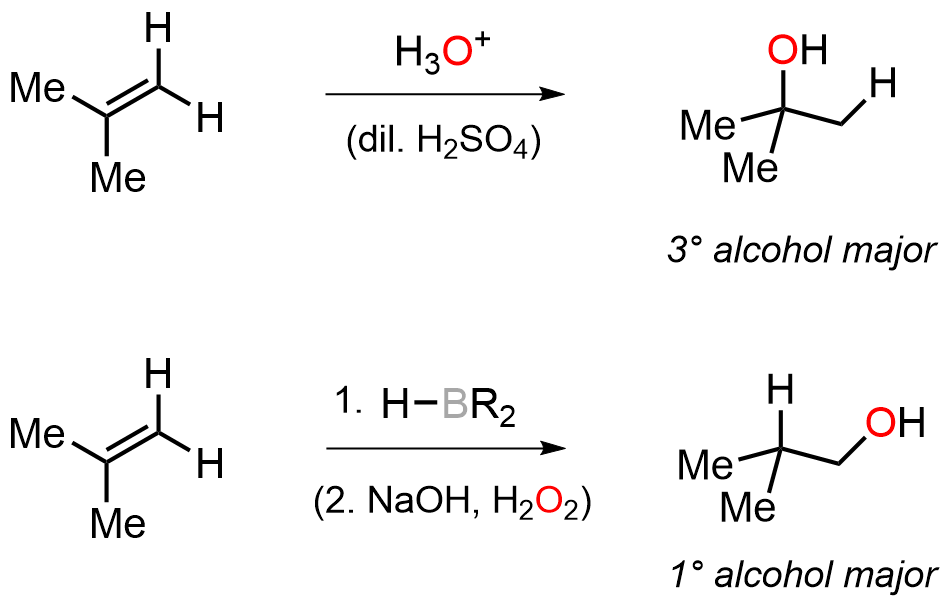
In both reactions the first reagent is adding to a flat alkene so it can’t be that geometry that is causing the different outcomes. In the first process the OH group ends up on the tertiary, more substituted and more crowded carbon, while in the second process the hydroxyl ends up on the less substituted less crowded end of the alkene. What causes the difference; transition state energies, intermediate stabilities, or both? If the OH adds to the tertiary carbon in the first reaction then it can’t be a steric issue but could be in the second reaction where the large borane reagent (e.g. the parachute, 9-BBN) appears to avoid the large alkyl groups on the alkene. We know that the alkyl groups will stabilize reactive intermediates such as carbocations in stepwise mechanisms (by hyperconjugation) but those same alkyl groups will deflect large incoming groups in a concerted approach. These ideas help direct us to the first reaction being stepwise via carbocations while the first step in the second process is most likely governed by steric considerations.
Kinetic vs Thermodynamics
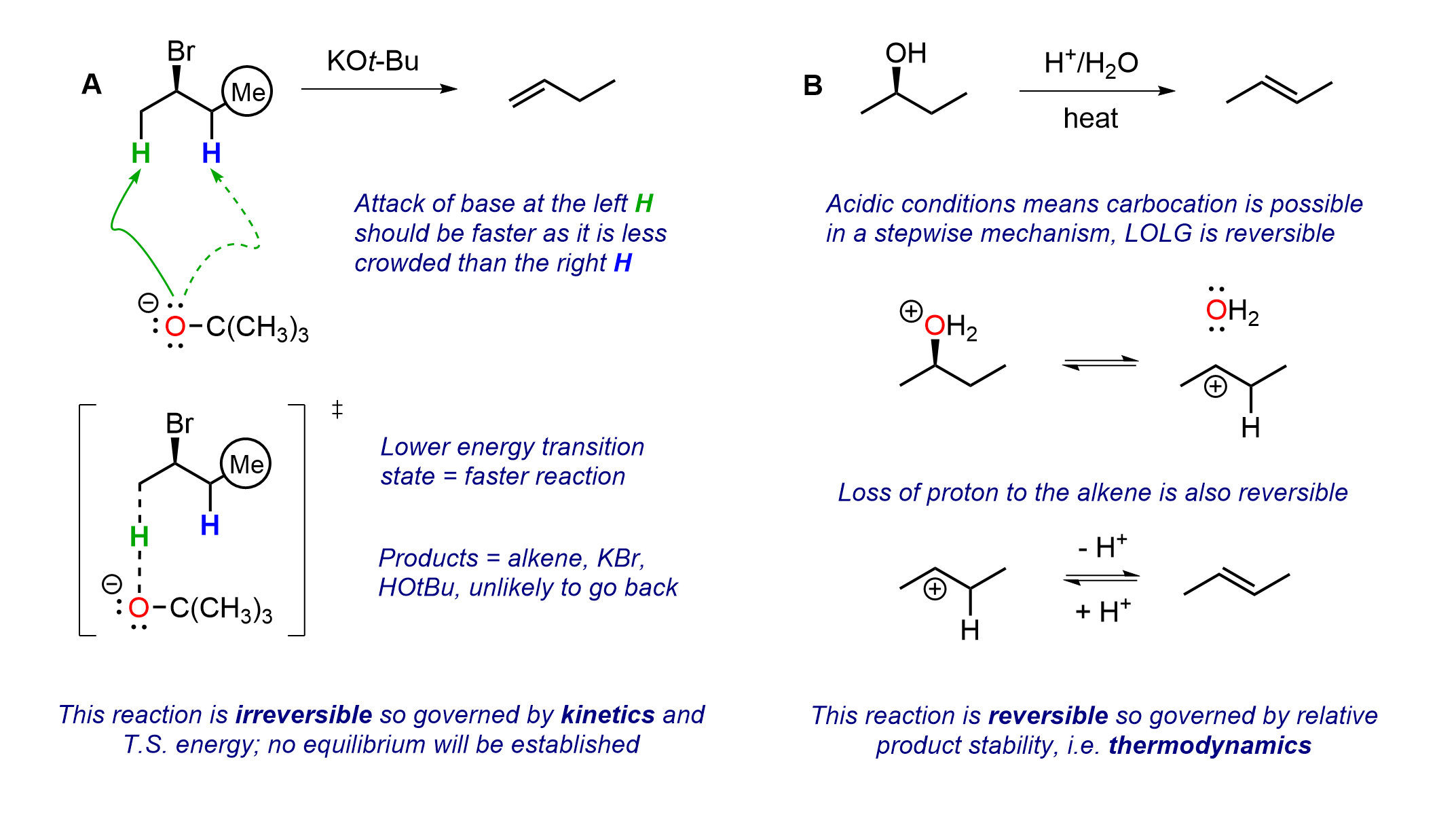
To get beyond rote memorization in a mechanism it is useful to be able to analyze each step in a reaction to decide if it is governed by kinetic or thermodynamic factors or, in some cases, both. Is the product distribution of a process governed by relative transition state energies, relative product stability, or both? The two reactions here highlight these ideas. In Equation A the environment is basic with a large base being employed; this results in the less substituted Hofmann alkene as the major product. In Equation B the environment is acidic, and the outcome favours the more substituted Zaitsev alkene being the major product.
Consider the following comparison of these elimination reactions in an exam question format.
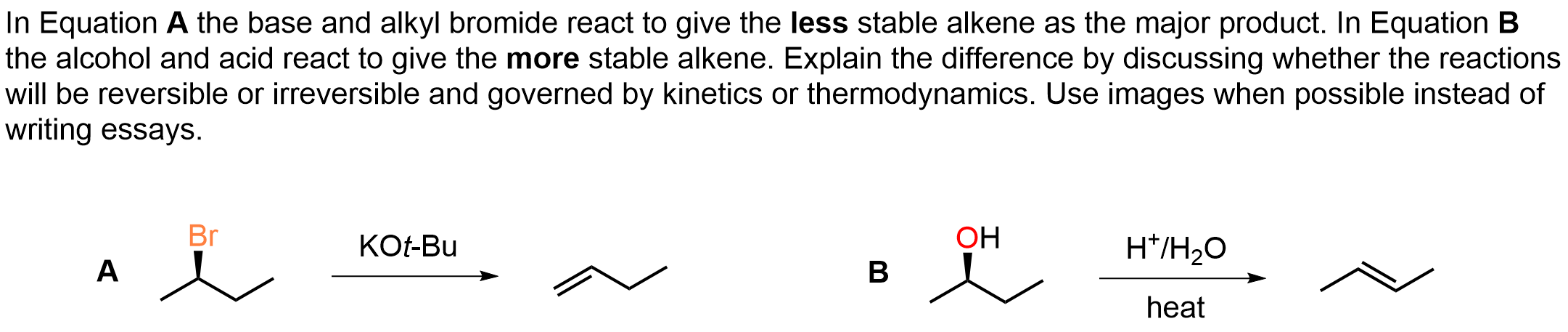
Reaction A uses an alkyl halide and a large base so we expect Hofmann regioselectivity. The base is trying to transfer the negative charge from the less stable O to the more stable Br, however the alpha carbon is blocked and SN2 is shut down. The base diverts to go after a beta proton, with there being two options here. The left hydrogen is more accessible since the methyl group on the right will block the other H. This leads to a faster deprotonation via the lower energy transition state. This reaction is irreversible, mainly since the negative charge has been transferred from O to Br, so transition state energies and kinetics govern the outcome.
In Reaction B an alcohol is reacted with acid at high temperature and the more stable Zaitsev alkene is formed. Here the alcohol needs to be protonated first to make a better leaving group, a step that will be reversible. The leaving group is then able to break off, in another reversible step, in which the water can simply trap the carbocation to go backwards.
If the water behaves as a base instead of a nucleophile, it may take a beta proton and generate an alkene. That step will also be reversible since alkenes are known to add protons to give carbocations. If a proton is lost from the left the Hofmann alkene would form, however that could also pick up a proton and go backwards. Picking off the proton on the right gives the more stable Zaitsev alkene. Since all steps are reversible, material will find its way mostly to the more highly substituted alkene in a process governed by thermodynamics.