Addition Mechanisms
HX Addition
Electrophilic Addition — Stepwise
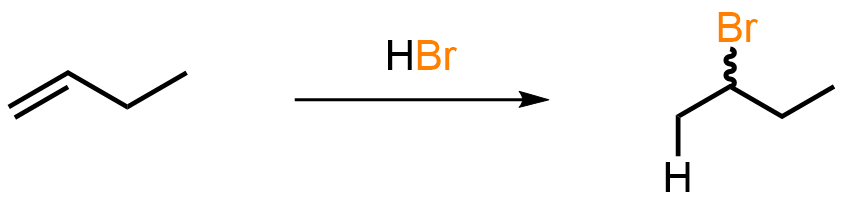
When alkenes are treated with acids such as HCl, HBr, or HI they undergo addition reactions to give saturated alkyl halides with the more highly substituted products being favored. The acidic conditions mean the alkene substrate will attack the acid and that carbocations are viable as intermediates. Kinetic studies show that the protonation step is rate-determining and, when prochiral substrates are used, the products are formed as racemic mixtures.
Working out the Arrows
The evidence suggests that electrophilic addition of HBr to the alkene involves two steps and goes through carbocations. The first step is formation of the carbocation in which the pi electrons from the alkene attack the hydrogen atom of HBr, which results in the positively charged carbon and a bromide ion. The stability of the resulting carbocation is significant and more stable carbocations such as secondary and tertiary are favored. The second step is then nucleophilic attack in which the bromide ion acts as a nucleophile and attacks the positively charged carbon. This results in the formation of the final product, the alkyl bromide.
The regioselectivity of the reaction is determined by Markovnikov’s rule, which translates to: when HBr adds to an unsymmetrical alkene, the major product is formed via the more stable carbocation intermediate. If the carbocation happens to be prochiral, as in this case, a racemic mixture of enantiomers is formed.

Borane Addition
Borane Addition — Concerted
The addition of a borane to an unsymmetrical alkene, followed by an oxidative workup with basic peroxide, results in the isolation of a racemic mixture of alcohols. Addition of the borane occurs with anti-Markovnikov regioselectivity and the stereochemistry of the addition is retained in the second step. Both regio- and stereochemical outcomes give clues to the mechanism involved.

Working out the Arrows
While the 6-electron boron is Lewis acidic the B to H bond is not polarized with boron having an electronegativity of 2.0 and H 2.1. This will mean that the pi bond in the alkene will not be protonated but will attack the electron-poor boron instead. Addition of the boron to the less substituted end of the alkene suggests that the regioselectivity is governed more by steric factors than electronic. Also, formation of only two stereoisomers and not four is evidence for a concerted syn addition and not stepwise through a carbocation. Since stereochemistry is retained in the second step that too must be concerted since stepwise formation of a carbocation would give more stereoisomers.
The observed regiochemistry and stereochemistry here leads to the conclusion that addition occurs through a concerted pathway, and the second, oxidation, step must also involve a concerted migration. While the borane reagent is Lewis acidic it is not a protic acid so carbocations are unlikely. Since the second operation is carried out under basic conditions a carbocation cannot be involved.

Summary
How do these foundational mechanisms help?
There is a common misconception that Organic changes every day and that there are no foundational rules in the subject. This isn’t the case of course. Knowing something about pH gives a solid idea of what is and is not going to happen in a mechanism. Strongly acidic will mean that a substrate is getting protonated while strongly basic means a substrate will be attacked. Neutral or acidic allows for carbocation formation but base generally does not. If a reaction gives only certain stereoisomers as products it probably means that flat intermediates such as radicals or carbocations are not involved since they can be attacked from two directions.
Stereochemical Clues
Compare each of the three concerted mechanisms discussed in the examples above and note that the stereochemical outcomes give clues as to how the changes occured. Notice that they all give certain stereochemistries but not all possibilties since no intermediate is formed. Conversely, the stepwise processes of SN1, E1, and electrophilic addition each give racemic mixtures of enantiomeric products since carbocations are formed and are attacked from two directions.
Regiochemical Clues
Regiochemical clues are also helpful, for example in the E2 reaction in which the size of the base can dictate which regioisomer will be formed as the major product. Small bases favor more stable Zaitsev outcomes while big bases generally give less-substituted Hofmann alkenes. The fact that the more stable products are not formed in the latter is strong evidence for the E2 process with base not being reversible and not equilibrating since that would give the Zaitsev outcome each time.