Alcohols & phenols
Synthesis and chemistry
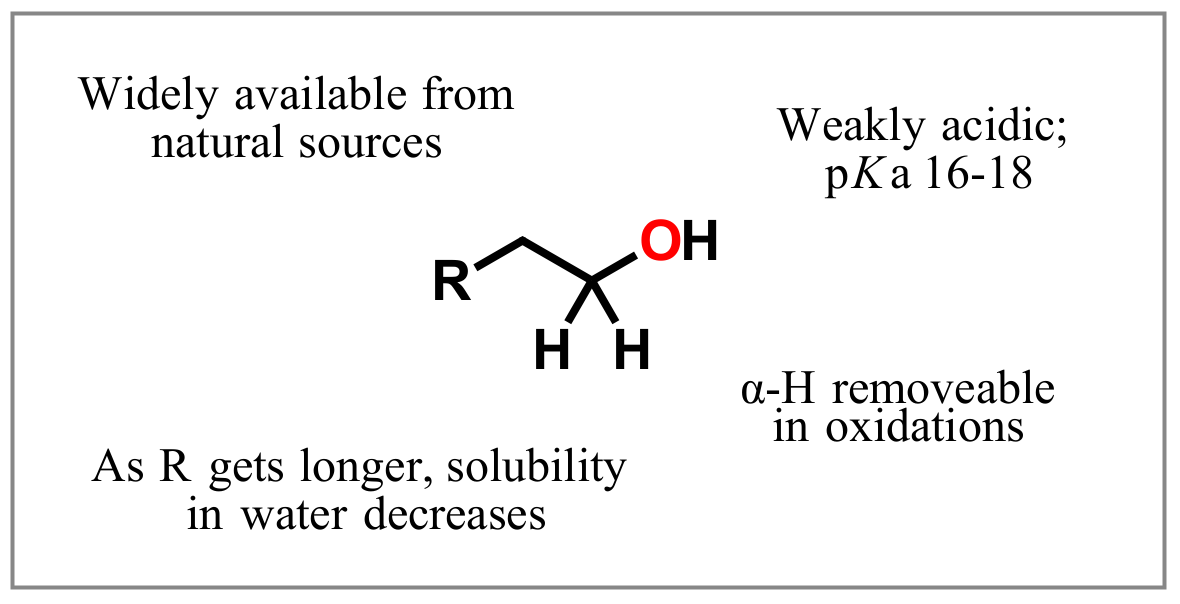
The hydroxyl group is hugely important in the second semester of organic chemistry. It is weakly acidic, it is a poor leaving group until activated, and it is one oxidation step away from carbonyl chemistry. Work through the six sections below in order; each one builds on the substitution and elimination chemistry you have already covered.
Acidity of alcohols and phenols
Inductive and resonance effects
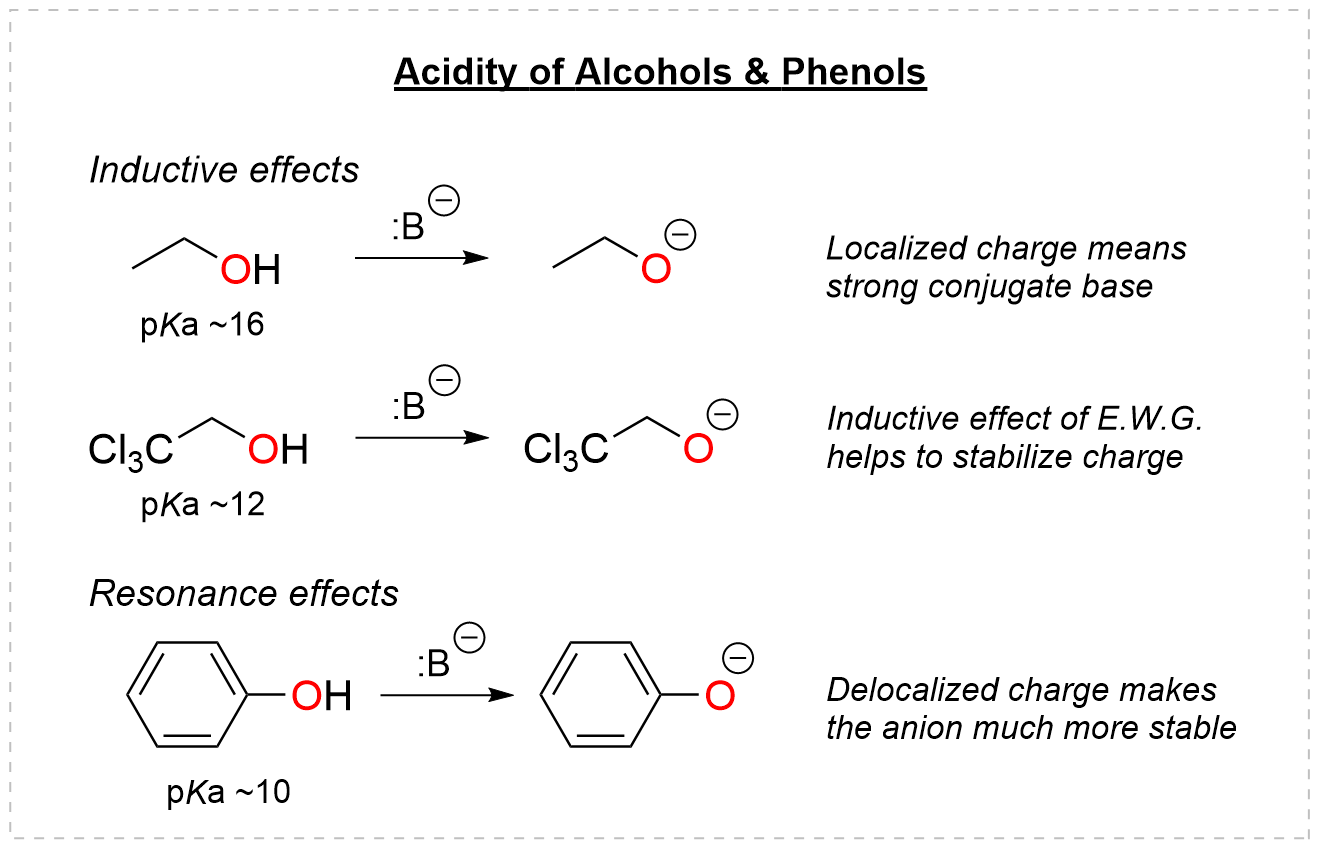
Compare conjugate bases, not starting materials. Ethanol has a pKa near 16 because the ethoxide charge stays localized on one oxygen. Attach three chlorines two bonds away and the pKa drops to about 12; the electron-withdrawing group pulls electron density away inductively and better spreads the electrons of the negative charge.
Resonance has more of an effect than induction. Phenoxide delocalizes its charge into the ring, so phenol has pKa 10; i.e. roughly a million times more acidic than ethanol. That single fact is why phenols may be deprotonated with hydroxide while alcohols need a much stronger base.
Preparations from earlier chapters
From halides and from alkenes
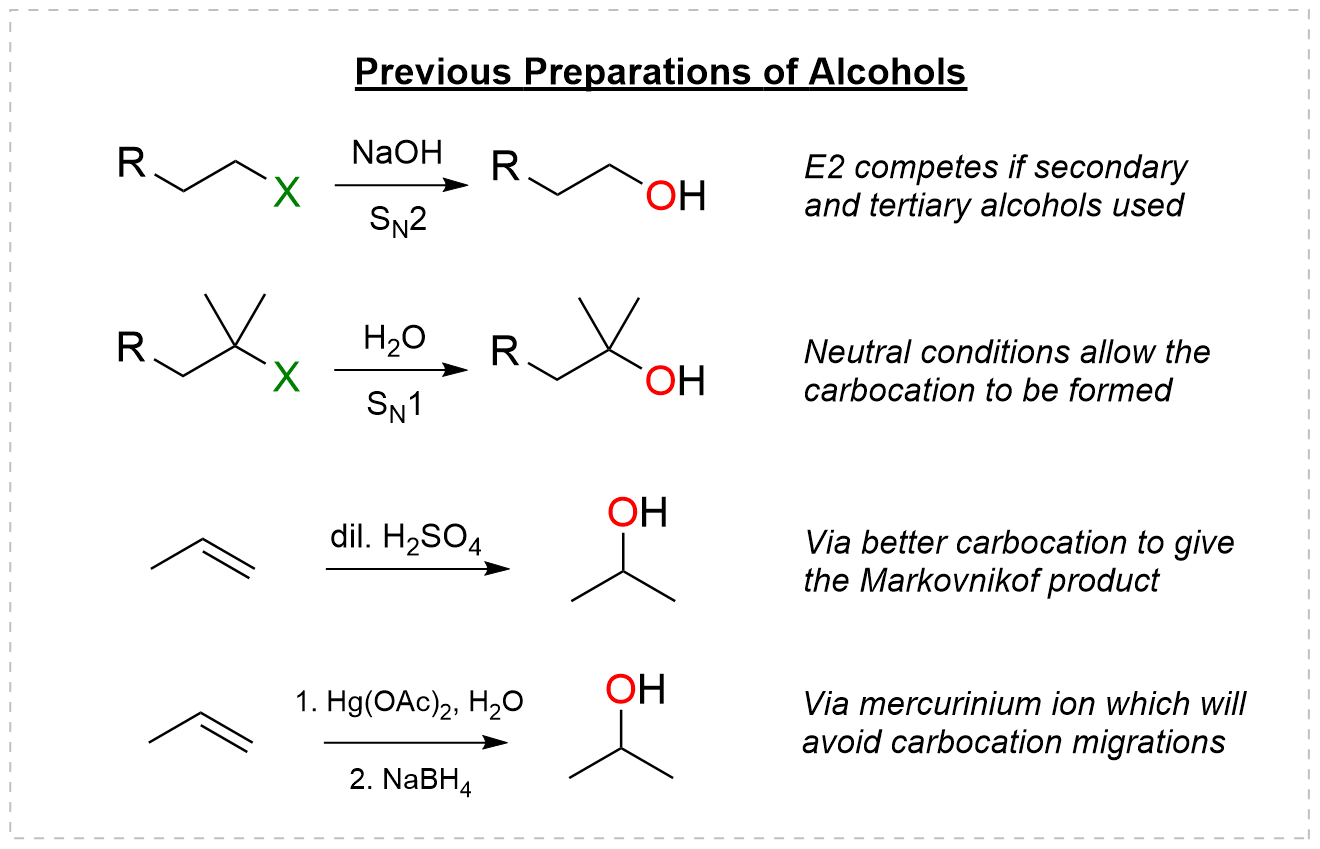
We already made alcohols two ways from alkyl halides. Hydroxide reacting with a primary alkyl halide via SN2; with secondary or tertiary substrates, E2 competes to give alkenes. A tertiary halide reacts in water via SN1 instead; neutral conditions being mild enough to allow carbocations to be formed in a stepwise process.
From alkenes there are two related hydrations. Dilute sulfuric acid gives the Markovnikov product through the more stable carbocation, however carbocations are known to rearrange. Oxymercuration with Hg(OAc)2/H2O then NaBH4 gives the same regiochemistry. but through a mercurinium ion, so no migration is possible.
New preparations: reduction and Grignard addition
Nucleophilic addition to a carbonyl
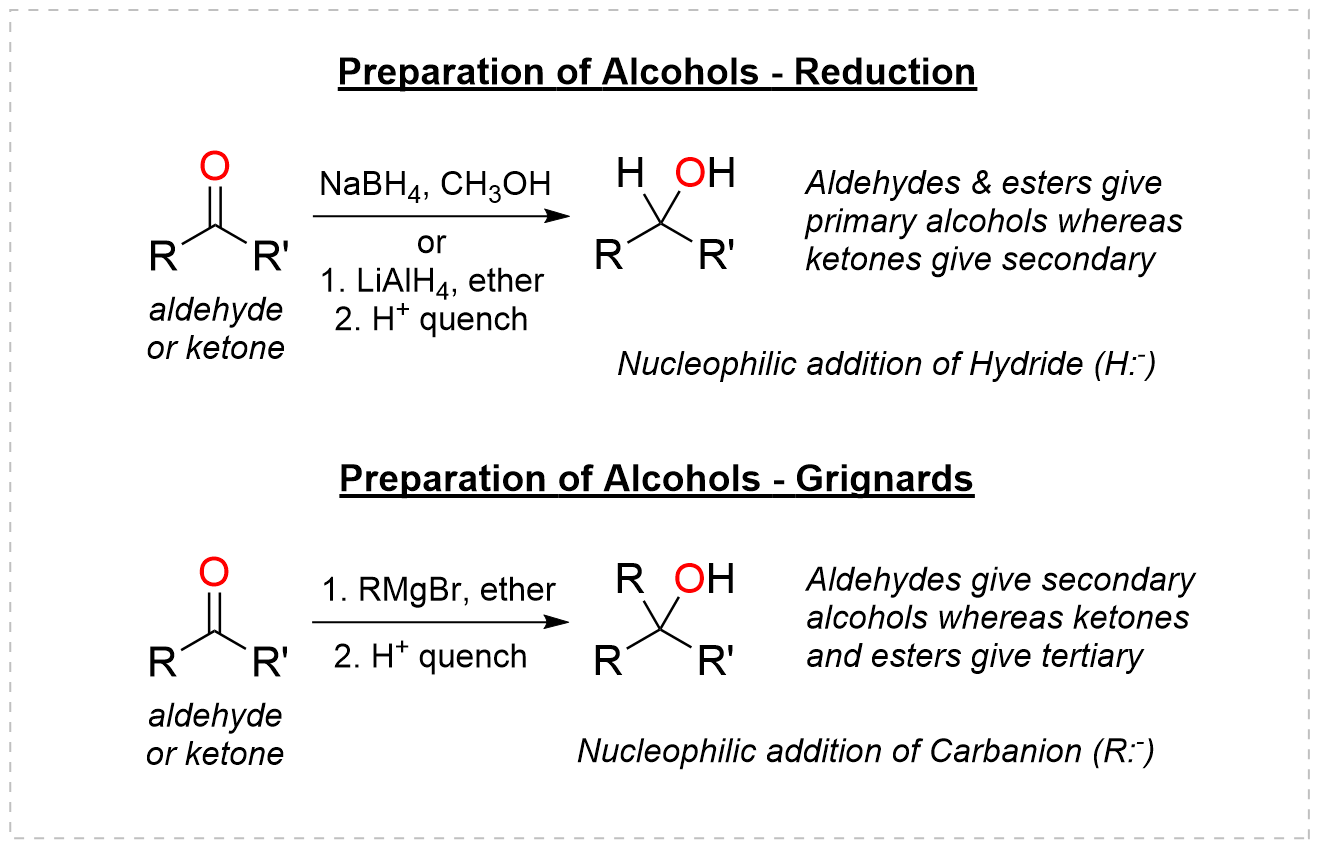
Both new methods feature the same mechanism but with a different nucleophile. Hydride from NaBH4 in methanol, or from LiAlH4 in dry ether (followed by an acidic quench), adds to the electron-poor carbonyl carbon. Aldehydes and esters give primary alcohols, while ketones give secondary alcohols.
Replacing hydride with a carbanion allows for formation of a carbon–carbon bond. RMgBr in dry ether, followed by an H+ quench, converts aldehydes into secondary alcohols. Ketones (or esters, which need two equivalents of nucleophile) are converted into tertiary alcohols. Counting the carbon groups on the new alpha carbon allows you to work backwards to the starting material.
Substitution reactions of alcohols
Turning OH into a leaving group
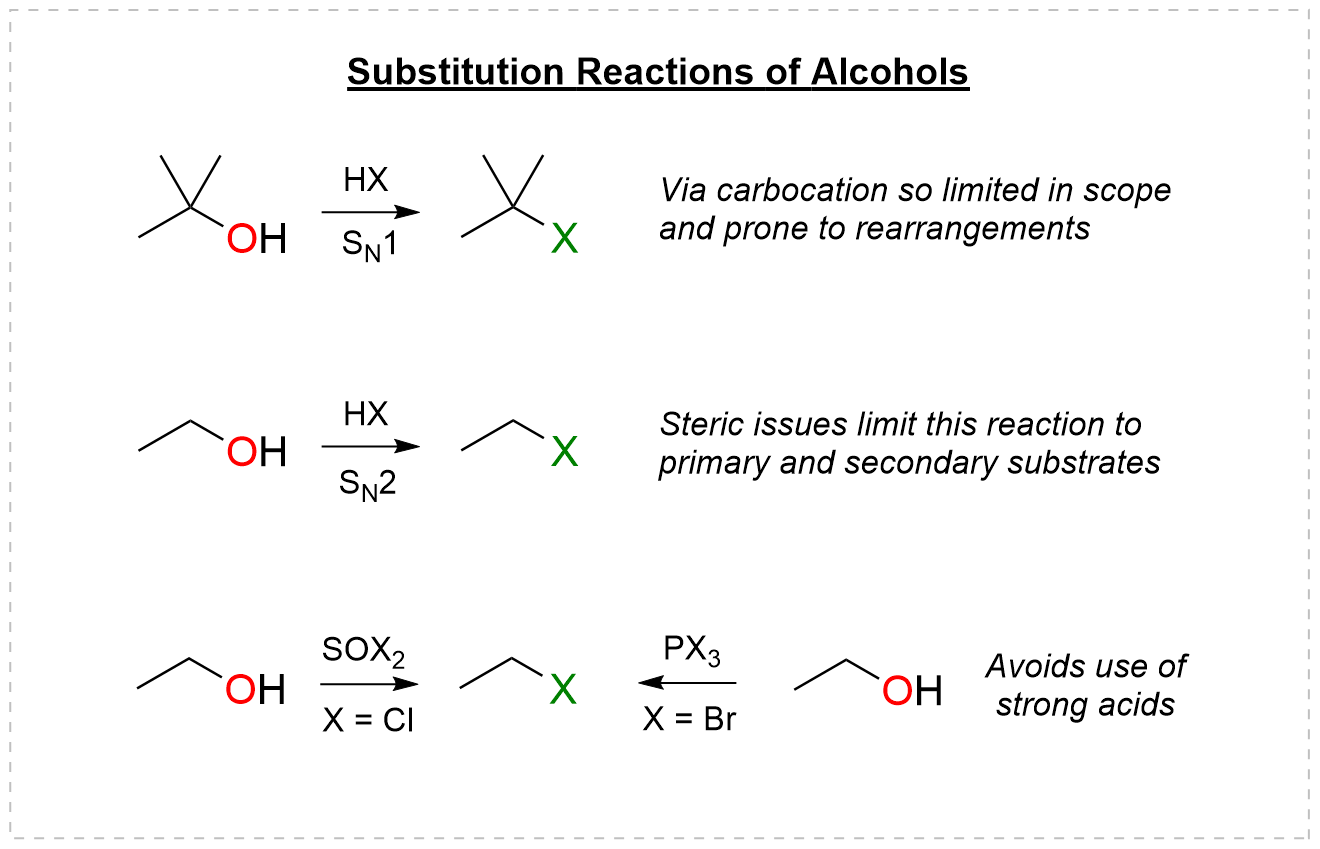
Hydroxide is a poor leaving group, so every substitution here starts by activating the oxygen. With HX, a tertiary alcohol loses water and reacts via SN1, which is limited in scope and prone to rearrangement, because of the formation of a carbocation. A primary or secondary alcohol reacts via SN2 instead, where sterics rather than cation stability govern the rate of reaction.
When strong acid would disrupt the rest of the molecule, SOCl2 may be used for the chloride or PBr3 for the bromide. Both convert the hydroxyl into a good leaving group in situ, under far gentler conditions.
Elimination reactions of alcohols
Thermodynamic versus kinetic control
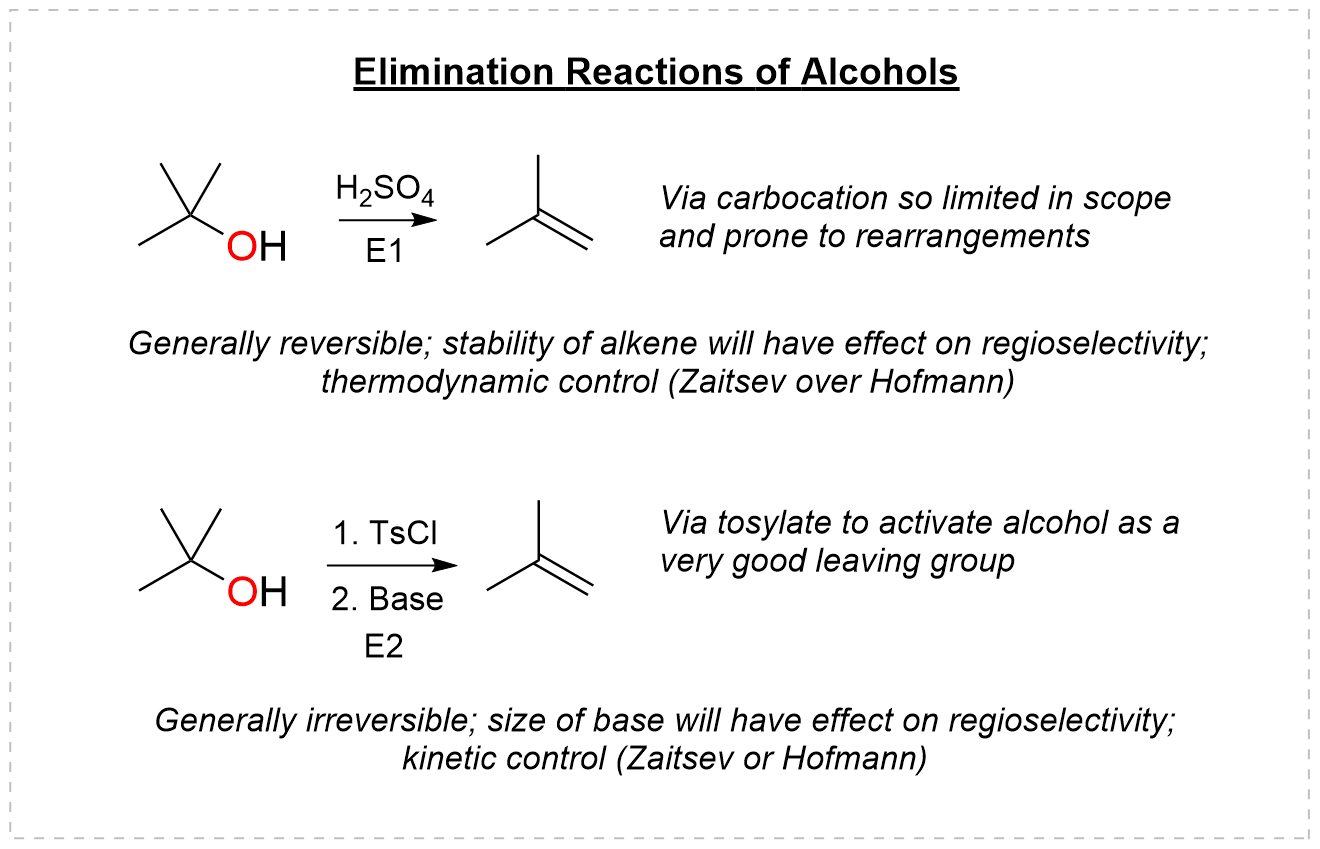
Sulfuric and phosphoric acids dehydrate an alcohol by the E1 pathway, again through a carbocation, so the scope is limited and rearrangement is possible. Such reactions are generally reversible, which means alkene stability decides the outcome. Typically you get thermodynamic control and the Zaitsev product.
Activation of the alcohol as a tosylate with TsCl, and then addition of base, would allow E2 instead. That pathway is essentially irreversible, so the size of the base, and not the stability of the product(s), controls regiochemistry. A small base gives Zaitsev; a bulky one gives Hofmann.
Oxidation of alcohols
REMOVAL OF THE ALPHA PROTON
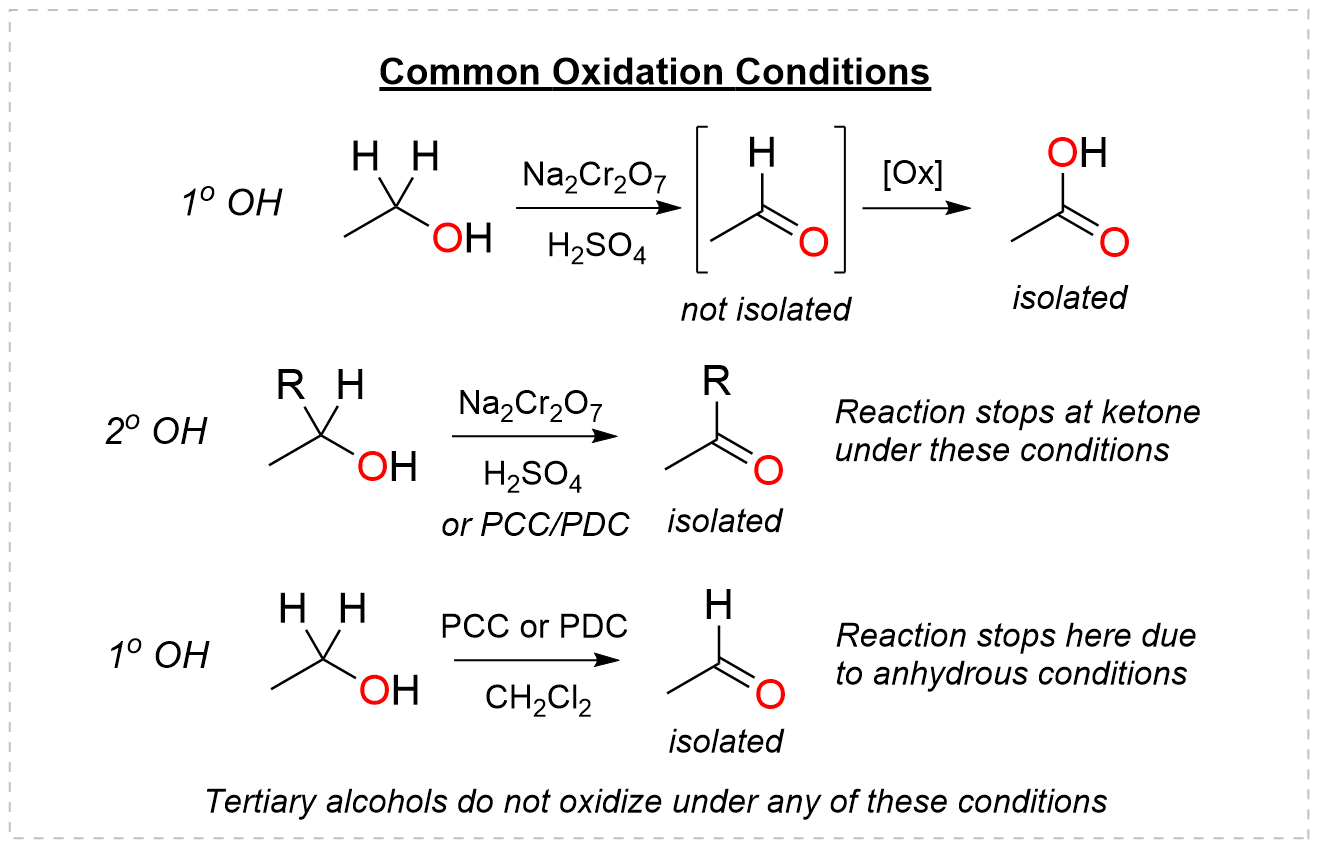
Oxidation outcomes depend on the availability of hydrogen atoms attached to the alpha carbon. A primary alcohol, with two alpha hydrogens, reacts with Na2Cr2O7/H2SO4, via the aldehyde. However, the aldehyde is usually not isolated since water in the mixture facilitates further oxidation to the carboxylic acid. Reacting the same primary substrate with PCC or PDC in CH2Cl2 under anhydrous conditions allows for isolation of the aldehyde.
A secondary alcohol is more limited in its oxidation chemistry. Chromate or PCC/PDC both stop at the ketone, because there is no second hydrogen on the alpha carbon to remove. Tertiary alcohols have none at all, so they do not oxidize under these conditions.
Reference
Reaction summary
Each transformation is listed here. Read it right to left when you are planning a synthesis.
Self-check
Six questions before you move on
Try to work out an answer on paper, then reveal to check. If your reason is right but the answer is wrong, you are closer than you think.
Phenol has a pKa near 10, ethanol near 16. What accounts for the six-order difference?
Resonance. Phenoxide delocalizes its negative charge into the ring, so the conjugate base is far more stable. Ethoxide holds the charge on one oxygen.
2,2,2-Trichloroethanol (pKa ~12) is more acidic than ethanol. The chlorines are not on the oxygen, so why does it matter?
Induction works through σ bonds. The electron-withdrawing CCl3 group pulls density toward itself and helps stabilize the alkoxide charge, even from two bonds away.
You need the aldehyde from a primary alcohol, and not the carboxylic acid. Which conditions, and why do they stop there?
PCC or PDC in CH2Cl2. The conditions are anhydrous, so there is no water to carry the aldehyde on to the carboxylic acid.
You want the alkene from a tertiary alcohol, but a nearby group would migrate. What do you do instead of H2SO4?
Make the tosylate with TsCl, then eliminate with base. E2 never forms a carbocation, so nothing can rearrange; the base size dictates the observed regiochemistry.
An ester is treated with excess RMgBr, then quenched with acid. What is the product, and how many new C–C bonds formed?
A tertiary alcohol, with two new C–C bonds. The ester adds one equivalent, loses the alkoxide to give a ketone, and that ketone is then attacked.
Acid-catalysed hydration and oxymercuration give the same regiochemistry. When does the choice between them actually matter?
Whenever a rearrangement is possible. Hydration goes through a carbocation and can migrate; oxymercuration goes through a mercurinium ion and cannot.