Alkyne Chemistry
1
Nomenclature
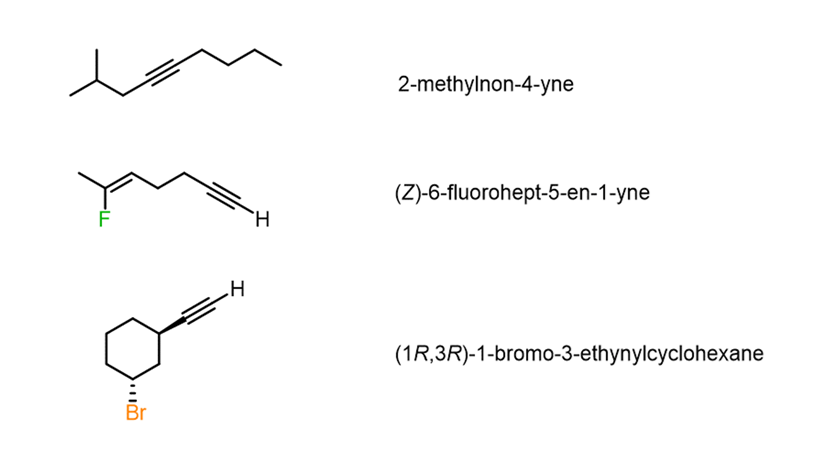
Alkynes follow the same rules as alkenes when it comes to names, however because of their linear geometry there is no possibility of cis/trans isomerism. For simple molecules, find the longest chain containing the alkyne group and use that as the root for the name (first example below). The ending for an alkyne is "yne" and the same rules for numbering of alkenes and where other functional groups are located still apply (second example). Sometimes it is easier to label the alkyne function as a substituent, as shown in the third example.
2
Structure & Properties
Shape: each carbon in a triple bond is sp hybridized, with one s orbital mixing with just one p orbital, leaving two unhybridized p orbitals that form the two pi bonds of the triple bond. That sp hybridization forces a 180° bond angle at each carbon, so all four atoms (H–C≡C–H) fall on a single straight line. This is different from the bent or tetrahedral shapes observed with sp² or sp³ carbons; the triple bond's geometry is uniquely linear.
Alkynes (or acetylenes) are found in Nature in various forms such as metabolites of animals and microorganisms. Alkynes, for example the acetylene used in oxy-fuel welding, are made industrially from calcium carbide reacting with water or by cracking bigger organic molecules. Simple examples are non-polar and thus water insoluble.
There are two regioisomeric classes alkynes; internal and terminal. The former will undergo addition and oxidation reactions, while the latter are weakly acidic, which means they may be deprotonated to give useful acetylide nucleophiles. Adding an alkyl electrophile then allows for chain-extension via substitution chemistry. Alkynes have become popular substrates since the advent of Click Chemistry, which extends the utility of the classic Huisgen [3+2] cycloaddition to the rapid assembly and conjugation of big molecules and even in vitro studies. This type of chemistry is now used widely in Organic and Bioorganic Chemistry and resulted in the 2022 Nobel Prize.
There are two regioisomeric classes alkynes; internal and terminal. The former will undergo addition and oxidation reactions, while the latter are weakly acidic, which means they may be deprotonated to give useful acetylide nucleophiles. Adding an alkyl electrophile then allows for chain-extension via substitution chemistry. Alkynes have become popular substrates since the advent of Click Chemistry, which extends the utility of the classic Huisgen [3+2] cycloaddition to the rapid assembly and conjugation of big molecules and even in vitro studies. This type of chemistry is now used widely in Organic and Bioorganic Chemistry and resulted in the 2022 Nobel Prize.

3
Preparation
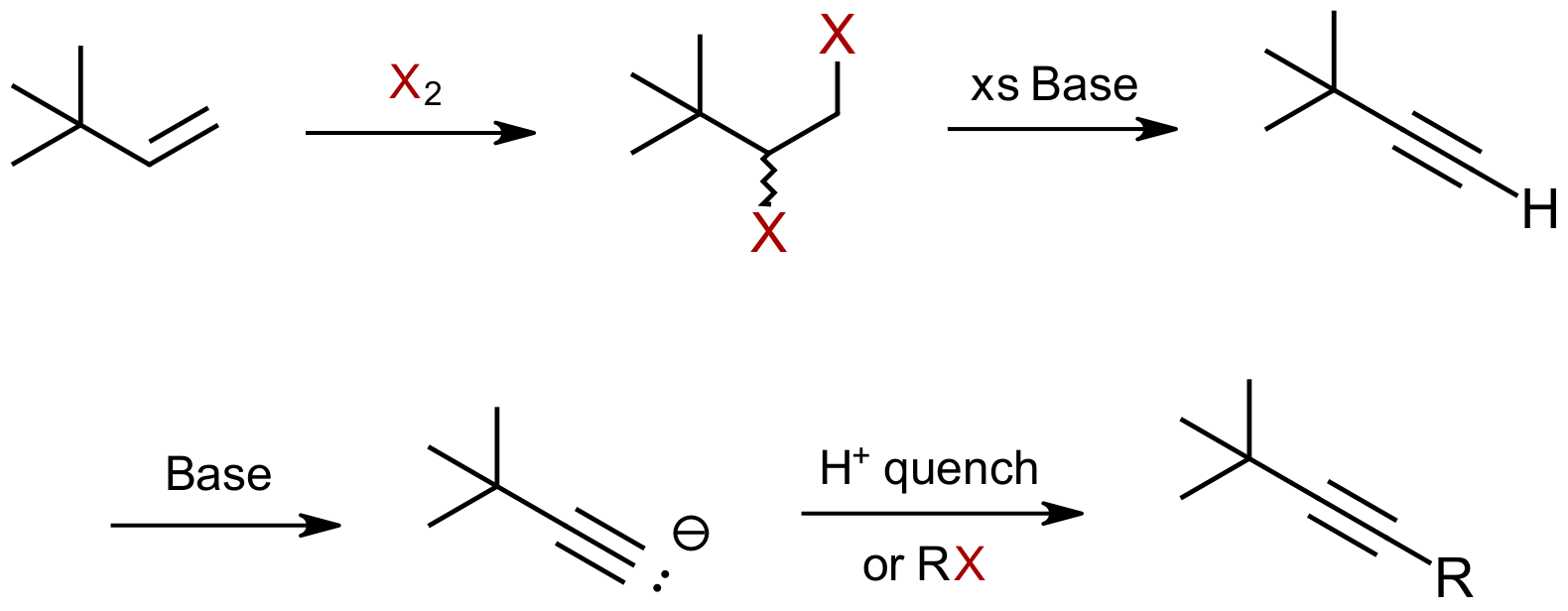
Alkynes may be synthesized by sequential eliminations from geminal or vicinal dihalides, the latter of which are formed from alkenes by electrophilic addition of halogens. Terminal alkynes, in which the alkyne function is at the end of a chain, are very useful for making bigger alkynes by chain extension. In the scheme below, addition to the prochiral alkene gives a racemic mixture of vicinal dihalides. When treated with an excess of a strong base, such as NaNH2, the dihalide is forced to undergo sequential bimolecular eliminations to give the triple bond. If the alkyne function is anywhere but at the end of a chain, the reaction is complete, however if a terminal alkyne is formed the reaction goes further.
Terminal alkynes have a pKa of around 25, so while they are weak acids they may be deprotonated by strong bases. If a terminal alkyne is generated after sequential eliminations, the alkyne is deprotonated in situ to give the acetylide anion. This may then either be protonated in a quench step or alkylated by the addition of an electrophile. If a terminal alkyne has been isolated, it may be deprotonated and alkylated in sequential synthetic operations.
Terminal alkynes have a pKa of around 25, so while they are weak acids they may be deprotonated by strong bases. If a terminal alkyne is generated after sequential eliminations, the alkyne is deprotonated in situ to give the acetylide anion. This may then either be protonated in a quench step or alkylated by the addition of an electrophile. If a terminal alkyne has been isolated, it may be deprotonated and alkylated in sequential synthetic operations.
4
Reactions
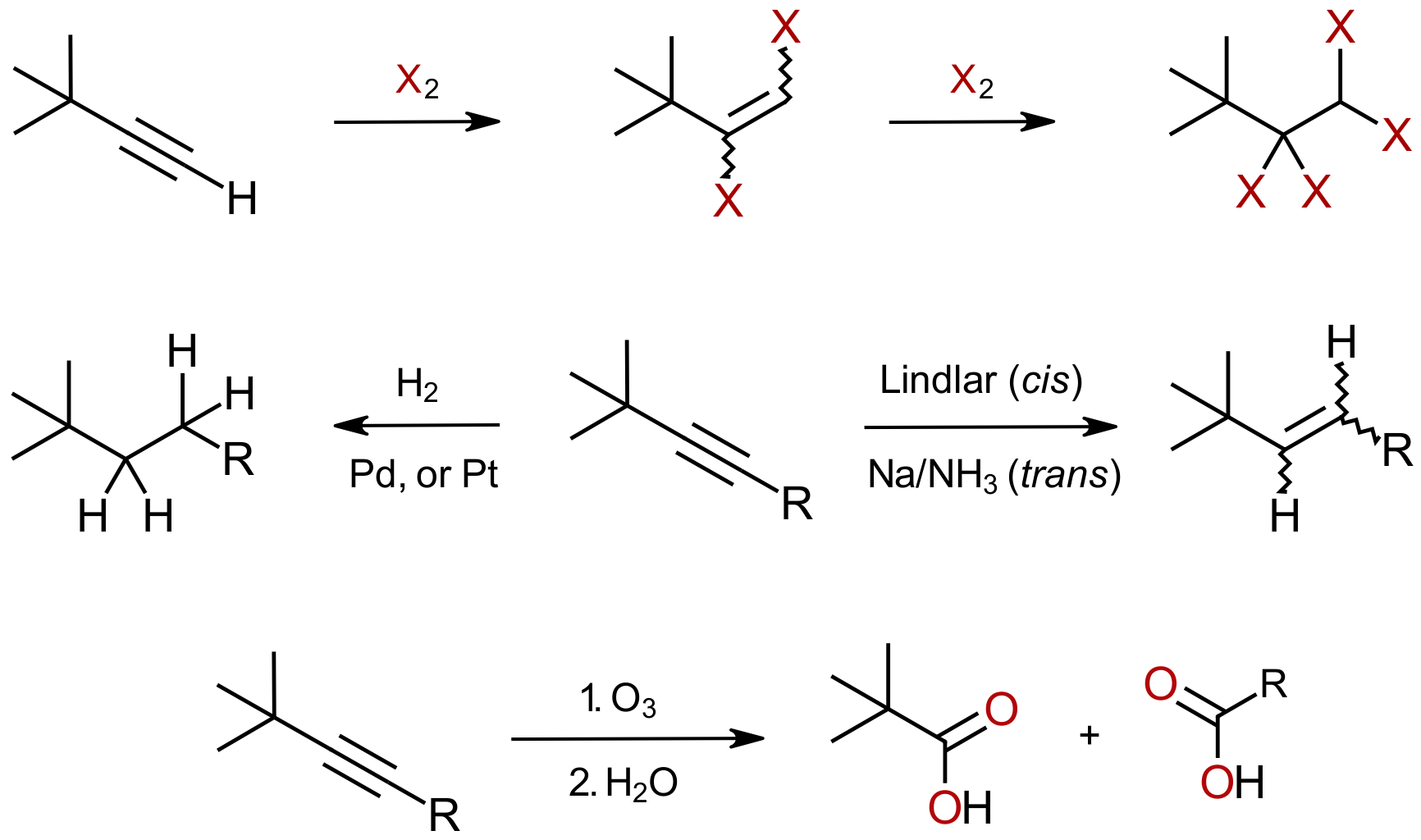
Alkynes are reactive since the pi electrons are not held as tightly as sigma so the pi electrons are easier to give away. This means that alkynes, or any regiochemical identity, add halogens to give vicinal dihalides (and then tetrahalides), undergo hydrogenation to reduction products, and are cleaved by ozone is a process similar to that observed with alkenes.
The addition of halogens gives alkene vicinal dihalides with random stereochemistry, while an excess of halogen results in further addition to the tetrahalide (below). Reduction may be complete to give the alkane, but it may be controlled to give cis- or trans-alkenes; the Lindlar mixture gives the cis isomer due to poisoning of the catalyst, which lowers its reactivity, while Na/NH3 give the trans isomer via a radical-based pathway. Ozonolysis cleaves the multiple bond in way similar to alkenes but the products here are more highly oxidized (see below).
The addition of halogens gives alkene vicinal dihalides with random stereochemistry, while an excess of halogen results in further addition to the tetrahalide (below). Reduction may be complete to give the alkane, but it may be controlled to give cis- or trans-alkenes; the Lindlar mixture gives the cis isomer due to poisoning of the catalyst, which lowers its reactivity, while Na/NH3 give the trans isomer via a radical-based pathway. Ozonolysis cleaves the multiple bond in way similar to alkenes but the products here are more highly oxidized (see below).