Amines
Synthesis and chemistry
Amines are organic ammonia derivatives with carbon attached, and much of their chemistry involves the lone pair on nitrogen. That lone pair makes an amine a base, a nucleophile, and a strong activating group on an aromatic ring. It is also what makes amines somewhat challenging to synthesize cleanly.
Structure, naming, and stereochemistry
Pyramidal nitrogen, a lone pair, and rapid inversion
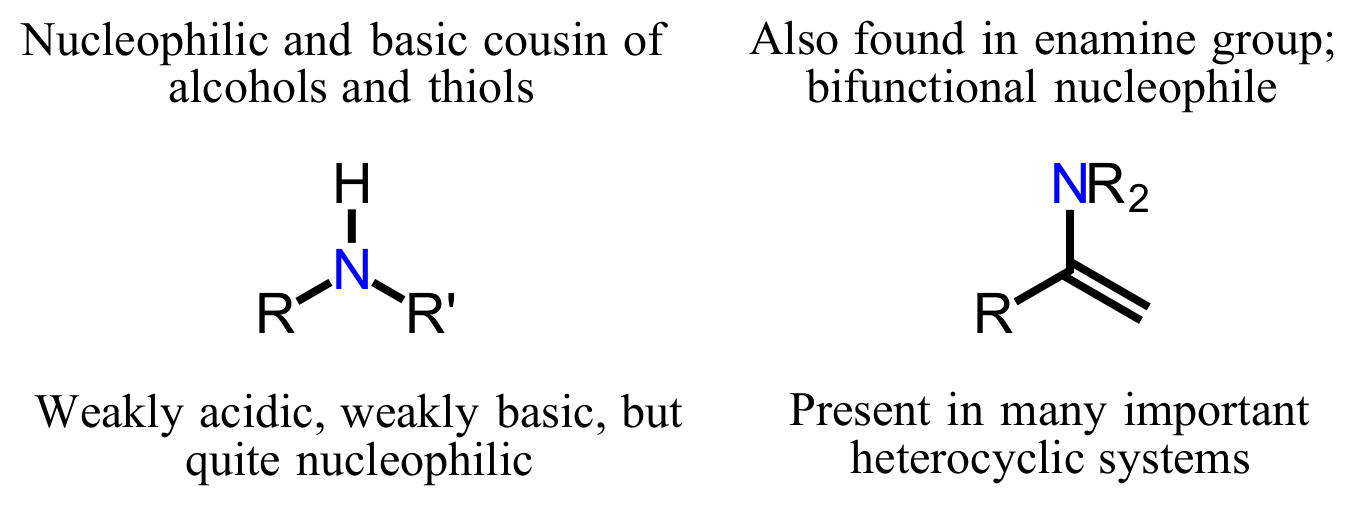
An amine is a derivative of ammonia in which one, two, or three hydrogens have been replaced by carbon. That numbers defines the class of amine: primary, secondary, or tertiary, and it refers to the number of groups on nitrogen rather than the substitution pattern of the carbon attached, which is a common source of confusion. A fourth substituent gives a quaternary ammonium ion, which has no lone pair and behaves differently. Nitrogen is sp3 hybridized with the lone pair in the fourth orbital, so the geometry is pyramidal with bond angles near 107°.
Amines are named by treating their alkyl groups as substituents on the parent amine, as in N-methylpropan-1-amine, and the N-prefix tells you that a substituent is on nitrogen rather than on the chain. When the amine is not the highest priority group it becomes an amino substituent. Aromatic amines are named as derivatives of aniline, and cyclic amines carry their own common names such as pyrrolidine, piperidine, and morpholine.
A nitrogen bearing three different groups plus a lone pair is formally a stereocentre, but the two pyramidal forms interconvert by inversion through a planar sp2 transition state with a barrier of only about 6 kcal/mol, so the enantiomers cannot be separated at room temperature. Quaternary ammonium salts have no lone pair to invert through and are configurationally stable, which is why chiral phase-transfer catalysts are based on them.
The lone pair also explains physical behaviour. Primary and secondary amines hydrogen bond to one another, so they boil higher than comparable alkanes but lower than alcohols, since N–H is a weaker donor than O–H. Tertiary amines cannot donate a hydrogen bond, and their boiling points reflect this, although they still accept one and remain reasonably water soluble at small chain lengths.
Basicity and acidity
Where the lone pair resides dictates base strength
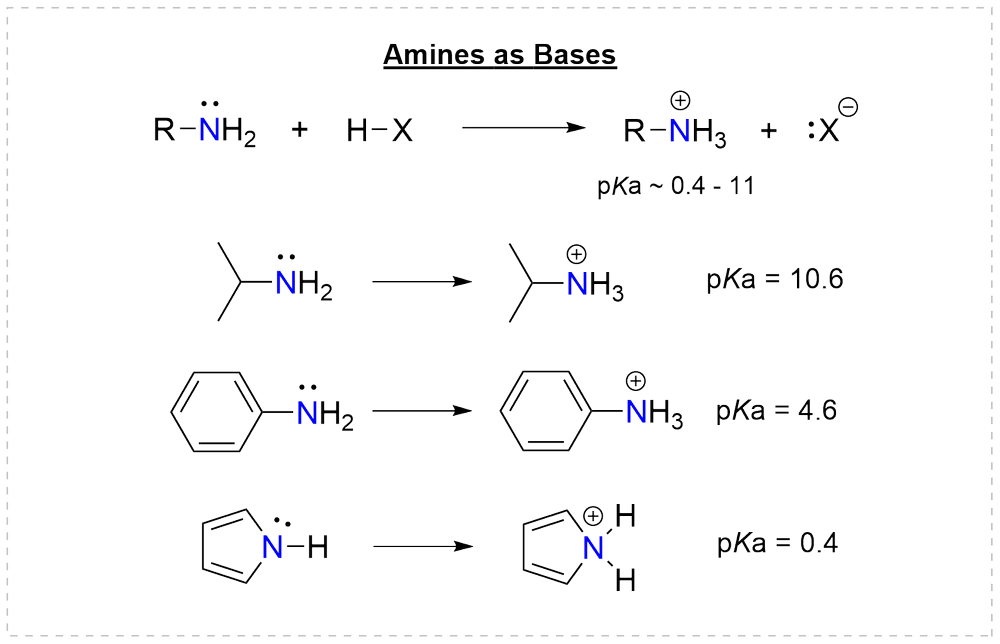
An amine is both a base and a nucleophile because of the lone pair, and the two behaviours compete throughout the chapter. Basicity is usually quoted as the pKa of the conjugate ammonium ion: around 10.6 for a simple alkylamine, 9.2 for ammonium itself, and only 4.6 for anilinium. A higher number means a stronger base, and the ordering tracks with how available the lone pair is.
Alkyl groups are weakly electron donating and stabilize the resulting cation, so alkylamines are slightly more basic than ammonia in water. Aniline is a far weaker base because the lone pair is conjugated with the ring and delocalized over three carbons; protonating it costs that stabilization. Electron-withdrawing substituents on the arene ring weaken it further, and 4-nitroaniline is barely basic at all. An amide is not basic in any useful sense, since the lone pair is fully conjugated to the carbonyl, and protonation happens on oxygen instead.
Hybridization matters as well. The lone pair of pyridine is in an sp2 orbital held closer to the nitrogen nucleus and is therefore less available than an sp3 lone pair, so pyridine (conjugate acid pKa 5.2) is much less basic than than its reduced cousin piperidine (11.1). In pyrrole the lone pair is part of the aromatic six-π-electron system, so the ring is essentially non-basic and protonates on carbon when forced.
A practical application of relative basicity is separation. Adding dilute HCl converts an amine to a water-soluble ammonium salt that partitions into the aqueous layer while neutral organics stay in ether; basifying with NaOH and re-extracting returns the free amine. Acid–base chemistry is the standard way to pull an amine out of a mixture, and it is also why many amine drugs are formulated as their hydrochloride salts.
Synthesis of amines
Alkylation, reduction, and reductive amination
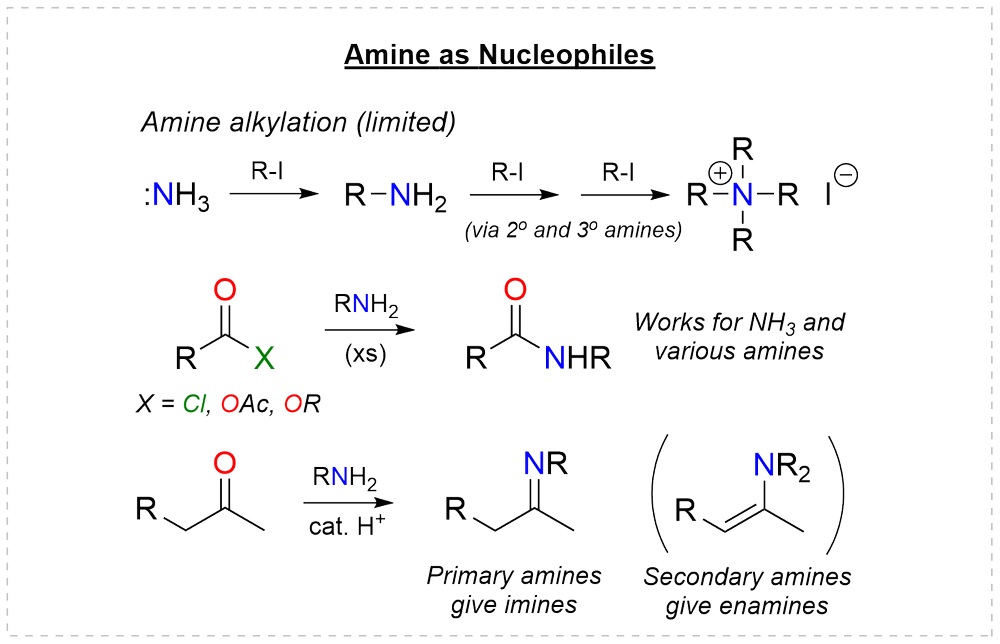
The obvious route to amines, treating ammonia with an alkyl halide, does not work well. The product amine is at least as nucleophilic as the starting ammonia, so it is alkylated in turn and the reaction runs on to a mixture of primary, secondary, tertiary amines and quaternary salt. Overwhelming excess of ammonia can make a primary amine practically, but selective routes are preferred.
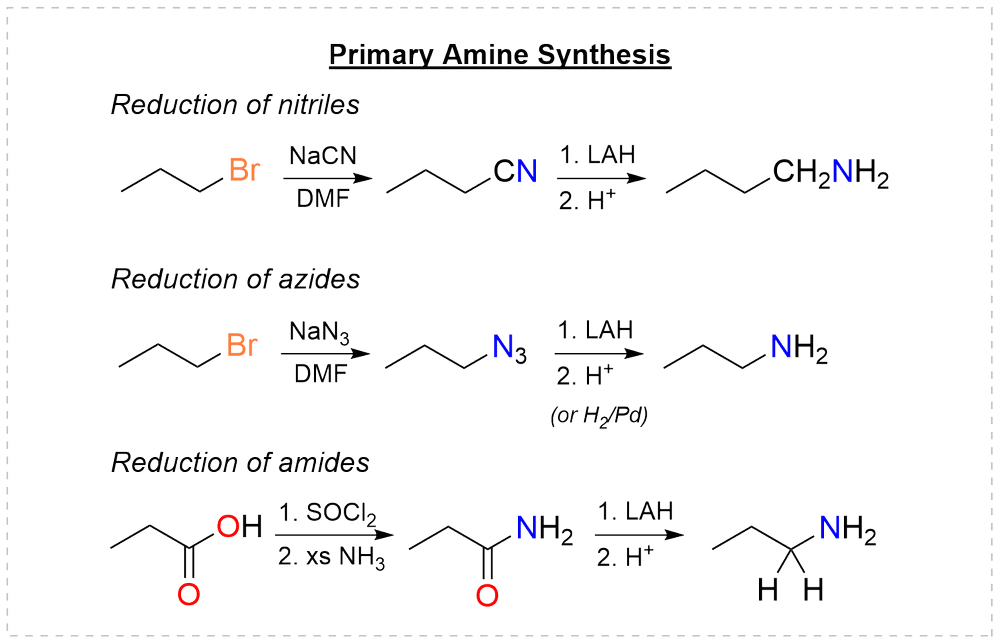
Reduction of a nitrogen already installed at a higher oxidation level avoids the over-alkylation problem entirely. A nitrile, made by SN2 displacement on a primary halide with cyanide, is able to be reduced by LiAlH4 or by catalytic hydrogenation to a primary amine one carbon longer than the halide it came from. An alkyl azide, made the same way substitution on an alkyl halide with sodium azide, is reduced by LiAlH4 or H2/Pd to the primary amine with no change in overall skeleton. An amide, easily made from the carboxylic acid through the acid chloride, is reduced by LiAlH4, which is a reliable route to secondary and tertiary amines also. A nitro group on an arene is reduced by Fe or Sn with HCl, or by H2 over a metal catalyst, which together with nitration is the standard way to install nitrogen on an arene ring.
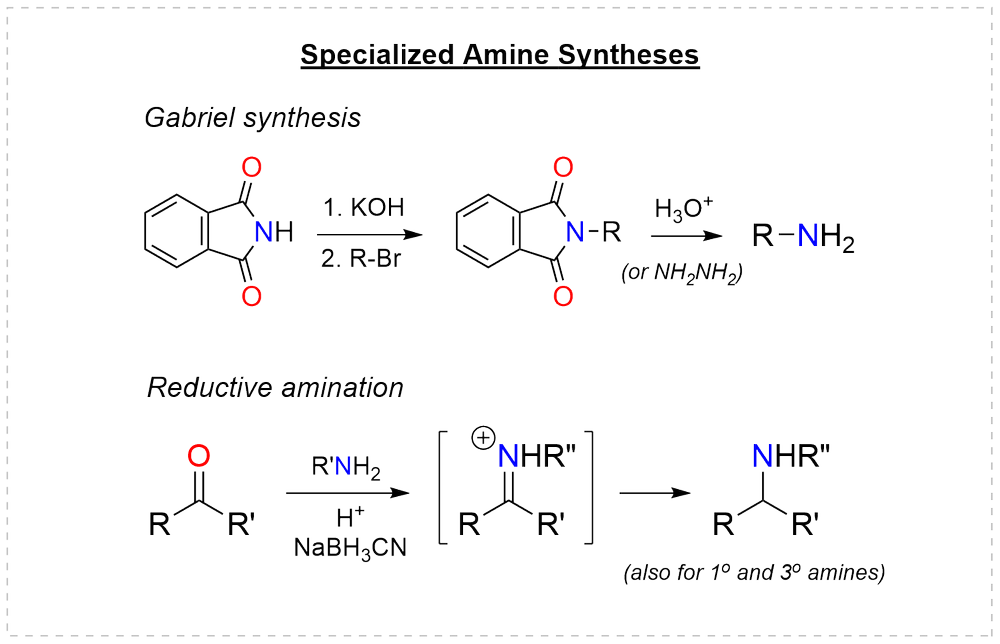
Two specialized syntheses handle the cases these reductions do not. The Gabriel synthesis delivers a primary amine cleanly by alkylating a nitrogen that cannot be alkylated twice. The potassium salt of phthalimide, whose single N–H is acidic because its nitrogen is flanked by two carbonyls, is alkylated by a methyl or primary halide, and hydrolysis or hydrazinolysis then releases the free amine.
Reductive amination is a very versatile method. An aldehyde or ketone condenses with ammonia or an amine to give an imine or iminium ion, and reduction in the same flask with the mild reducing reagents NaBH3CN or NaBH(OAc)3 gives the amine. The correct choice of carbonyl compound and the amine dictates the product, and primary, secondary, and tertiary amines are all accessible, and because the mild hydride reagents reduce the iminium ion far faster than the ketone, the sequence can be run without isolating the intermediate.
Reactions at nitrogen
Acylation, sulfonation, and the Hofmann elimination
Nucleophilic amines react with electrophiles at nitrogen. Alkylation is the reaction just described and suffers the same over-alkylation problem as alkylating ammonia, though it does work well when the goal is the quaternary ammonium salt. Acylation with an acid chloride or anhydride is much better behaved; the amide product has a delocalized, non-nucleophilic nitrogen and cannot react again, so a single acyl group is installed. Acylation is used often as a protecting group strategy, since an amide is far less basic and less activating than a free amine, and hydrolysis returns the amine at the end.
Sulfonyl chlorides behave the same way with amines and give sulfonamides. Tosylation converts an amine into a much weaker base whose N–H group, flanked by the electron-withdrawing sulfonyl moeity, is acidic enough to be removed by hydroxide. The resulting anion is a competent nucleophile for a subsequent alkylation, which is a controlled route to a secondary amine.
Exhaustive methylation with excess CH3I converts an amine to a quaternary ammonium iodide, and heating that salt with silver oxide and water gives the Hofmann elimination. Hydroxide removes a β-hydrogen and a neutral trialkylamine departs, giving an alkene by an E2 pathway. The leaving group is quite large, and affects the preferred conformation of the substrate. The base consequently attacks the least hindered β-position, and the outcome is the anti-Zaitsev, less substituted alkene, which is the opposite selectivity to an ordinary alkyl halide elimination when a small base is used.
Amines also attack the carbonyl carbon of an aldehyde or ketone, and the class of the amine dictates the direction in which the reaction goes. A primary amine adds, loses water, and gives an imine, with the new C=N in place of the C=O. A secondary amine reaches the same iminium ion intermediate but has no N–H left to lose, so a proton is removed from the α-carbon instead. The product is an enamine, which is an electron-rich nucleophile in its own right. A tertiary amine has no protons to lose so it does not participate in this type of chemistry.
Aryl diazonium chemistry
One functional group, many products
Treating a primary aromatic amine with sodium nitrite and cold aqueous HCl at 0–5 °C gives an aryl diazonium salt. Unlike its aliphatic counterpart it survives in cold solution, because the aryl cation that would form if nitrogen was lost is far too unstable to form, so the diazonium group remains until a nucleophile is present. Warming the solution decomposes the diazonium, so the salt is made and used immediately without isolation.
The real value of this chemistry is that N2 is an excellent leaving group and a wide variety of species can replace it. Copper(I) halides give the aryl chloride or bromide in the Sandmeyer reaction, KI gives the iodide, CuCN gives the nitrile, warming in water gives the phenol, and hypophosphorous acid or ethanol replaces the diazonium group with hydrogen. Fluoride is installed through the tetrafluoroborate salt by the Schiemann reaction.
Reductive removal is quite useful. Nitration, reduction, and then use of the amino or diazonium group to direct a further substitution, followed by removal of the nitrogen, installs a substituent in a position no direct electrophilic substitution could achieve.
Diazonium ions are also weak electrophiles in their own right and couple with strongly activated arenes such as phenols and N,N-dialkylanilines at the para position. The extended conjugation across the resulting azo linkage absorbs visible light, which is why azo compounds are the basis of a large fraction of synthetic dyes and pH indicators, methyl orange among them.
Heterocyclic amines
Rings where nitrogen changes the rules
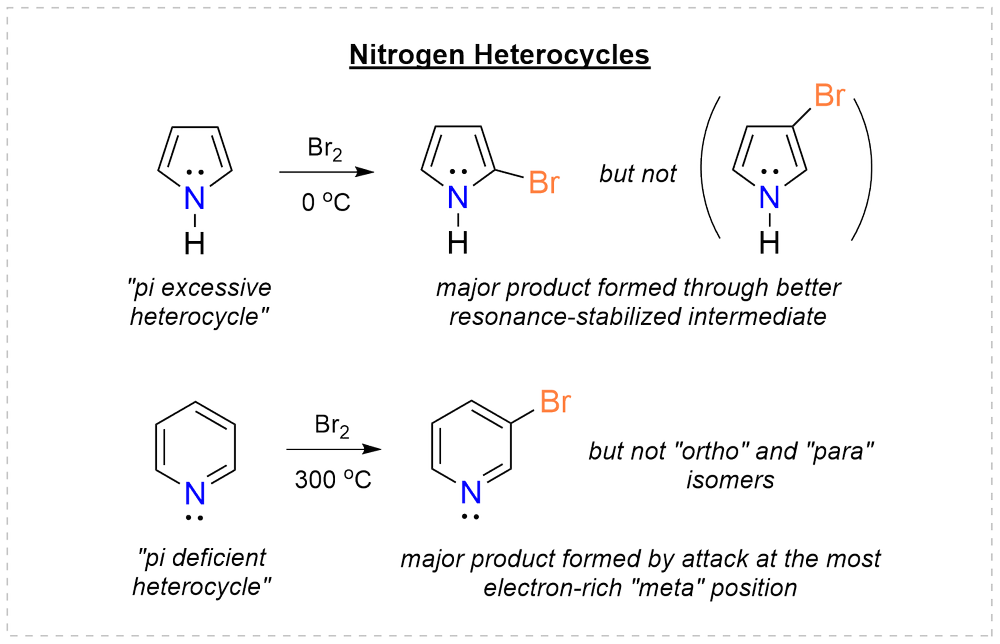
Nitrogen in a ring behaves according to how its lone pair is situated. In non-aromatic compounds pyrrolidine and piperidine it is an ordinary sp3 lone pair, and these act as good bases and decent nucleophiles, essentially cyclic dialkylamines. In pyrrole the lone pair is donated into the π system to complete an aromatic sextet, so the ring is electron rich, extremely reactive towards electrophilic substitution at C2, and N is effectively non-basic.
Pyridine sits between the two scenarios. Its lone pair lies in an sp2 orbital in the ring plane and is not part of the aromatic system, so pyridine is a genuine base and nucleophile while still remaining aromatic. Because the electronegative nitrogen withdraws density from the ring, however, pyridine is deactivated towards electrophilic substitution and reacts at C3 when it reacts at all, while nucleophilic substitution is favourable at C2 and C4 where the intermediate negative charge is stabilized on nitrogen.
Imidazole has one nitrogen of each type: a pyrrole-like nitrogen carrying the N–H and contributing its lone pair to the ring, and a pyridine-like nitrogen whose in-plane lone pair acts as a base. That combination, with a conjugate acid pKa near 7, is why the histidine side chain in proteins can both accept and donate a proton at physiological pH and appears in the active site of so many enzymes.
Recognizing which kind of nitrogen we are dealing with helps understand the chemistry. If the lone pair is needed for aromaticity, the nitrogen is not basic; if it is in an in-plane sp2 orbital, the nitrogen is basic but less so than an amine; if the nitrogen is saturated and not conjugated, it acts as an ordinary amine.
Reference
Reaction summary
Every transformation in this chapter, in the order the sections introduce them.
Self-check
Six questions before you move on
Try to work out an answer on paper, then reveal to check. If your reasoning is right but the answer is wrong, you are closer than you think.
How does the primary / secondary / tertiary label for an amine differ from the rule used for an alcohol?
For an alcohol the label describes the carbon bearing the OH; for an amine it counts the carbon groups attached to nitrogen. So tert-butylamine is a primary amine, since its nitrogen carries only one carbon, even though that carbon is tertiary.
Aniline is about a million times less basic than cyclohexylamine. Explain.
In aniline the nitrogen lone pair is conjugated into the benzene ring and delocalized over the ortho and para carbons. Protonation destroys that stabilization, so the equilibrium lies far to the left. Cyclohexylamine is more basic because of the localized sp3 lone pair, and its alkyl group is mildly donating as well.
Why is direct alkylation of ammonia a poor way to make a primary amine, and which two routes get around that?
The product is at least as nucleophilic as ammonia, so it is alkylated again and again, giving a mixture through to the quaternary salt. The Gabriel synthesis uses phthalimide, whose nitrogen can only be alkylated once, and the azide route uses N3– followed by reduction. Both involve SN2, so both need a methyl or primary electrophile.
You need a secondary amine from a ketone and a primary amine. What do you use?
Reductive amination. Condense the two to form the iminium ion under mildly acidic conditions and reduce in the same pot with NaBH3CN. The mild hydride reduces the iminium much faster than the ketone, so no isolation of the intermediate is needed and the ketone is not reduced to an alcohol.
Hofmann elimination of a quaternary ammonium salt gives the less substituted alkene, unlike E2 on an alkyl bromide. Why?
The leaving group is a trialkylamine and is very bulky, which has consequences for the preferred conformation of the substrate. Hydroxide reaches the least hindered β-hydrogen, so the reaction is under kinetic rather than product-stability control and gives the anti-Zaitsev alkene.
How would you make 3-bromotoluene, which direct bromination of toluene will not give?
Nitrate toluene (ortho/para), take the para-nitro isomer, reduce it to the amine, then brominate; the strongly donating amino group directs the bromine ortho to itself, which is meta to the methyl. Finish by diazotizing with NaNO2/HCl and treating with H3PO2 to replace the nitrogen with hydrogen.