Aromaticity
Structure and stability
Benzene is far more stable than its structure suggests, with that extra stability being related to its pi system. A cyclic, planar, fully conjugated ring holding the right number of π electrons is stabilized beyond what alkene conjugation alone can account for. Four general conditions must be met for "aromaticity" where one involves counting the number of pi electrons, and others relate to conjugation and molecule geometry. The same general analysis extends to charged rings, rings containing nitrogen or oxygen, and fused polycyclic systems.
The four requirements
All four must met at once
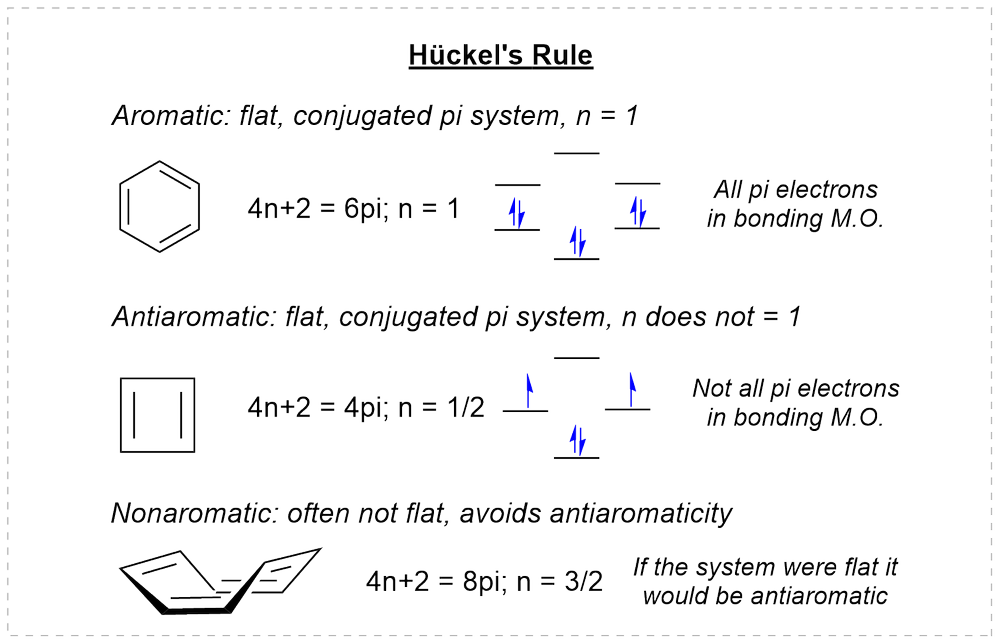
A molecule is aromatic only if four conditions are met at the same time. 1. The π system must be cyclic. 2. The ring must be planar, or close enough that the p orbitals still overlap. 3. Every atom in the ring must contribute a p orbital to a continuous, fully conjugated loop (a single sp3 carbon breaks the p orbital communication). 4. The number of π electrons in the loop must equal 4n+2, where n is zero or a positive integer.
Benzene meets all four requirements. It is a six-membered ring of sp2 carbons, each contributing one p orbital and one π electron, giving six π electrons; with n = 1, 4n+2 = 6. The consequence is that all six C–C bonds are the same length, intermediate between a single and a double bond, and the two Kekulé structures are actually resonance contributors to one delocalized structure rather than two forms in equilibrium.
Working through the requirements in order is helpful. As an example, cyclooctatetraene has eight π electrons and could in principle be conjugated, but it actually adopts a tub-shaped geometry rather than staying planar, so the p orbital overlap is disrupted and it behaves as an ordinary polyene. If practical, checking planarity before counting electrons can avoid coming to the wrong conclusion.
Hückel's rule and antiaromaticity
Why 4n+2 and not 4n?
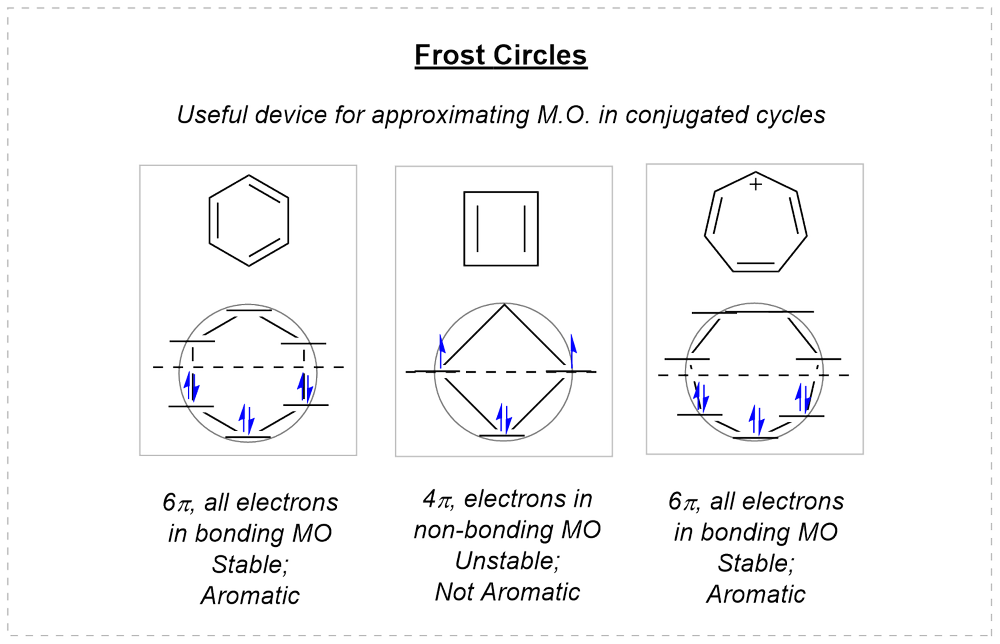
The electron count is related to the molecular orbitals involved. Combining the p orbitals of a planar ring gives one lowest-energy bonding orbital and then degenerate pairs above it, with every filled orbital contributing to bonding with no unpaired electrons. This requires 2, 6, 10, 14 electrons, i.e. the 4n+2 series. A Frost circle, the molecule ring inscribed in a circle with a ring corner pointing down, reproduces the pattern quickly for any ring size and allows for assessment of aromatic stability, or lack of it.
A cyclic, planar, conjugated system with 4n electrons is a different case entirely. The last two electrons must occupy a degenerate pair of non-bonding orbitals, one in each, and the system is actually destabilized relative to the alternative open-chain polyene. That is antiaromaticity. Cyclobutadiene is the standard example, and it is so unstable that it is difficult to isolate and undergoes a cycloaddition to give cyclooctatetraene.
Three outcomes are therefore possible. Aromatic requires all four conditions to be met with 4n+2 electrons. Antiaromatic requires all four conditions with 4n electrons. Non-aromatic covers everything else; a ring that is non-planar, or interrupted by an sp3 centre, or simply not cyclic. Molecules avoid antiaromaticity where they can, usually by twisting out of plane as in the case of cyclooctatetraene.
Ions and heterocycles
Charged rings, and which lone pairs count
Charge changes the electron count, but the same requirements still apply. Cyclopentadiene has an sp3 CH2 that breaks conjugation, but removing one of its protons gives the cyclopentadienyl anion, which now has six π electrons in a planar five-membered ring. This is aromatic, and correspondingly easy to form, which is why that CH2 is far more acidic than an ordinary alkane. Cycloheptatriene also gives an aromatic ion, is this case one that is positively charged. Losing a hydride ion gives the tropylium cation, which has six π electrons spread over seven carbons, and is therefore aromatic and unusually stable for a carbocation.
In heterocycles the question is whether a heteroatom lone pair is part of the π system. It counts only if it sits in a p orbital parallel to the ring. In pyrrole the nitrogen has no ring double bond of its own, so its lone pair occupies the p orbital and joins the pi cloud: four electrons from the two double bonds plus two from nitrogen gives six, and pyrrole is aromatic. That is also why pyrrole is a poor base; protonating the nitrogen would remove those electrons from the ring and aromaticity would be lost.
Pyridine is the opposite case. Its nitrogen is participating in a ring double bond, so the π system already has its six electrons and the nitrogen lone pair has to sit in an sp2 orbital in the plane of the ring, pointing outward. It is not part of the aromatic system, so pyridine behaves as a base. Other heterocycles such as furan and thiophene follow the pyrrole pattern, with one lone pair in a p orbital in the pi cloud and the second left in the plane.
Evidence for aromaticity
What the measurements show
Independent sources of evidence lead to the same conclusion. 1. The structure of benzene is symmetric: every C–C bond is 1.39 Å, between a single bond at 1.54 and a double bond at 1.34. 2. The reactivity of the cycle is different from that of alkenes; hydrogenating benzene releases roughly 36 kcal/mol less than three isolated double bonds would, and that difference is the resonance energy.
3. The NMR spectrum is the most convenient diagnostic. An aromatic ring sustains a ring current in the applied field, and the induced field deshields the hydrogens on the outside of the ring, putting them at 6.5–8 ppm rather than the 5–6 ppm of an ordinary alkene.
And the reactivity of aromatic compounds is distinctive. Benzene does not decolorize bromine, does not add across its double bonds, reacts only with strong electrophiles, and then by substitution and not addition, which preserves the ring's pi cloud. Aromaticity is desirable, so reactions that would destroy the π system are avoided in favour of ones that ultimately retain it.
Benzylic substitution
Reactions outside the ring
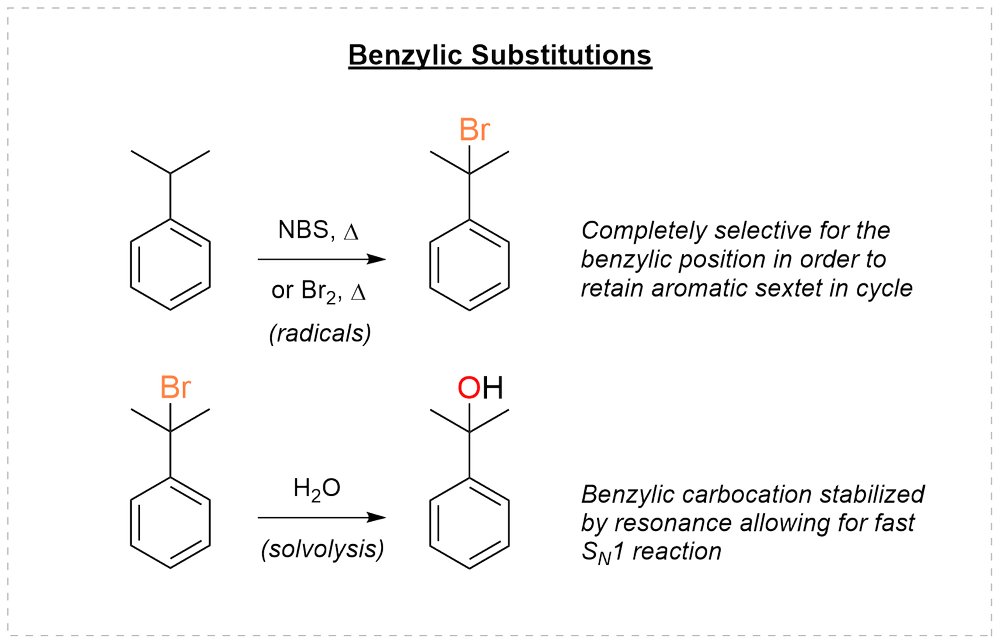
The benzene ring itself is stabilized and generally unreactive, but the carbon directly attached to it is unusually reactive. Radical bromination with NBS and heat, or Br2 and heat, halogenates the benzylic position selectively. The selectivity is complete because abstracting the benzylic hydrogen gives a radical that is delocalized into the ring's pi cloud without breaking the aromatic sextet. Abstracting a ring hydrogen would be difficult considering the sp2-H bonding, which is quite strong.
The same delocalization applies to the cation. A benzylic halide ionizes readily, because the resulting benzylic carbocation spreads its positive charge through the ring by resonance, so solvolysis in water is fast and gives the benzylic alcohol by SN1 with retention of the aromatic system. In both radical and carbocation cases the pattern is the same: the ring pi cloud stabilizes an adjacent reactive intermediate.
Benzylic eliminations and additions
The same cation, reached from either direction
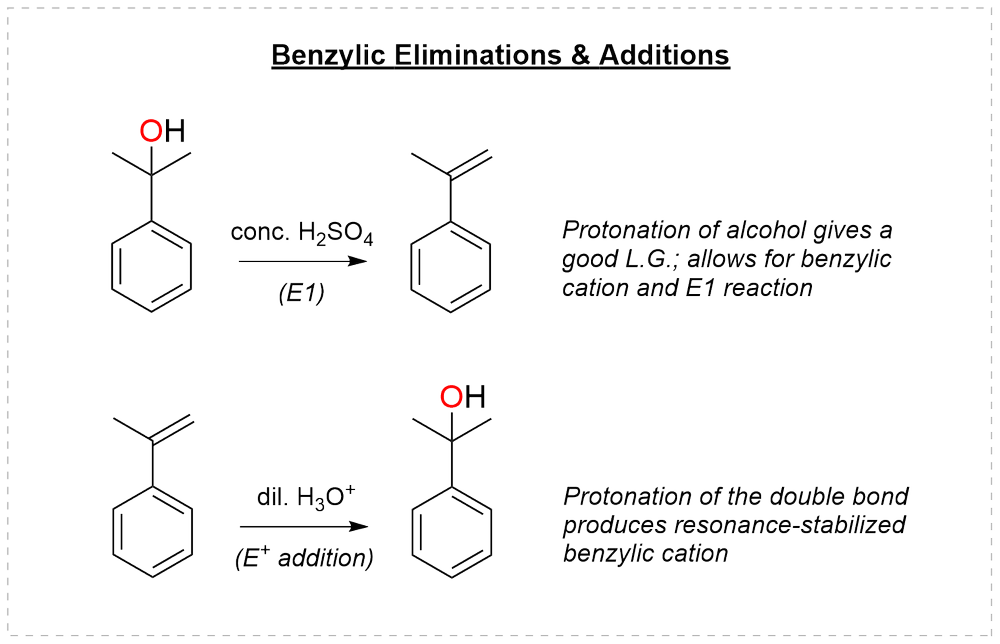
A benzylic alcohol dehydrates easily. Concentrated sulfuric acid protonates the hydroxyl group, turning it into a good leaving group, and water departs to give the resonance-stabilized benzylic cation; loss of a proton then gives the alkene. The reaction occurs by the E1 pathway rather than E2 because the cation is achievable. The new pi bond is conjugated with the ring, which contributes to the molecule's overall stability.
The E1 pathway is usually reversible since alkenes are able to pick up electrophiles and generate carbocations. Here, dilute aqueous acid protonates the alkene at the position that gives the benzylic cation, and water then captures it to return the alcohol. Both directions in volve the same intermediate species, so the regiochemistry of the addition depends on whether the resulting cation can be delocalized into the ring.
Reference
Worked classifications
Count the π electrons in the cyclic system, then check requirements.
Self-check
Six questions before you move on
Try to work out an answer on paper, then reveal to check. If your reasoning is right but the answer is wrong, you are closer than you think.
Cyclooctatetraene has eight π electrons. Is it antiaromatic?
No, it is non-aromatic. Antiaromaticity requires a planar, fully conjugated ring, and cyclooctatetraene adopts a puckered shape precisely to avoid that. Its p orbitals no longer overlap continuously, so it behaves as an ordinary polyene.
Why is the CH2 of cyclopentadiene far more acidic than a normal alkane C–H?
Deprotonation converts that sp3 carbon to sp2 and puts the resulting lone pair into a p orbital, completing the conjugated pi system. The anion has six π electrons in a planar ring and is aromatic, so it is stabilized far more than an ordinary carbanion.
Pyridine is a reasonable base; pyrrole is not. Explain the difference.
In pyridine the nitrogen already contributes to a ring double bond, so its lone pair sits in an in-plane sp2 orbital and is free to accept a proton. In pyrrole the lone pair occupies a p orbital and is part of the six aromatic electrons; donating it to a proton it would lose the aromaticity.
Why does molecular orbital picture single out 4n+2 rather than just any even number?
A cyclic π system has one lowest orbital and then pairs of degenerate orbitals above it. Filling that pattern completely takes 2, then 6, then 10 electrons. Any 4n count leaves the top degenerate pair half-filled with one unpaired electron each, which is destabilizing rather than stabilizing.
A compound shows ring hydrogens at 7.2 ppm. What does that tell you, and what would an antiaromatic ring show?
A ring current is circulating, which means a delocalized aromatic π system; the induced field deshields the outside hydrogens. An antiaromatic ring circulates the opposite way, so its hydrogens are shielded and appear unusually far upfield.
Hydrogenating benzene releases about 36 kcal/mol less than expected. Expected from what, and what is the shortfall?
Expected from three times the heat of hydrogenation of an isolated alkene such as cyclohexene. Since both such reactions give cyclohexane, the deficit measures how much more stable benzene is than three separate double bonds because of the resonance, or delocalization, energy.