Aromatic substitution
Reactions and substituent effects
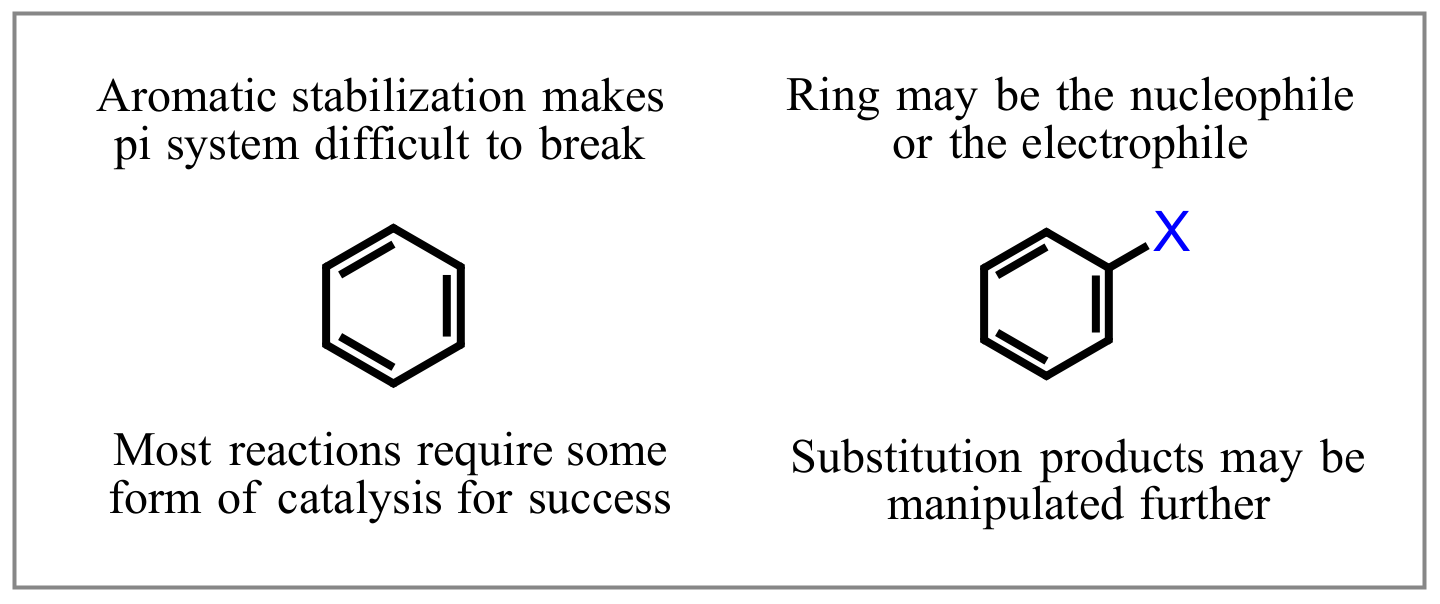
Benzene is a weak nucleophilic. Its π electrons are delocalized around the ring, making the system particularly stable. Reactions that destroy that delocalization cost a great deal of energy, so benzene does not add across a double bond the same way an alkene does. Benzene most often substitutes instead, with an electrophile replacing a hydrogen and the aromatic ring being restored. That preference organizes the whole Benzene chapter, from the five classical electrophilic substitution reactions to the way an existing substituent controls where the next one goes.
The substitution mechanism
Two steps through an arenium ion
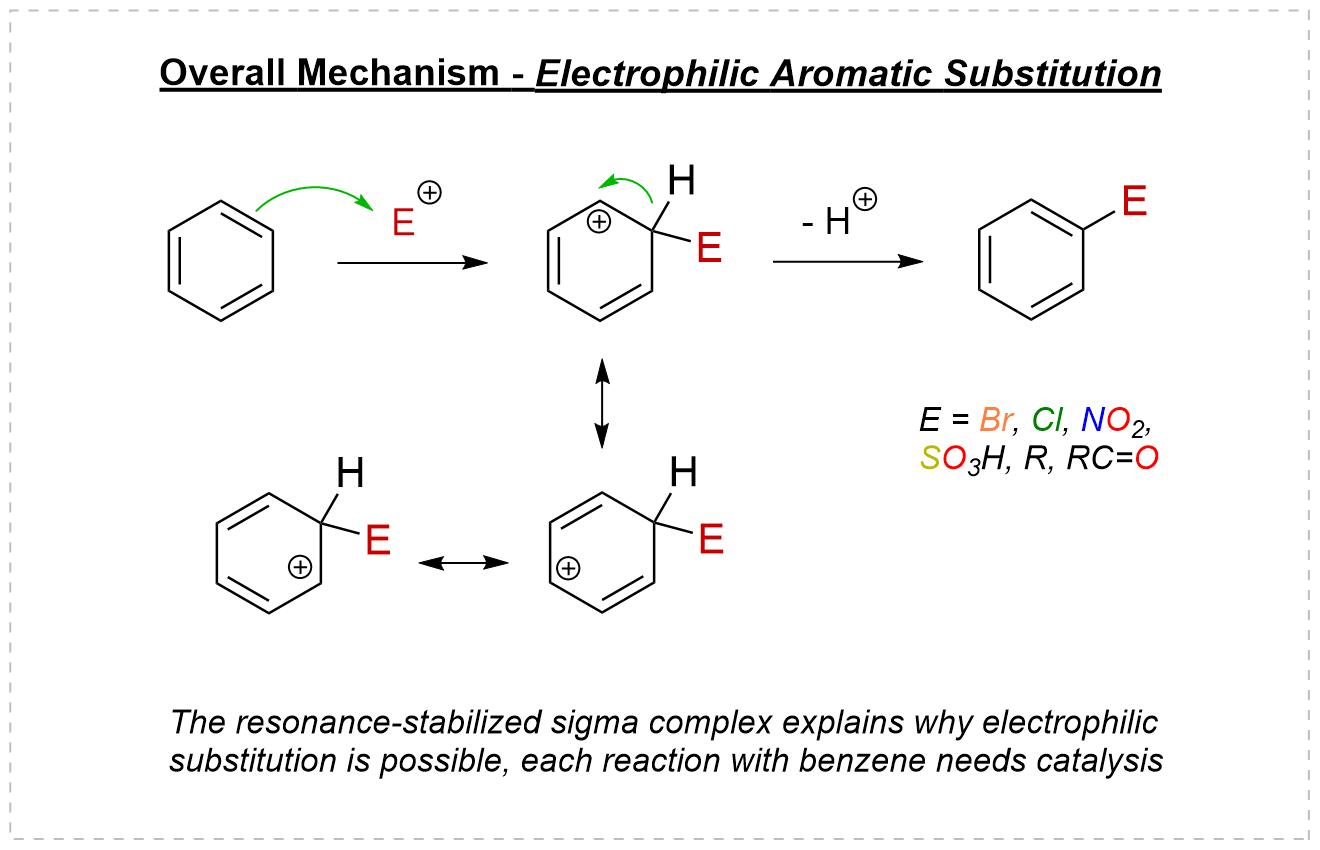
Every electrophilic aromatic substitution follows the same two steps. The ring attacks the electrophile with a pair of π electrons, giving a cationic intermediate called the arenium ion, or sigma complex. A weak base then removes the hydrogen from the carbon that was attacked, and the aromatic 6 pi system is restored. The intermediate is a carbocation delocalized over several carbons, but is not itself aromatic
That temporary loss of aromaticity is why the first step is the slow one, and it also explains why the second step is needed. Addition would leave the ring permanently non-aromatic and forfeit the delocalization energy, so the reaction is an addition-elimination sequence with a proton being lost in the second step. An alkene under the same conditions simply adds with the loss of the weaker pi bond being compensated for by forming stronger sigma bonds.
Because the first step is rate-determining, reactivity and regiochemistry are related to the stability of the arenium ion that is formed. A substituent that helps stabilize the positive charge lowers that barrier and speeds the reaction up, while a substituent that pulls electron density away raises the activation barrier and slows the reaction down. Section 04 below is that argument applied to the position of attack on an already substituted ring.
Generating the electrophile
Halogenation, nitration and sulfonation
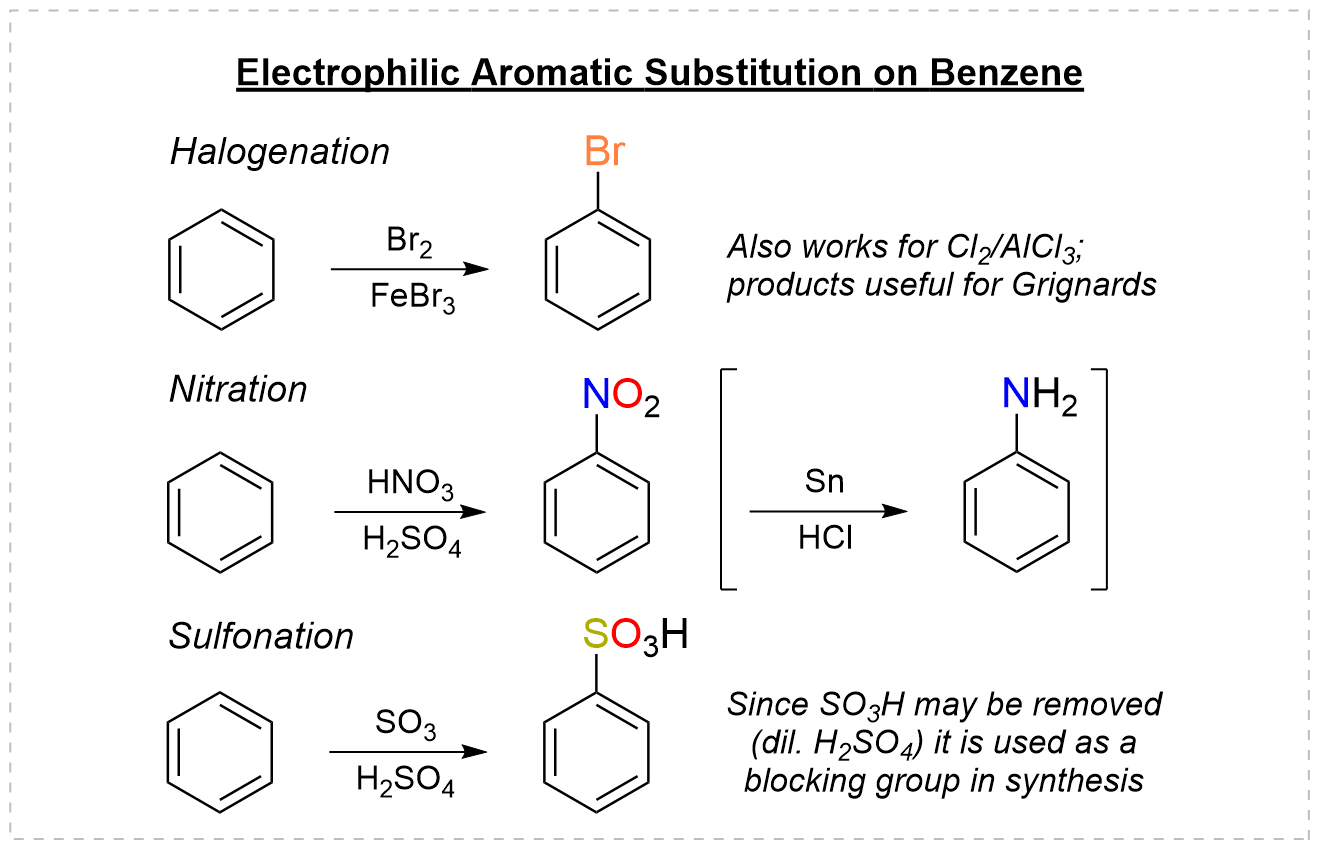
Benzene is a weak nucleophile, so the electrophile has to be quite reactive. Br2 and Cl2 are not reactive enough on their own so a Lewis acid such as FeBr3 or AlCl3 is added, which coordinates to one halogen and polarizes the bond. The ring then attacks the far end of the activated electrophile. Fluorination is too violent to control and iodination needs an oxidant, so aryl fluorides and iodides are usually made by other routes.
Nitration uses a mixture of nitric and sulfuric acid. Sulfuric acid protonates nitric acid, water leaves, and the nitronium ion NO2+ is generated in solution; that is the electrophile that the arene ring attacks. The nitro group is a versatile substituent in its own right, because it can be reduced to an amine with a tin or iron reductant in acid, or with hydrogen over a catalyst..
Sulfonation with fuming sulfuric acid delivers SO3 and gives a sulfonic acid. Unlike the others, this reaction is readily reversible: dilute aqueous acid and heat removes the sulfonic acid group. That makes it useful as a blocking group, occupying a position and then being removed once the desired substituent is in place.
Friedel–Crafts chemistry
Alkylation, acylation and why acylation is often preferred
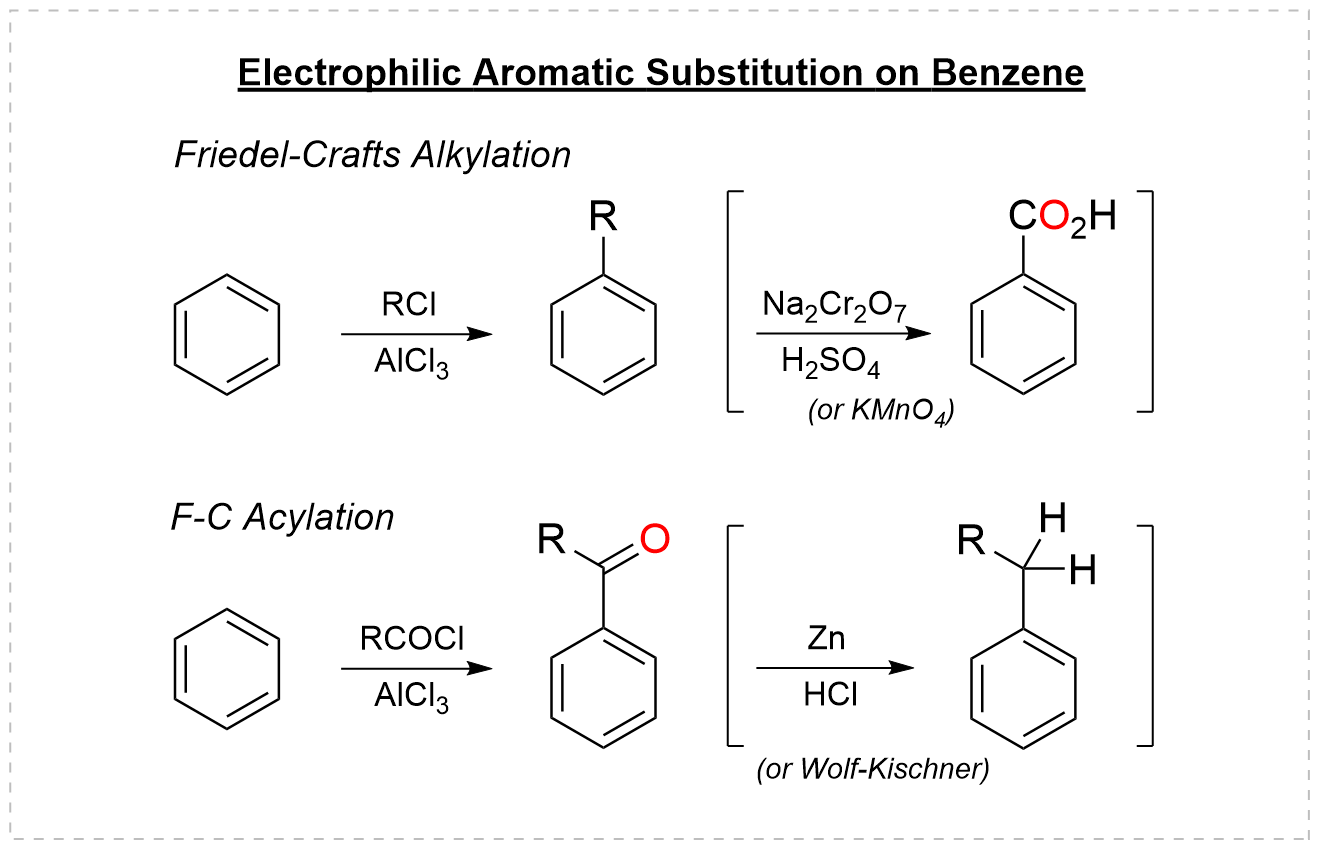
Friedel–Crafts alkylation forms a carbon–carbon bond. AlCl3 activates an alkyl halide, often to a carbocation, and the ring attacks it. The reaction has four well-known limitations. 1. The carbon electrophile may rearrange, so a primary halide usually delivers a branched product rather than the straight-chain one. 2. The alkyl group installed is activating, so the product reacts faster than the starting material and polyalkylation follows. 3. The reaction fails on strongly deactivated rings such as nitrobenzene. 4. An aryl or vinyl halide will not ionize at all.
Acylation avoids the first two problems. An acid chloride plus AlCl3 gives an acylium ion, which is resonance-stabilized by the oxygen lone pair and therefore does not rearrange. The resulting ketone group is deactivating, so it does not undergo a second acylation. The result is a clean monosubstituted aryl ketone.
That combination makes acylation followed by reduction the standard solution to the alkylation problem. Acylate to introduce the desired carbon chain, then reduce the ketone to a CH2 group with zinc amalgam in HCl or by hydrogenolysis. A straight-chain alkylbenzene that is precluded by alkylation is now straightforward.
Substituent effects
Relative rates, and where the next group goes
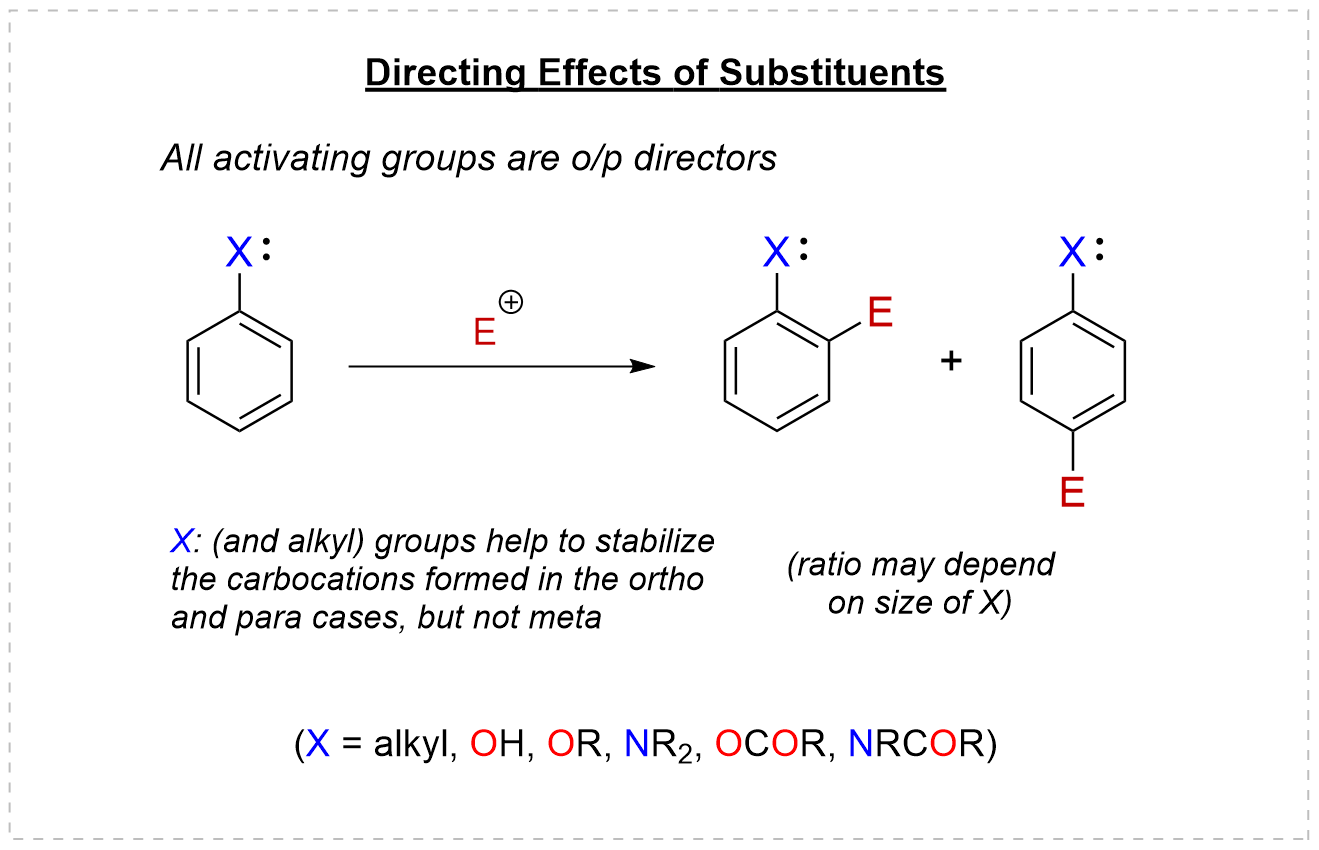
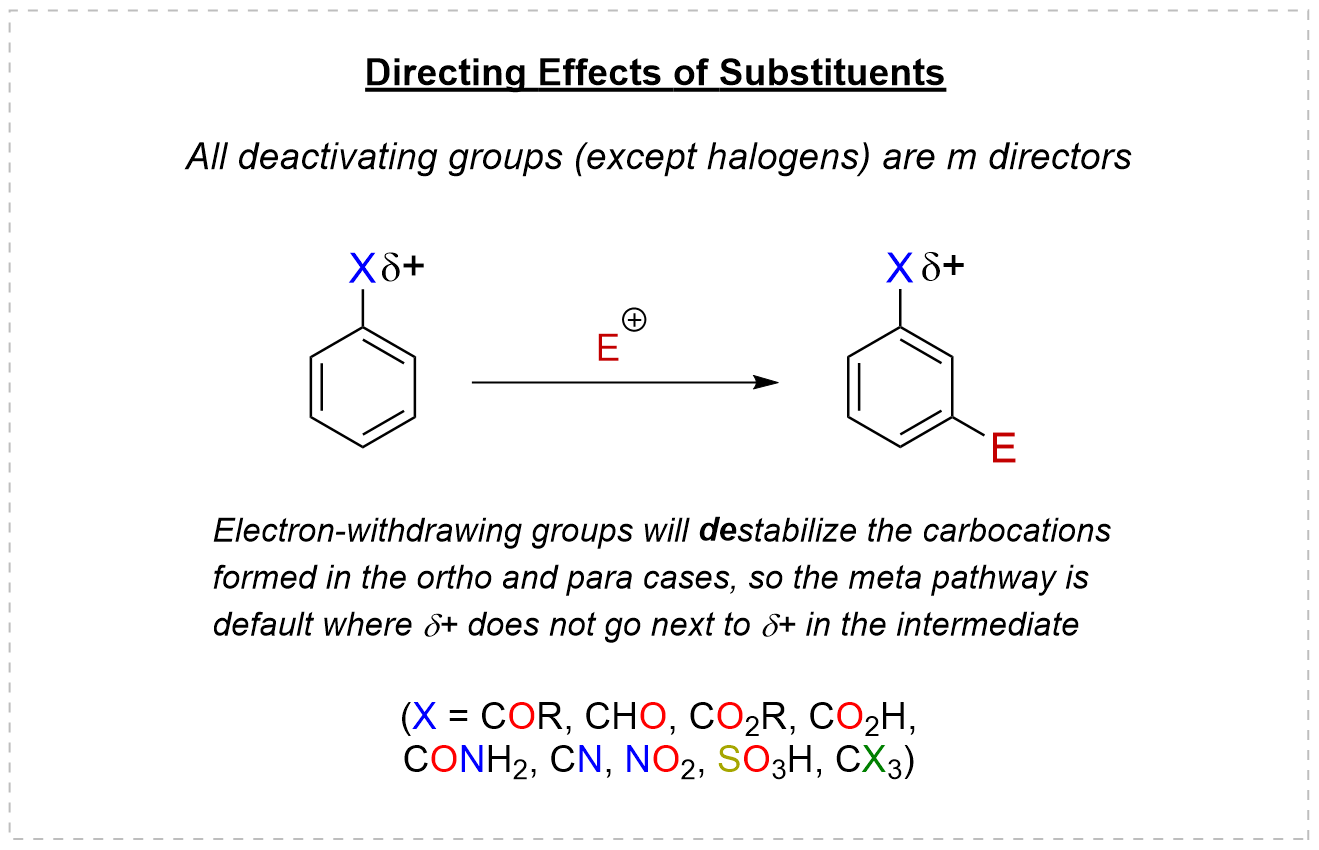
A substituent already on the ring changes both how fast the next substitution happens and where it will occur. Both effects are related to the stability of the arenium ion. This is affected by induction through σ bonds, which depends on the electronegativity of the attached group, and resonance through the π system, which requires a lone pair or a π bond on the substituent. Where the two effects couteract, resonance usually wins.
Groups with a lone pair on the attached atom; NH2, OH, OR, and more weakly the halogens, can donate into the ring through resonance, and they direct the incoming group ortho and para. Drawing the arenium ion for each position shows why: attack at ortho or para gives a resonance structure in which the substituent's lone pair carries some of the positive charge, and that structure is unavailable for meta attack. Alkyl groups also direct ortho/para, but by hyperconjugation rather than by delocalization of a lone pair.
Groups with a positive or partially positive attached atom; NO2, C=O, SO3H, CN, NR3+ withdraw density and direct meta. The reasoning is the opposite: ortho and para attack put positive charge on the carbon bearing the withdrawing group, which is now the worst possible place for it, so meta attack is the "least bad" option. All of these groups deactivate the ring and make the next substitution slower.
The halogens are the exception when it comes to rates. They are electronegative enough to deactivate the ring by induction, yet they still have lone pairs to donate, so they direct ortho and para while slowing the reaction down. This is the one example of where the rate effect and the directing effect are opposite.
Nucleophilic aromatic substitution
When the arene ring is the electrophile
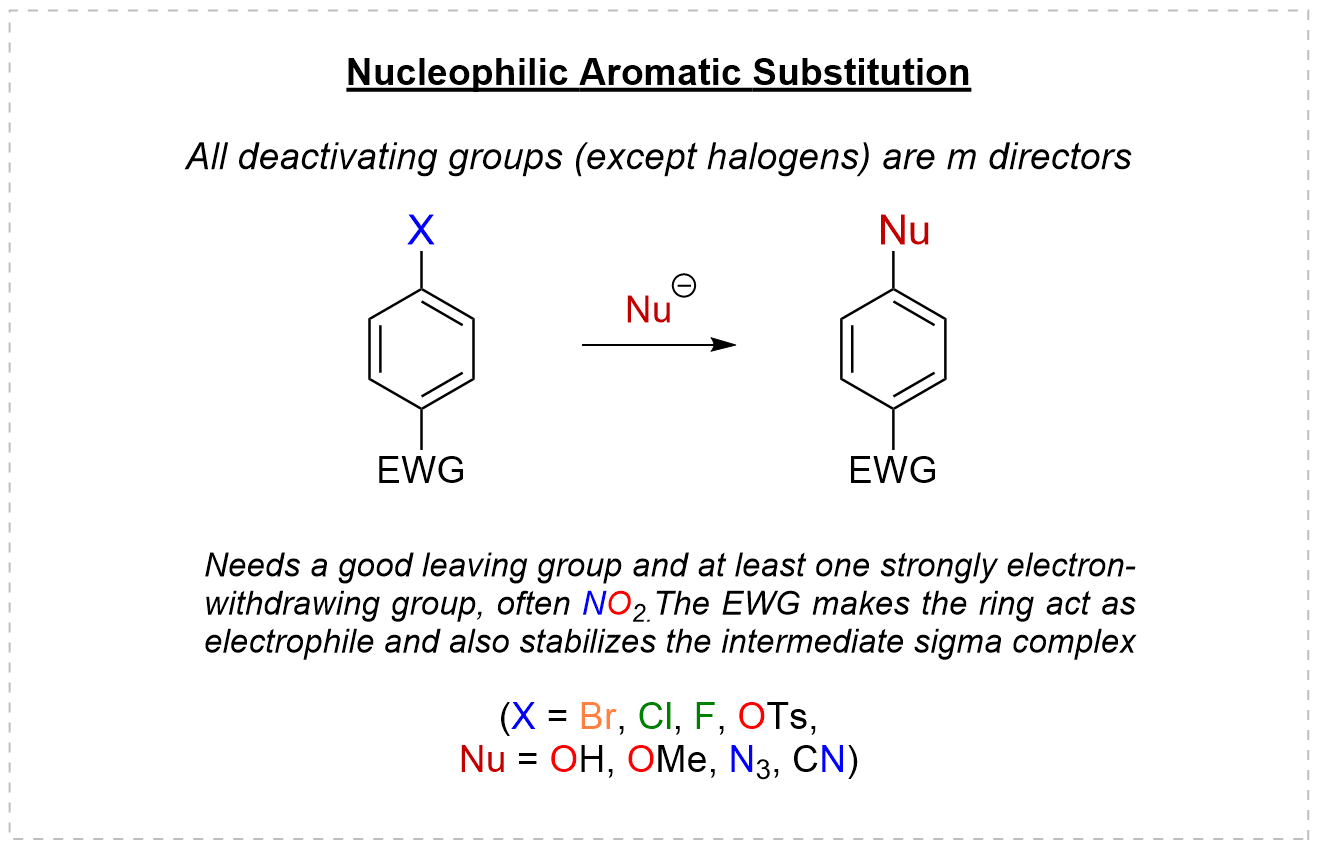
An aryl halide will not undergo SN2 chemistry since the ring blocks backside attack, and it will not be able to ionize to an aryl cation either as would be required for SN1. But if the ring carries a strong electron-withdrawing group ortho or para to a halide, a nucleophile can attack the carbon bearing the halide directly. The intermediate is an anionic Meisenheimer complex, and the electron-withdrawing group(s) stabilize the negative charge by resonance. The halide then leaves and aromaticity is regained.
The activating groups must be ortho or parato the leaving group, because only those positions allow for distributing the negative charge into the withdrawing group; meta substituents do not help. Also, fluoride gives the fastest rates of reaction here, not the slowest, because loss of halide is not the slow step. It is the fluorine's high electronegativity that accelerates the initial attack of the nucleophile on the adjacent (ipso) carbon.
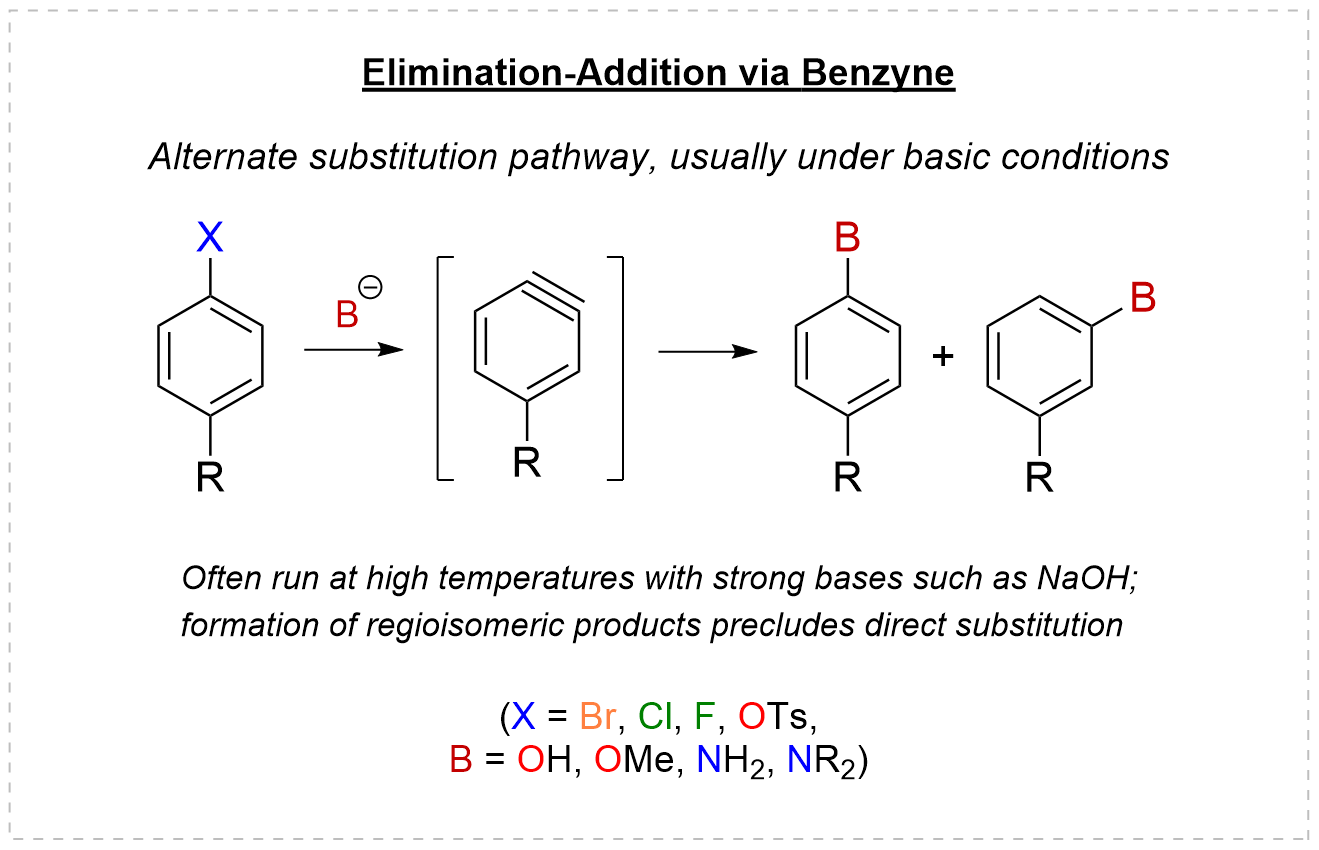
Under much harsher conditions, sodium amide and no (de)activating groups attached, an unactivated aryl halide reacts by a different route entirely, eliminating HX to give benzyne, which is a strained intermediate with a formal, and very strained, triple bond in the ring. The nucleophile then adds to either end of that triple bond, which is why this route can give two regioisomeric products from one starting material.
Reference
Reaction summary
Each transformation is listed here. Read it right to left when planning a synthesis.
Reference
Directing effects
Grouped by strength. Note that the halogens are the one row where rate and direction disagree.
Self-check
Six questions before you move on
Try to work out an answer on paper, then reveal to check. If your reasoning is right but the answer is wrong, you are closer than you think.
Cyclohexene decolorizes Br2 instantly; benzene needs FeBr3 and gives substitution rather than addition. Explain both outcomes.
Benzene's π system is delocalized and thereby stabilized, so it is a much weaker nucleophile than an alkene and needs a Lewis acid to make the electrophile reactive enough for benzene to be interested. An addition would cause loss of the aromatic system, so the arenium ion loses a proton instead and reforms the delocalized aromatic system.
Why does –OCH3 direct ortho and para, while –NO2 directs meta?
Draw the arenium ion for each position. With –OCH3, ortho and para attack give a resonance structure in which the oxygen lone pair carries some of the charge; meta attack does not. With –NO2, ortho and para attack put positive charge on the carbon bearing the withdrawing group, which is the least stable option, so meta wins by default.
Chlorine slows aromatic substitution down but still sends the incoming group ortho and para. How is this possible?
The two effects are separate. Induction dominates the rate: chlorine is electronegative and pulls electron density from the ring, so every position reacts more slowly than in benzene. Resonance still dictates the position: the lone pair can stabilize the arenium ion after ortho or para attack but not from meta.
Friedel-Crafts alkylation of benzene with 1-chloropropane gives mostly isopropylbenzene. How would you make propylbenzene instead?
As the primary carbon becomes more positive during coordination with the Lewis acid, the system rearrange to the secondary carbocation before the ring attacks. To avoid this, acylate instead; add propanoyl chloride with AlCl3 to give the aryl ketone, since an acylium ion cannot rearrange, and then reduce the carbonyl to CH2 with Zn(Hg)/HCl.
You need meta-bromonitrobenzene. Does it matter which group you install first?
Yes. Nitrate first: the nitro group is a meta director, so the bromine goes where you want it. Brominating first would give an ortho/para director and the wrong nitration product(s).
In SNAr, fluoride is the best halide leaving group and iodide the worst, the opposite of SN2. Why?
Loss of halide is not the slow step here; attack of the nucleophile to form the Meisenheimer complex is. Fluorine's electronegativity makes that (ipso) carbon the most electrophilic and stabilizes the developing negative charge, so it accelerates the step that actually controls the rate.