Carboxylic acids & derivatives
Synthesis and chemistry
Carboxylic acids are acidic because their conjugate bases are resonance-stabilized. Carboxylic acid derivatives generally react by a two-step sequence: a nucleophile adds to the carbonyl, then the carbonyl reforms by expelling an attached leaving group. Acid catalysis is also possible, for example in the Fischer reaction.
Carboxylic acids and their derivatives
Where they occur and what they become
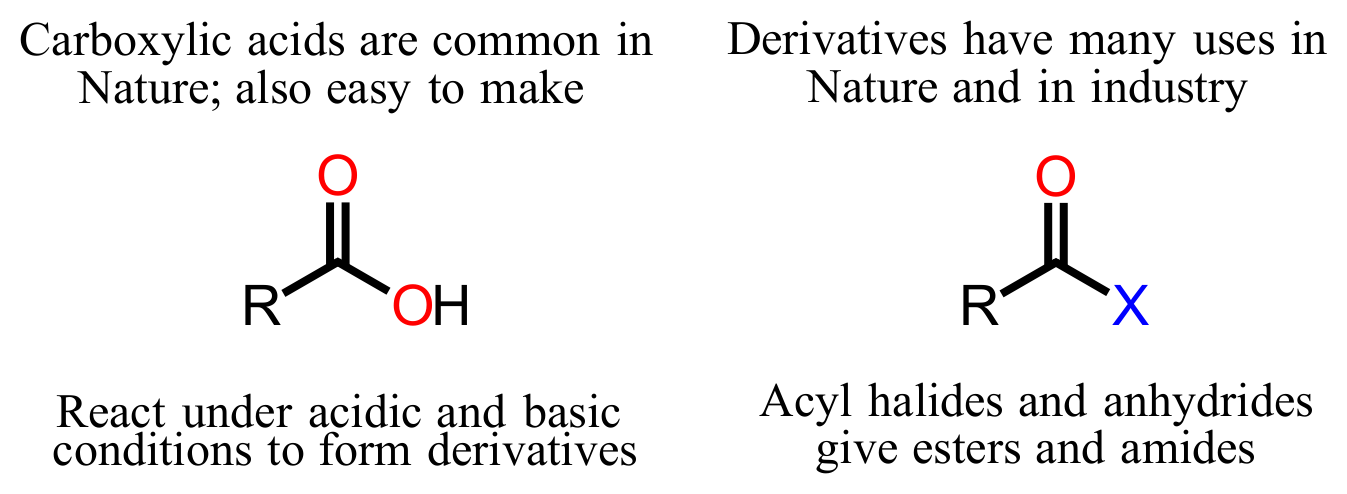
Carboxylic acids are common in Nature, from acetic acid and the fatty acids to citric and amino acids, and they are also among the easiest functional groups to make: oxidation of a primary alcohol or an aldehyde, carboxylation of a Grignard reagent, or hydrolysis of a nitrile all end at the same place.
The carboxyl group is also a gateway. Replacing its hydroxyl with another heteroatom gives the family of derivatives — acid chlorides, anhydrides, esters and amides, written generically as RCOX — and these are what do the work in Nature and in industry, from triglycerides and peptides to polyesters and pharmaceuticals.
Derivatives are formed under both acidic and basic conditions. Acyl halides and anhydrides are reactive enough to be attacked directly by an alcohol or an amine to give esters and amides, while a carboxylic acid itself needs either acid catalysis, as in Fischer esterification, or prior activation. The rest of this chapter is that logic in order: how acidic the group is, how the acid is made, and how one derivative is converted into another.
Acidity
Resonance, pK values, and substituent effects
The carboxyl group features a carbonyl and a hydroxyl on the same carbon, with the two interacting. The carbon is sp2 hybridized and the whole group is planar. A lone pair on the hydroxyl oxygen overlaps with the π system, which shortens the C–O single bond, lengthens the C=O bond slightly, and consequently makes the carbonyl carbon less electrophilic than that of an aldehyde or ketone.
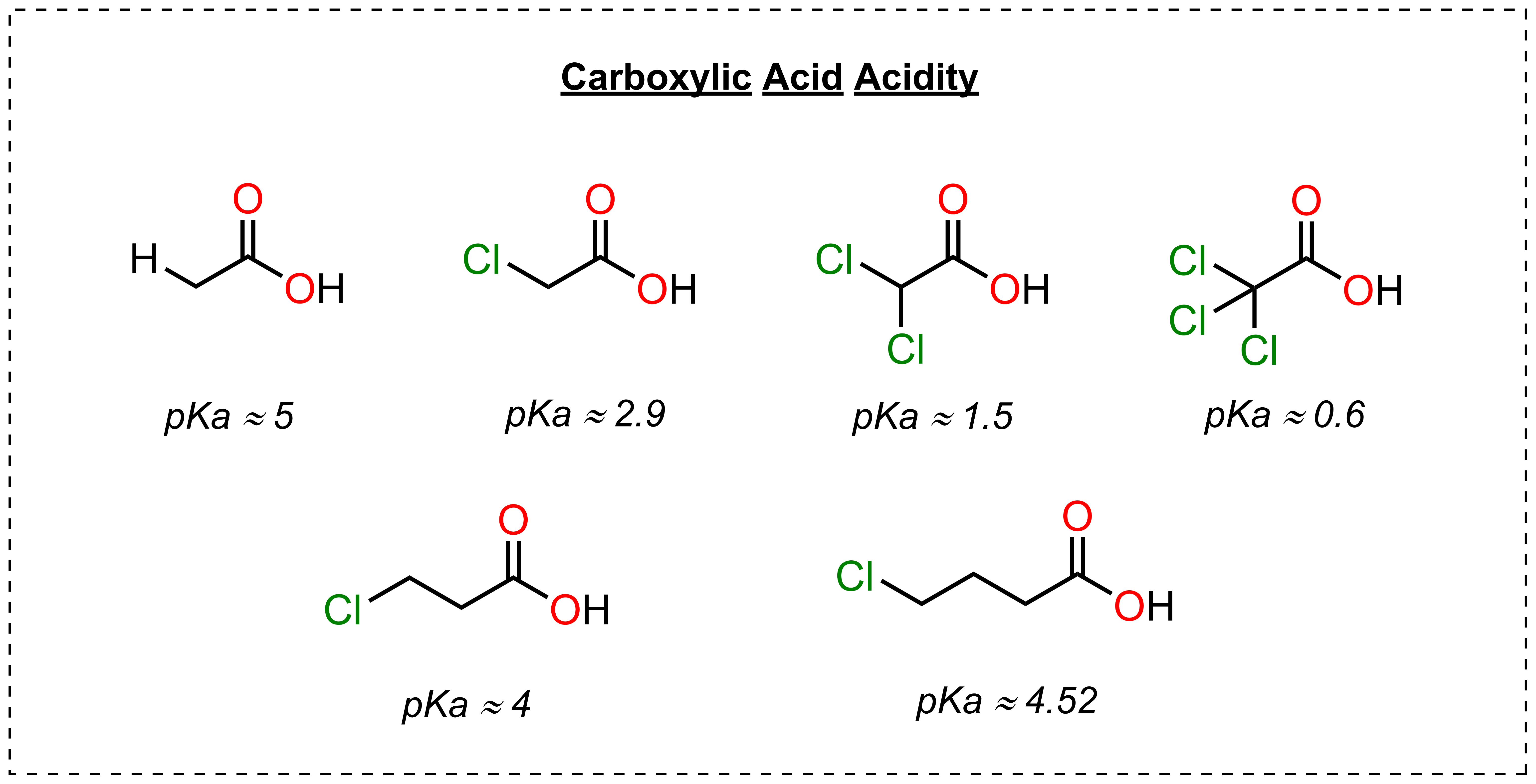
Typical carboxylic acids have pKa values near 5, which is some ten orders of magnitude more acidic than an alcohol, because the conjugate base is a carboxylate in which the negative charge is delocalized equally over two equivalent oxygens. Losing the proton is therefore much more favourable than it is for an alcohol, where the charge in the conjugate base is localized on one atom.
Substituents affect the pKa value in predictable ways. Electron-withdrawing groups stabilize the carboxylate and thereby strengthen the acid. The effect falls off sharply with distance as the EWG is moved further away from the carbonyl, however the effect is additive when EWGs are added to the same carbon. Chloroacetic acid is roughly a hundred times stronger than acetic acid, and trichloroacetic acid is stronger still. Electron-donating alkyl groups work the other way. Because a carboxylate is a stable anion, treating an acid with aqueous NaOH or NaHCO3 gives a water-soluble salt, which is a routine way to separate an acid from a neutral organic mixture.
Preparation of carboxylic acids
Oxidation, carboxylation, and nitrile hydrolysis
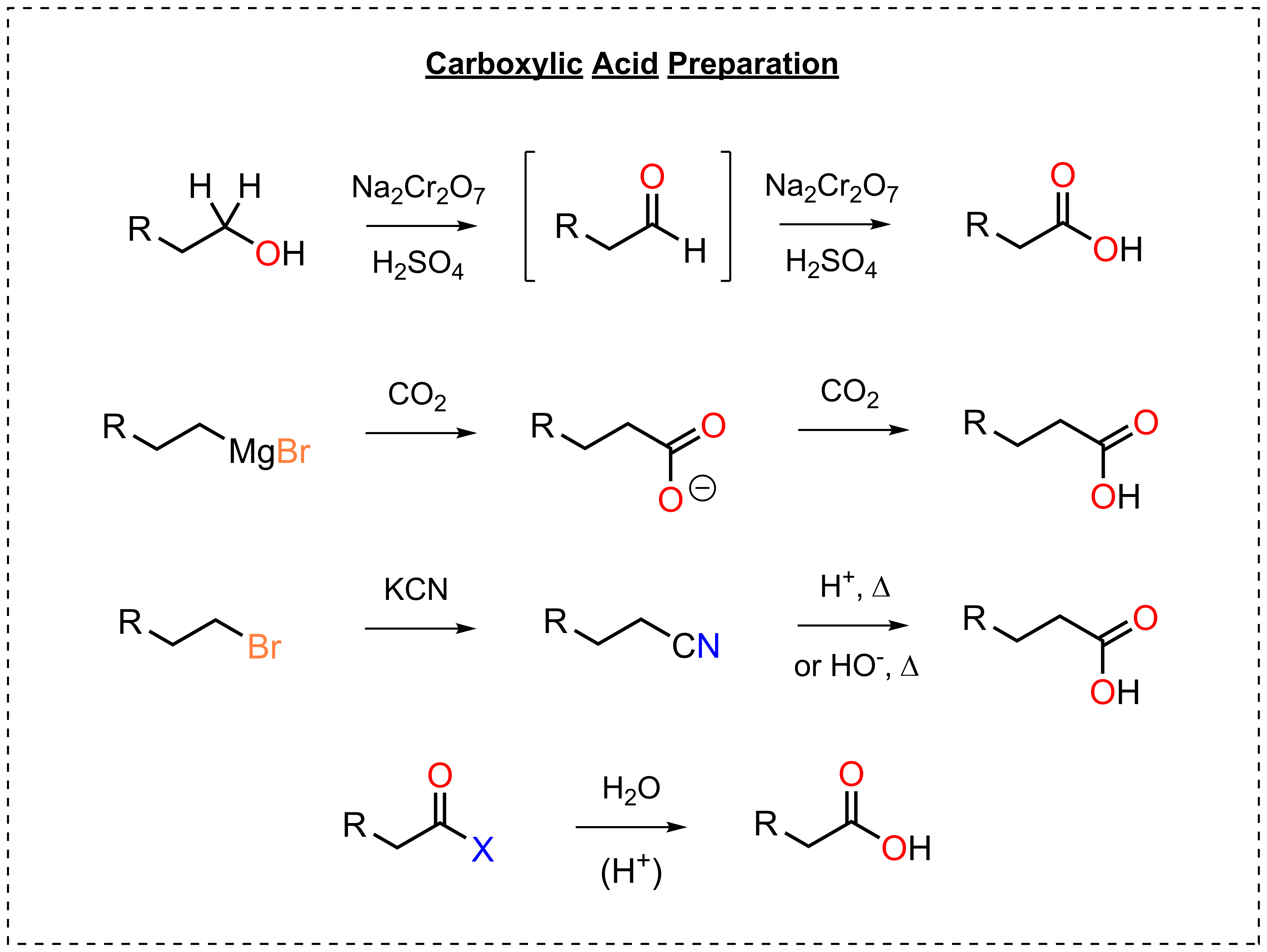
Oxidation is the most direct route. A primary alcohol or an aldehyde is oxidized to the acid by chromic acid or KMnO4, and the aqueous medium helps by hydrating the intermediate aldehyde so that oxidation continues. An alkylbenzene with at least one benzylic hydrogen present is oxidized by hot KMnO4 all the way to benzoic acid, no matter how long the chain, because the reaction cleaves at the benzylic position.
Two routes build on the carbon skeleton by adding one carbon. A Grignard reagent attacks CO2 and an acidic workup gives the acid with one more carbon than the halide it came from. Alternatively, an alkyl halide is converted to a nitrile with cyanide anion by SN2, and hydrolysis of the nitrile in hot aqueous acid or base delivers the same carboxylic acid. Choice of which to use depends on what else the molecule tolerates, since a Grignard is incompatible with acidic protons and the cyanide route needs a substrate that will undergo substitution.
Hydrolysis of any carboxylic acid derivative regenerates the acid, and that is worth remembering as a planning tool. An ester, amide, anhydride or acid chloride can all be taken back to the parent acid, so a derivative may be used as a protected or activated form and unmasked at the end.
Nucleophilic acyl substitution
A shared mechanism and the reactivity order
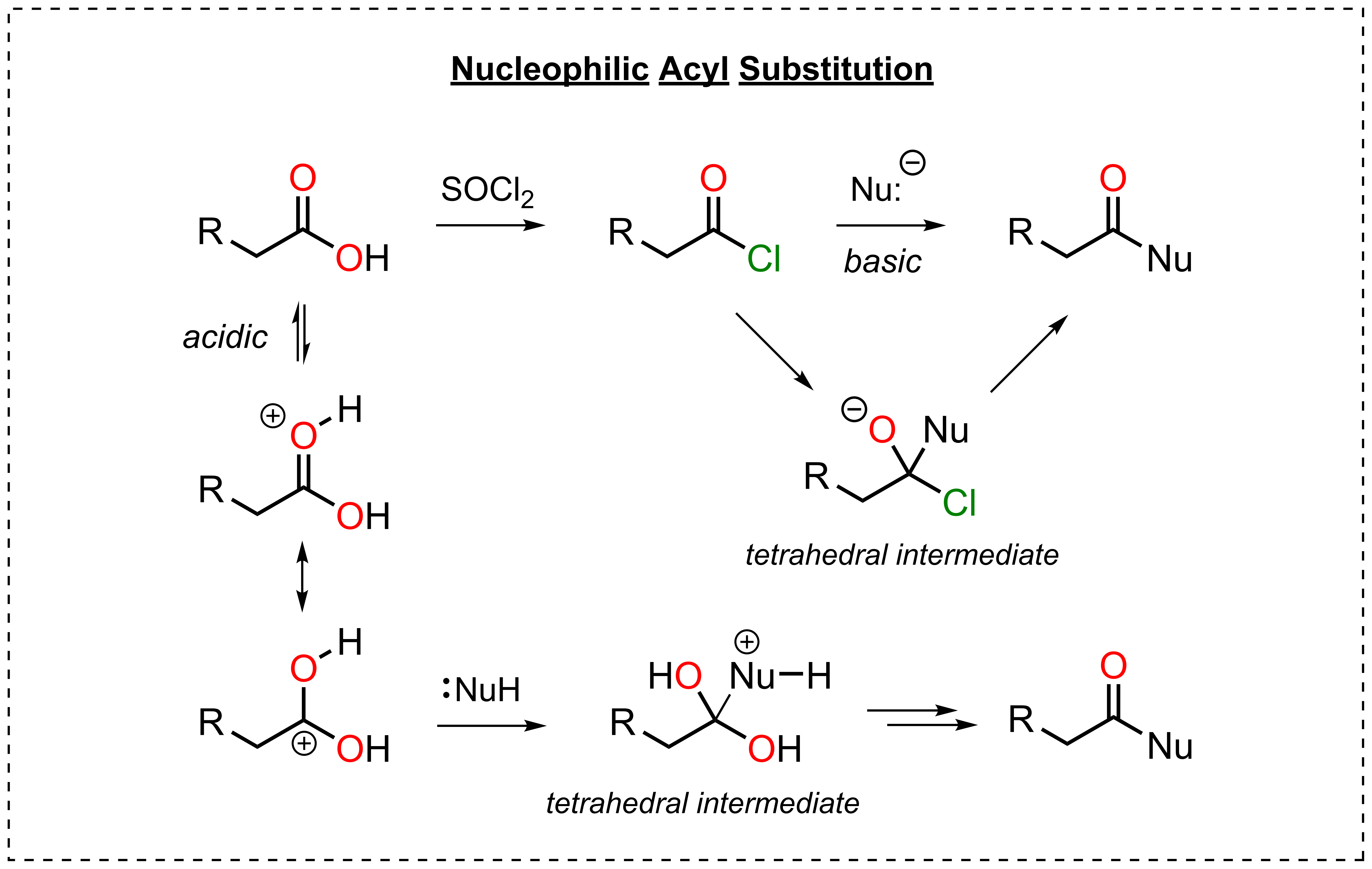
Nearly all carboxylic acid derivative chemistry occurs via the same mechanism. A nucleophile adds to the carbonyl carbon to give a tetrahedral intermediate, then the carbonyl reforms by expelling the best leaving group. Addition, then elimination, which means a substitution has occurred overall.
Reactivity depends on how much the substituent donates electron density into the carbonyl and also correlates with the leaving group’s stability. The order generally follows: acid chloride > anhydride > ester ≈ carboxylic acid > amide > carboxylate. Chloride does little to stabilize a carbonyl, but is a fine leaving group, so acid chlorides react with most nucleophiles. An amide nitrogen on the other hand donates strongly into the carbonyl and amide bonds are correspondingly hard to break, which is also why proteins survive in an aqueous environment.
In practice, we typically go in one direction with derivatives; from more reactive to more stable. Any derivative can be converted into others directly, but going to more reactive species requires either activation, as with SOCl2, or forcing an unfavourable equilibrium to the right with excess reagent and removal of a product. Under acidic conditions the carbonyl is protonated first and the nucleophile is weak, while under basic conditions a strong nucleophile attacks the neutral carbonyl. If the immediate product is a carboxylic acid it is deprotonated quickly to the carboxylate salt.
Making the derivatives
Acid chlorides, anhydrides, esters and amides
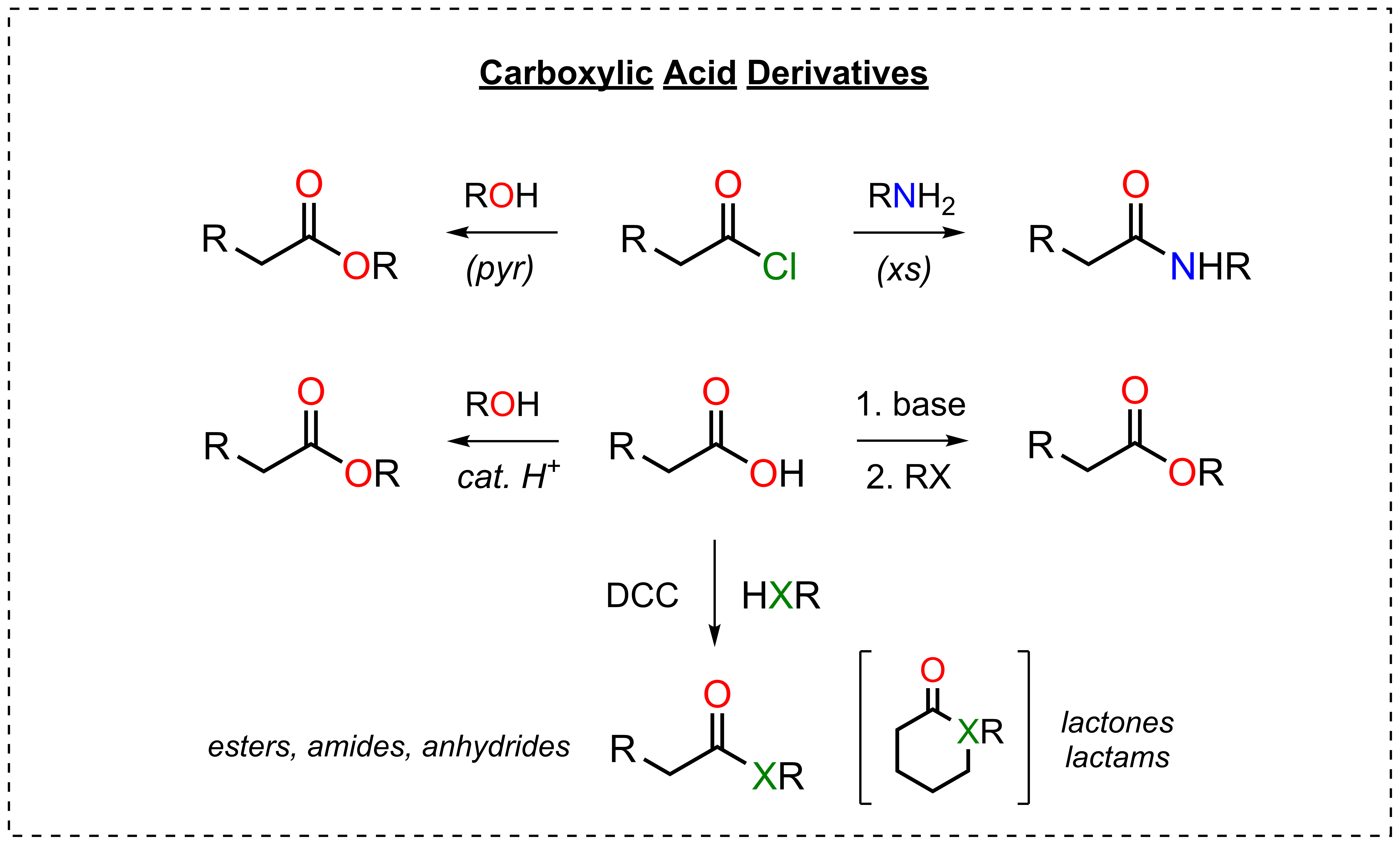
Acid chlorides are an activated form of the carboxylic acids and are versatile intermediates. Thionyl chloride converts an acid to its acid chloride, with SO2 and HCl leaving along the way; oxalyl chloride does the same. From there, reacting an acid chloride with an alcohol gives an ester, an amine gives an amide, and a carboxylate anion gives an anhydride.
Esters may also be made from the acid directly. Fischer esterification heats a carboxylic acid with an excess of alcohol and an acid catalyst. Every step is reversible, so the reaction is driven to product by using the alcohol as solvent or by removing water. A carboxylate and a primary alkyl halide give the same ester by SN2, which avoids the equilibrium entirely, although this method is limited.
Amides need special attention, because an amine and a carboxylic acid first react as a base and an acid to give an unreactive ammonium carboxylate. Heating drives off water and gives the amide, but the mild alternative is a coupling agent such as DCC, which activates the carboxyl in situ and is the standard method for making peptide bonds. Cyclic esters and amides, lactones and lactams, form the same way when the two groups are positioned in the same molecule.
Hydrolysis and reduction
Saponification, hydride reagents, and organometallics
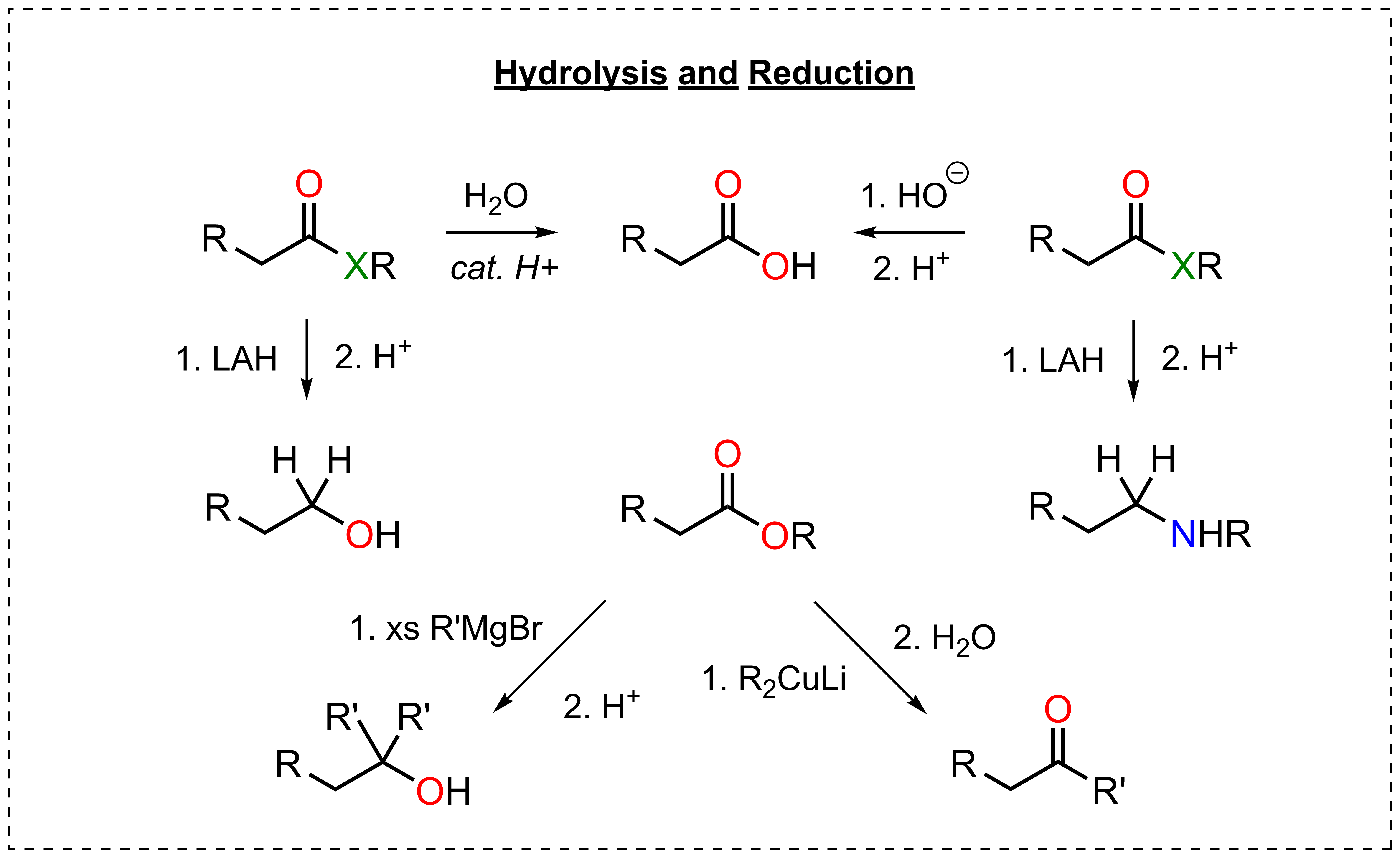
Acid-catalyzed ester hydrolysis is a Fischer esterification in reverse and reaches equilibrium, so a large excess of water is used. Base-promoted hydrolysis, known as saponification, is not reversible. Hydroxide attacks to form a tetrahedral intermediate, the alkoxide leaves, and the carboxylic acid produced is immediately deprotonated to the carboxylate, which is the energy sink for the process. Acidifying the mixture at the end gives the free acid.
Reduction with hydride reagents follows the same reactivity order. Lithium aluminium hydride (LAH) reduces a carboxylic acid, an ester or an amide, giving a primary alcohol from the first two and an amine from the third, since oxygen leaves instead of nitrogen. Sodium borohydride is too mild to touch esters, amides, or carboxylic acids, which is what makes it useful for reducing a ketone in the presence of an ester. To stop at the aldehyde, one equivalent of DIBAL at low temperature is the reagent of choice.
Organometallic reagents add twice. A Grignard reagent converts an ester to a ketone, which is more reactive than the ester and is attacked again, so the isolated product is a tertiary alcohol bearing two identical new R groups. Where a single addition is wanted, a Gilman reagent or a Weinreb amide stops cleanly at the ketone.
Nitriles
A carboxylic acid derivative without a carbonyl
A nitrile has no carbonyl, but its carbon is at the same oxidation level as a carboxylic acid carbonyl carbon and it behaves like a derivative. The carbon is sp hybridized and electrophilic, and the nitrogen holds a lone pair in an sp orbital, so nitriles are weak bases and reasonably polar.
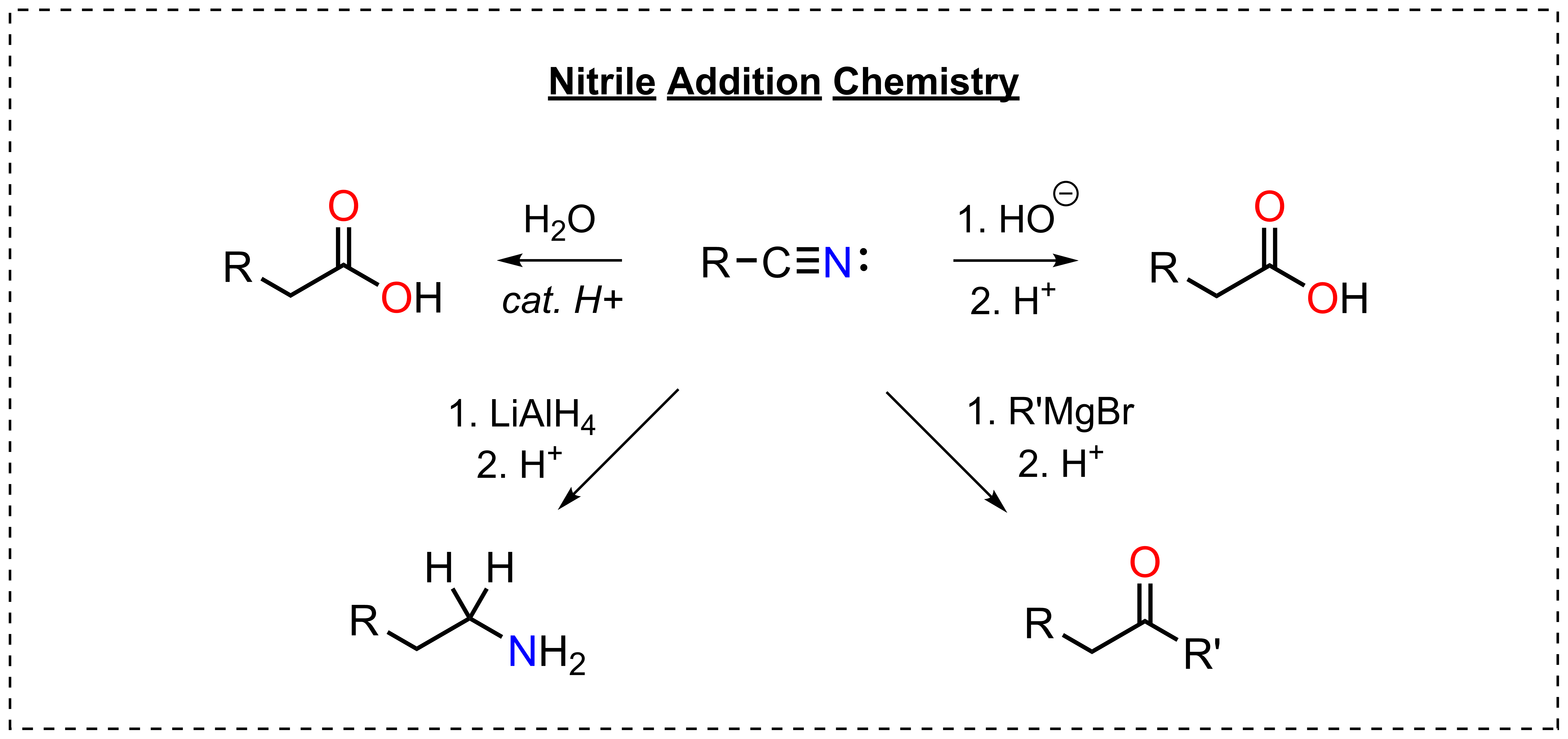
Three other reactions add to a nitrile’s flexibility. Hot aqueous acid or base hydrolyzes a nitrile to the carboxylic acid, through the amide as an intermediate that can be isolated under controlled conditions. Lithium aluminium hydride adds two hydrides and gives a primary amine. A Grignard reagent adds once to give a metalated imine that does not react further, and an aqueous workup hydrolyzes it to a ketone.
This explains why nitriles are used so often in synthesis; displacing a halide with cyanide extends the chain by one carbon, and the nitrile can then be taken on to an acid, an amine or a ketone as needed.
Reference
Reaction summary
Each transformation is listed here. Read it right to left when planning a synthesis.
Self-check
Six questions before you move on
Try to work out an answer on paper, then reveal to check. If your reasoning is right but the answer is wrong, you are closer than you think.
Acetic acid has a pKa near 5 and ethanol near 16. What accounts for the difference.
Deprotonating acetic acid gives a carboxylate in which the negative charge is shared equally over two equivalent oxygens, and the anion is resonance-stabilized. An alkoxide localizes the whole charge on one oxygen with no delocalization, so it is far less stable and the parent alcohol is correspondingly less acidic.
Why is trichloroacetic acid a much stronger acid than acetic acid?
The three chlorines are strongly electron-withdrawing and pull electron density away from the carboxylate, spreading the negative charge and stabilizing the conjugate base. A more stable conjugate base means a stronger acid. The effect is inductive, so it weakens rapidly as the halogens move further from the carboxyl group.
You have a carboxylic acid and need the corresponding amide. Why not simply mix it with the amine?
The amine is a base and the carboxylic acid is acidic, so they react as an acid–base pair and give an ammonium carboxylate, in which the nucleophile is protonated and the electrophile is deactivated. Either heat it to drive off water, or activate the carboxyl first, with SOCl2 to give the acid chloride or with DCC as a coupling agent.
Saponification of an ester goes to completion while acid-catalyzed hydrolysis does not. Why?
Under acid, every step is reversible and the reaction settles at an equilibrium. Under base, the carboxylic acid formed is immediately deprotonated to a carboxylate, which is stabilized and cannot be attacked by the alcohol. The product is therefore removed from the equilibrium and the reaction is driven to completion.
A molecule contains both a ketone and an ester, and you need to reduce only the ketone. What reagent do you use?
Sodium borohydride in methanol. It is mild enough to reduce the ketone while leaving the ester untouched, so no protecting group is needed. LiAlH4 would reduce both; the selectivity here comes from the reactivity of the reagent.
A Grignard reagent added to an ester gives a tertiary alcohol, not a ketone. Explain, and suggest a method for stopping at the ketone.
The first addition kicks out the alkoxide and gives a ketone, which is more reactive than the ester it came from. So a second equivalent of Grignard reagent attacks immediately and the isolated product is a tertiary alcohol with two identical new groups attached. To stop at the ketone, use a less reactive organometallic such as a Gilman (cuprate) reagent, or convert the acid to a Weinreb amide whose chelated intermediate resists a second addition.