Conjugated alkenes
Synthesis and chemistry
Two double bonds separated by a single bond behave differently from two pi isolated ones. The p orbitals overlap across all four carbons, the π electrons delocalize, and the molecule is both more stable and more versatile than a simple alkene. That delocalization is what gives conjugated dienes their extra stability, and explains their 1,2 and 1,4 addition products, and their central role in the Diels–Alder reaction.

Conjugation and stability
Delocalization and s-cis / s-trans conformers
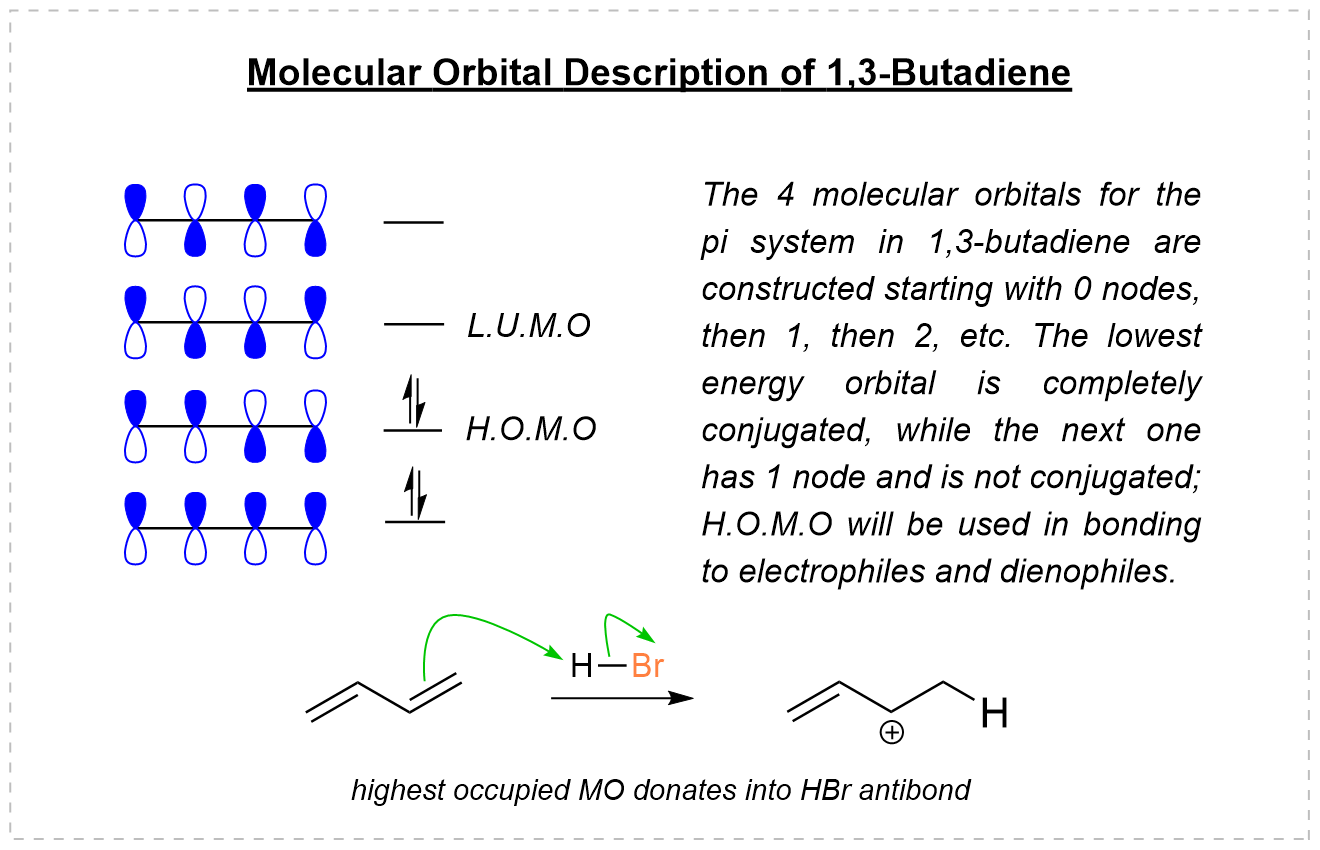
A conjugated diene has its two double bonds separated by one single bond, as in 1,3-butadiene. All four carbons are sp2 hybridized, so all four p orbitals are parallel and overlap with their neighbours; the π electrons are spread across the whole system rather than being localized. Evidence comes from the bond lengths, where the central C2–C3 bond is shorter than an ordinary single bond, and in the heats of hydrogenation, where a conjugated diene releases several kcal/mol less energy than an isolated diene of the same formula. That difference is the delocalization energy.
Partial double-bond character in the central bond has a second consequence: rotation about it is restricted, so a conjugated diene has two planar conformations. The s-trans conformation, with the two double bonds pointing in opposite directions, is the more stable and is what most acyclic dienes prefer at equilibrium. The s-cis conformation is a few kcal/mol higher because of steric interactions, but it is the only conformer that can react in a Diels–Alder cycloaddition.
Conjugated dienes are usually made the same way as simple alkenes, but with the thermodynamic preference for conjugation. Double dehydrohalogenation of a dihalide, or elimination from an allylic halide, tends to give the conjugated isomer because it has a more transition state that leads to the more stable product. Similarly, acid-catalyzed dehydration of an alcohol delivers a conjugated diene when one is possible.

The allylic cation
One intermediate carbocation, two electrophilic carbons
Protonating one end of a conjugated diene gives a carbocation next to the remaining double bond, which is now an allylic cation. The empty p orbital overlaps with the π bond, so the positive charge is delocalized over two carbons rather than localized on one. Two resonance structures describe this, with the overall resonance hybrid representing the structure more accurately. A secondary allylic cation is comparable in stability to a tertiary cation, which is why conjugated systems protonate so easily.
The practical consequence is that a nucleophile can attack at either end of the delocalized cation. The first step of addition happens at the position that gives an allylic cation, and that part follows Markovnikov reasoning as usual, but the nucleophile now has a choice of where to attack, and that choice is what produces the two products of addition. Note also that the same delocalization makes an allylic halide unusually reactive in SN1 chemistry, since ionization also generates this stabilized carbocation.
1,2- and 1,4-addition
Kinetic and thermodynamic control
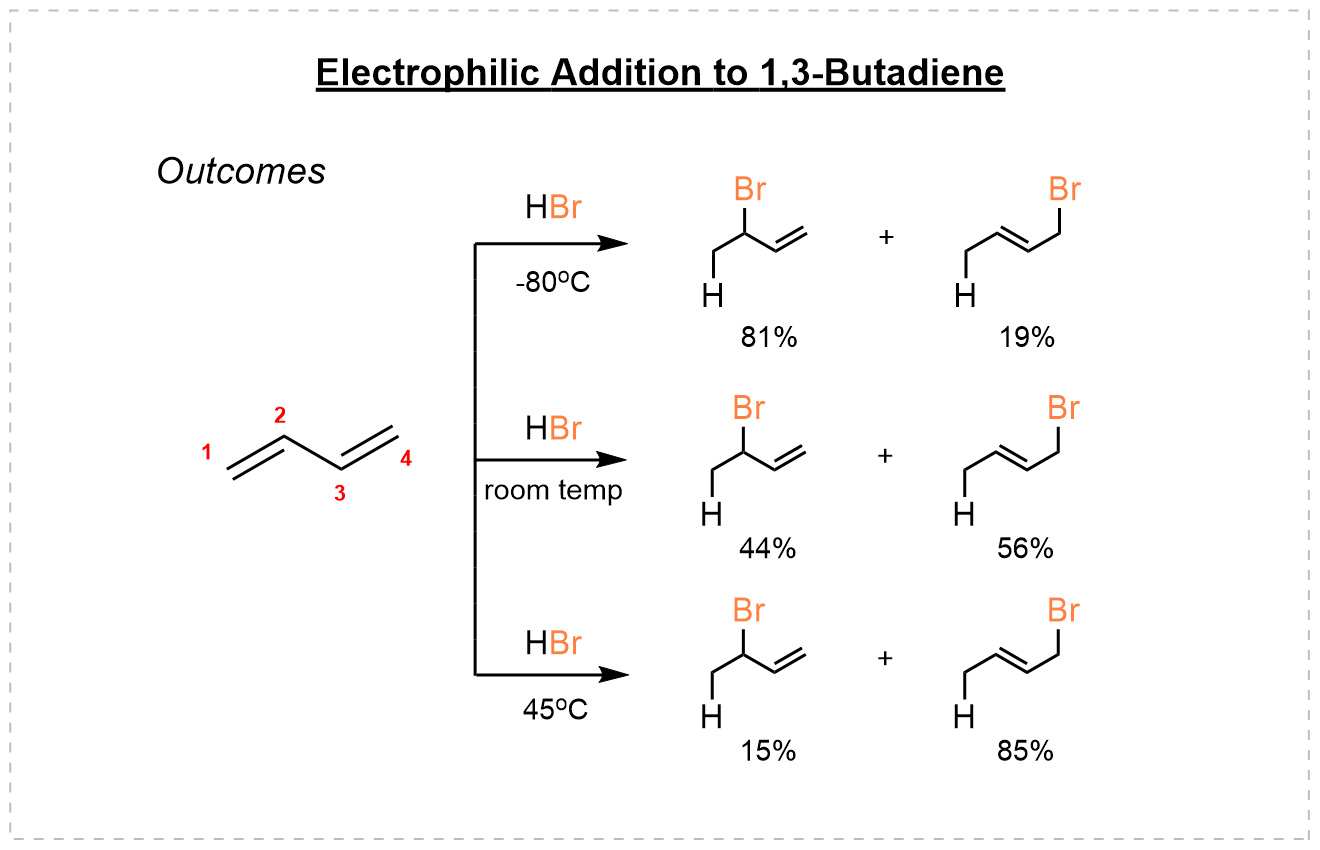
Adding one equivalent of HBr to 1,3-butadiene gives two products. Capture of bromide at the carbon adjacent to the protonated end gives the 1,2-adduct; capture at the far end of the delocalized cation gives the 1,4-adduct, in which the remaining double bond has moved to the middle of the chain. Both come from the same intermediate, so their formation may be accounted for in the same mechanism, with only a different attack in the second step.
Which isomer dominates depends on the temperature at which the reaction is run. At low temperature the 1,2-adduct predominates: bromide is captured faster at the carbon bearing more of the positive charge, and the reaction is under kinetic control because the reverse step is minimized. Warming the reaction promotes the reverse step, so the two products equilibrate through the allylic cation, and the mixture favours the more stable isomer. That is the 1,4-adduct, whose internal double bond is more highly substituted. Warm conditions therefore promote thermodynamic control.
This addition of HBr to 1,3-butadiene is the standard illustration of this phenomenon: the kinetic product is the one that forms fastest, over the lowest barrier, and the thermodynamic product is the one that is lowest in energy. They need not be the same compound and isomers are possible. The same reasoning applies to bromination of a diene with Br2, which likewise gives 1,2- and 1,4-dibromides.
The Diels–Alder reaction
Concerted cycloaddition with predictable stereochemistry
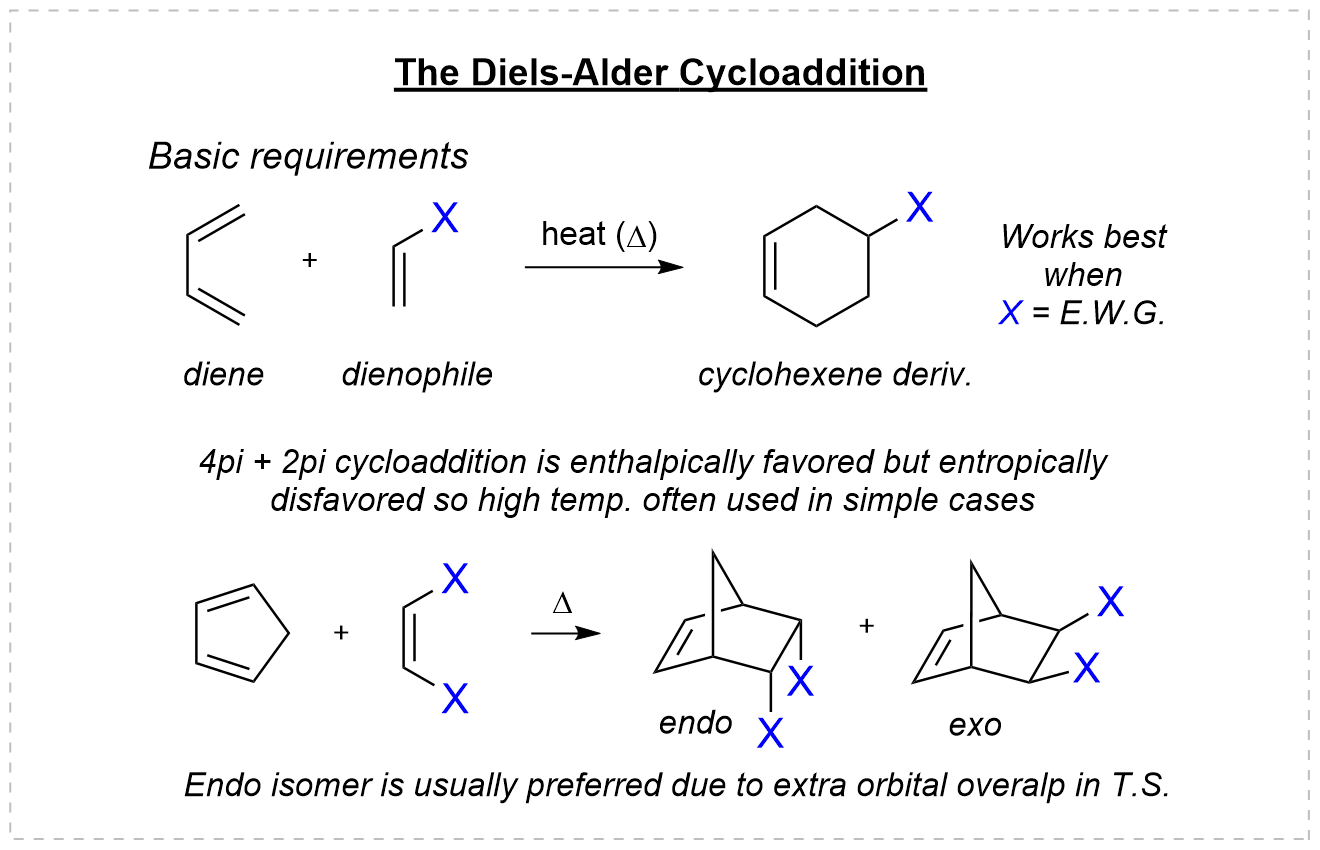
A conjugated diene and an alkene combine in one step to give a cyclohexene adduct. Four π electrons from the diene and two from the alkene, the dienophile, create a cyclic transition state; two new sigma bonds form at once and no intermediate is involved. The reaction is favoured because two π bonds are traded for two stronger σ bonds, and it works best when the dienophile carries an electron-withdrawing group, an ester, a ketone, a nitrile, etc., while the diene is usually electron-rich.
Two geometric requirements follow from the concerted mechanism. The diene must be in the s-cis conformation, since only then can both ends (the frontier orbitals) reach the dienophile; a diene locked s-trans is unreactive. A cyclic diene such as cyclopentadiene is permanently s-cis and correspondingly reactive. As a consequence of both new bonds forming on the same face of each partner, the stereochemistry of the starting materials is retained: a cis dienophile gives a cis-substituted ring, and a trans dienophile gives a trans one.
With a cyclic diene the two partners can come together in two ways, and the endo product predominates; the substituent on the dienophile tucks under the forming ring rather than pointing away from it. That preference is thought to be due to secondary orbital overlap effects between diene and dienophile pi orbitals. Together these preferences make the Diels–Alder one of the most useful ring-forming reactions available and its use in synthesis is widespread because the products are predictable.
Reference
Reaction summary
Each transformation is listed here. Read it right to left when planning a synthesis.
Self-check
Six questions before you move on
Try to work out an answer on paper, then reveal to check. If your reasoning is right but the answer is wrong, you are closer than you think.
1,3-Pentadiene releases less heat on hydrogenation than 1,4-pentadiene. Why?
Both isomers give the same alkane. The conjugated diene is stabilized by delocalization of its π electrons across all four carbons, so it is more stable and has less energy to release.
Why is the C2–C3 bond of 1,3-butadiene shorter than the C–C bond of butane, and why does that restrict rotation?
Delocalization gives the central bond partial double-bond character, which shortens it. Rotating about it would break that π overlap, so there is a barrier. The molecule prefers the planar s-trans and s-cis forms.
One equivalent of HBr and 1,3-butadiene gives mostly the 1,2-adduct at −80 °C but mostly the 1,4-adduct at 40 °C. Explain both results.
At lower temperatures we are trying to prevent equilibrium, so you see whichever product forms faster over the lower barrier. i.e. the 1,2-adduct. At higher temperatures, addition is reversible and the two products equilibrate through the allylic cation, so the more stable 1,4-adduct with its internal, more substituted alkene is preferred.
Why is a secondary allylic cation about as stable as a tertiary cation?
The empty p orbital overlaps with the adjacent π bond, so the charge is shared between two carbons rather than localized on one. Resonance delocalization of this kind is worth roughly as much as the hyperconjugation and induction that stabilize a tertiary cation.
Cyclopentadiene is a far better Diels–Alder partner than 2,3-di-tert-butyl-1,3-butadiene. Why?
The cycloaddition needs the diene to be s-cis so both ends (the frontier orbitals) can reach the dienophile. The ring holds cyclopentadiene permanently in that geometry, while bulky substituents force the acyclic diene into the s-trans conformation, where it cannot react.
A cis dienophile gives only the cis-substituted cyclohexene. What does that tell you about the mechanism?
That it is concerted. Both new σ bonds form at the same time on one face of each partner, so no intermediate exists long enough to rotate and the relative geometry of the dienophile is carried through into the product.