Enols & enolates
Synthesis and chemistry
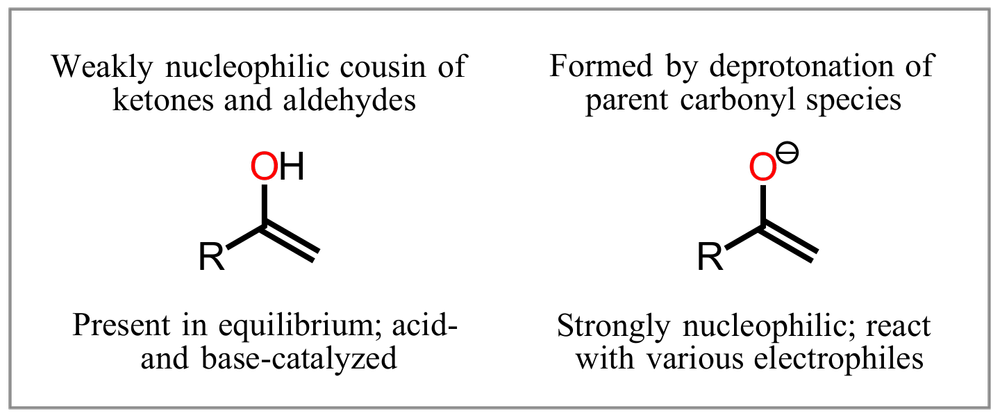
A carbonyl compound with an α-hydrogen plays an important role in synthesis. Removing that proton gives a resonance-stabilized enolate, which is a powerful nucleophile. Acid instead gives the neutral enol. Nearly all of the chemistry in this chapter is that of those two species attacking an electrophile.
Keto-enol tautomerism
Two structures in equilibrium, not resonance
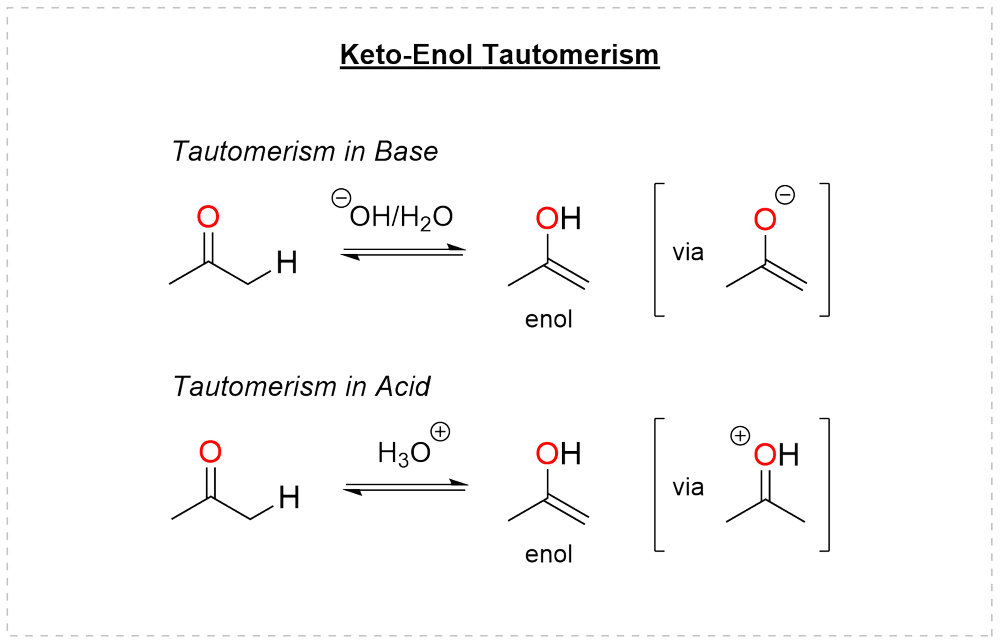
A carbonyl compound with a hydrogen on the carbon next to the carbonyl (i.e. alpha) exists in equilibrium with an isomer in which that hydrogen has moved to oxygen and a C=C has replaces the C=O. The two are tautomers, which are constitutional isomers that interconvert by moving a proton. Tautomers are not related as resonance structures; the atoms occupy different positions. Interconversion is slow without a catalyst, and both acid and base accelerate it.
In acid the carbonyl oxygen is protonated first, which makes the α-hydrogen much more acidic, and a weak base removes it to give the neutral enol. Under base the α-hydrogen is removed first to give the resonance-stabilized enolate, and protonation on oxygen then gives the same enol. In both situations, the net result is that the α-carbon has become nucleophilic.
For most simple aldehydes and ketones, at neutral pH, the equilibrium lies far towards the keto form, because a C=O is considerably stronger than a C=C. Acetone is roughly one part enol in a million. The balance shifts when the enol gains some extra stability: a 1,3-diketone such as acetylacetone is substantially enolized because its enol is conjugated and internally hydrogen bonded, and phenol is entirely "enol" because tautomerizing would lose the extra stability of the aromatic ring. A practical consequence is that an α-stereocentre next to a carbonyl racemizes on standing in acid or base, since the planar enol can be reprotonated on either face.
α-Hydrogen acidity and enolates
Acidity, LDA, and kinetic vs thermodynamic
An α-hydrogen of a ketone has a pKa near 19, an ester near 25, and an ordinary alkane near 50. The difference is related to the type of conjugate base formed: an enolate delocalizes its negative charge onto the carbonyl oxygen, so the more electronegative atom helps stabilize. Flanking a carbon with two carbonyls compounds the effect, so a β-keto ester’s pKa will be around 11 and malonic ester near 13, which are each acidic enough for an ordinary alkoxide to deprotonate them completely.
Choosing the base therefore matters. Sodium ethoxide, pKa of its conjugate acid near 16, deprotonates a simple ketone only to a small extent, which sets up an equilibrium in which a little enolate coexists with a lot of ketone. That is ideal when the added electrophile is reactive and unwanted self-condensation is not a problem. When a full equivalent of enolate is needed, lithium diisopropylamide (LDA) is used; its conjugate acid has a pKa near 36, so deprotonation is quantitative and irreversible.
When a ketone has two different α-positions, the conditions decide which enolate forms. LDA at −78 °C is bulky and reacts fastest at the less hindered α-carbon, giving the kinetic enolate, and because the deprotonation is irreversible, that enolate is then the reactive species for the next step. An alkoxide dissolved in its parent alcohol allows proton transfer back and forth from solvent until the more stable, more substituted enolate predominates, i.e. the thermodynamic enolate, favoured because its C=C carries more alkyl substituents.
α-Halogenation and α-alkylation
Acid, base, the haloform reaction, and SN2
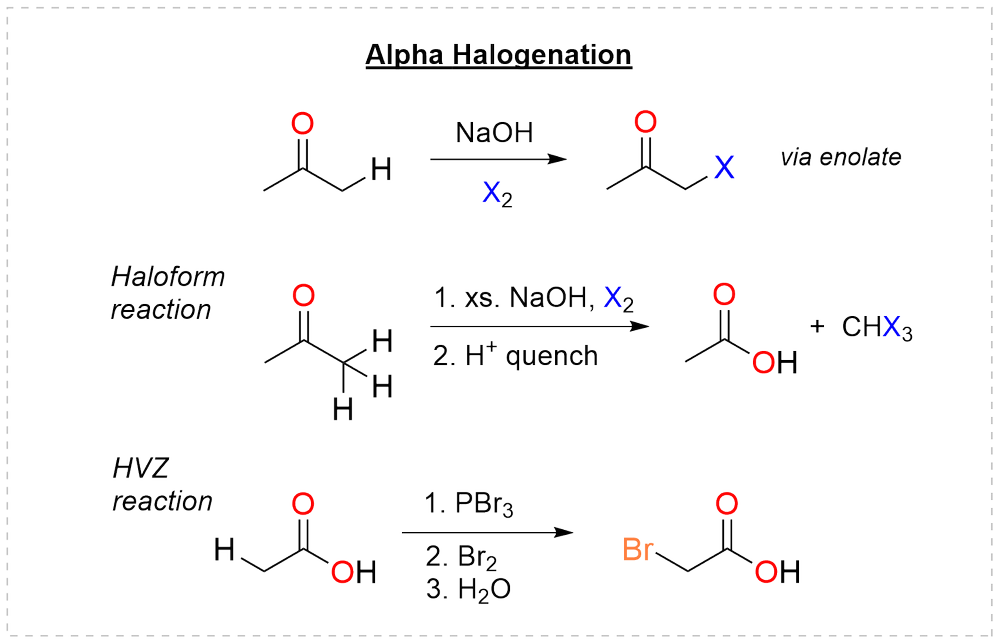
Halogenation at the alpha carbon is usually a single substitution. The enol forms in low concentration, attacks Br2 or Cl2, and gives the α-halo ketone. Carboxylic acids need help, since they enolize poorly; the Hell–Volhard–Zelinsky reaction adds PBr3 to make the acid bromide, which enolizes readily, and hydrolysis of the acyl bromide after alpha bromination produces the α-bromo acid. The halogenated products are useful electrophiles, for example substitution with an amine nucleophile is a standard route to an α-amino acid.
In base, the same alpha-halogenation reaction goes further. Each halogen added makes remaining α-hydrogens more acidic, so a methyl ketone is halogenated three times. Hydroxide then attacks the carbonyl and expels the CX3– anion, which is stabilized enough to leave. After deprotonation of the thus-formed carboxylic acid, the products are a carboxylate and a haloform; with iodine the yellow CHI3 precipitate is a classical test for a methyl ketone being present in a molecule.
Alkylation of the enolate nucleophile is also possible in an SN2 reaction. LDA deprotonates and generates the enolate quantitatively, and a methyl or primary halide or tosylate then alkylates to deliver the α-alkyl carbonyl compound. Secondary halides are sluggish and crowded tertiary ones eliminate, because the enolate is also a base. Where a simple ketone enolate is troublesome, a β-keto ester or malonic ester is alkylated instead with an alkoxide base, and hydrolysis with heat then removes the auxiliary ester by decarboxylation through its enol, as in the acetoacetic ester and malonic ester syntheses (see Section 06 below).
Aldol and Claisen condensations
Enolate attacks carbonyl: addition, condensation, and substitution
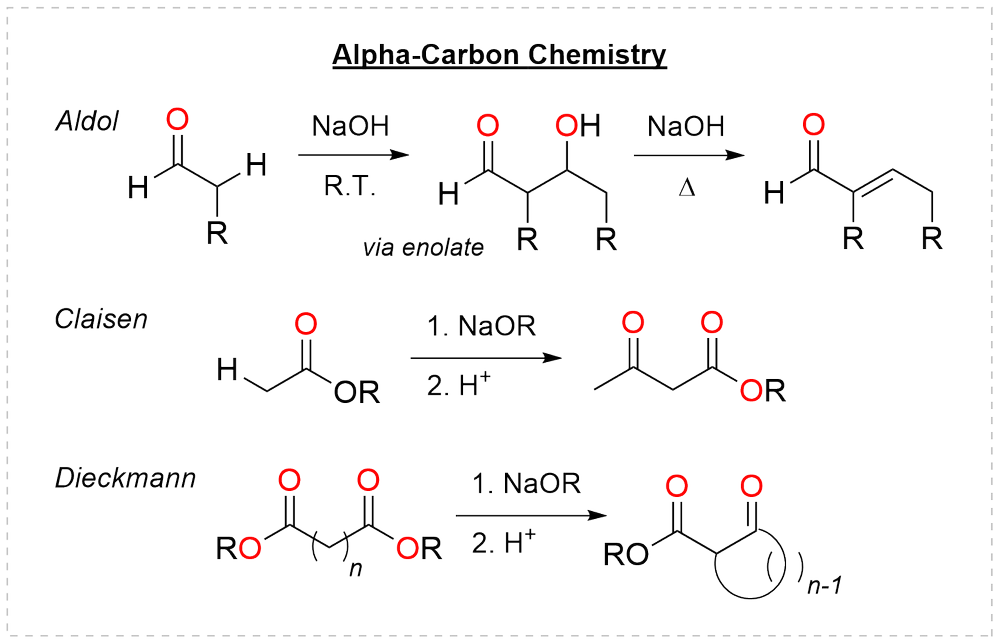
In an aldol reaction one carbonyl compound becomes the enolate and attacks another acting as the electrophile, giving a β-hydroxy aldehyde or ketone. Every step is reversible, and for aldehydes the addition equilibrium is favourable, so cold dilute base gives the addition product; for most ketones it is not, because the ketone electrophile and the aldol products are more crowded. Heating changes the outcome, since the aldol product still has an acidic α-hydrogen, and removing it allows hydroxide to leave from the β-position by an E1cb pathway. The conjugated α,β-unsaturated product makes that dehydration effectively irreversible, which is what pushes an unfavourable ketone aldol through to an isolable product.
A crossed aldol between two different carbonyl compounds, each with α-hydrogens, would give four products, which is of little practical use. To prevent this, we use a partner with no α-hydrogen as the electrophile, such as benzaldehyde or formaldehyde. Alternatively, forming one enolate quantitatively with LDA at low temperature and only then adding the other carbonyl compound allows for a clean crossed aldol process. When both component carbonyls are in one molecule the same crossed aldol reaction closes rings. An intramolecular aldol of a 1,5-diketone gives a cyclohexenone, since five- and six-membered rings form preferably to other sizes.
The Claisen condensation is the ester version of this process, but it ends in substitution rather than addition, because an ester has a leaving group where the aldehyde or ketone did not. An alkoxide removes an α-hydrogen, the subsequent ester enolate attacks a second ester, and the tetrahedral intermediate collapses by expelling alkoxide to give a β-keto ester. We match the alkoxide to the ester, e.g. ethoxide with an ethyl ester, so that transesterification does not lead to mixtures. Every step to that point is reversible and the reaction is driven to product by the final deprotonation of the β-keto ester, whose central hydrogen has a pKa near 11. That doubly stabilized enolate is the thermodynamic sink, which is why a full equivalent of base is consumed, why an acidic workup is needed, and why an ester with only one α-hydrogen fails to condense.
Two variants extend the utility of this raection. The Dieckmann condensation is the intramolecular case, closing a 1,6- or 1,7-diester to a five- or six-membered cyclic β-keto ester. While a mixed Claisen pairs an ester with no α-hydrogen, such as diethyl carbonate or ethyl formate, with one that has them attached, so only one enolate is possible. The β-keto ester product can be alkylated at the central carbon and then hydrolyzed and heated, losing CO2 through a cyclic transition state to give a ketone.
Conjugate addition
Michael donors, acceptors, and Robinson annulation
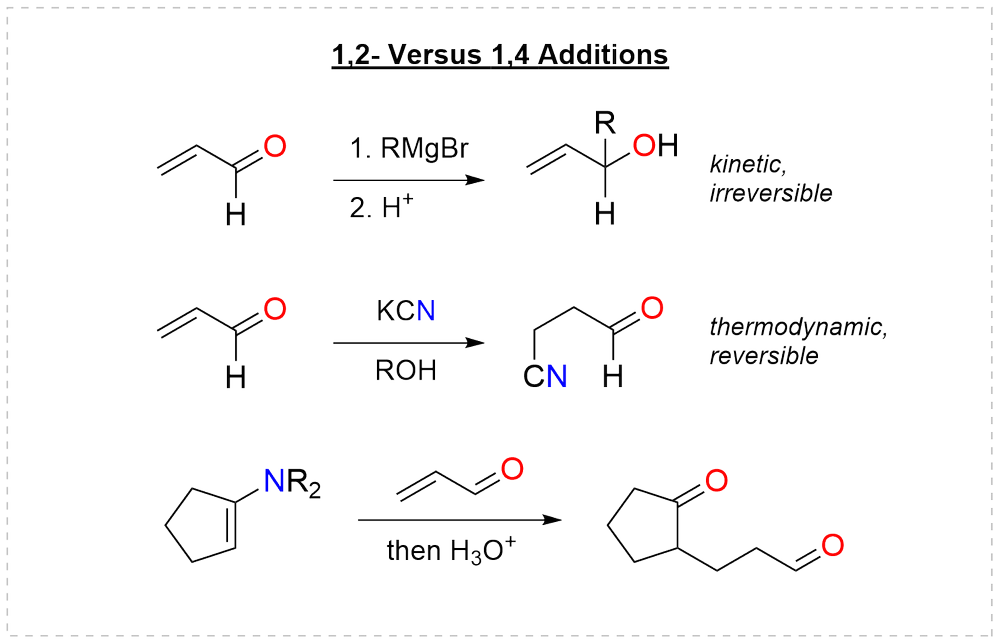
An α,β-unsaturated carbonyl compound is electrophilic at two places. Resonance puts positive character on the carbonyl carbon and on the β-carbon, so a nucleophile may add 1,2 to give an alcohol or 1,4 to give, after tautomerization, the saturated carbonyl compound with a new substituent at the β-position. Which product dominates depends on the nucleophile: hard, strongly basic reagents such as Grignard reagents and LiAlH4 tend towards 1,2-addition, while softer, weaker nucleophiles add at the beta carbon.
The Michael reaction is the case when enolates are used. A stabilized enolate, from a β-keto ester, a malonate, or a nitroalkane, is generated with a catalytic amount of alkoxide and then adds 1,4 to the enone, giving a 1,5-dicarbonyl compound. The donor is deliberately chosen to be weakly basic so that it adds as a nucleophile rather than deprotonate, and the reaction is reversible enough to favour the conjugate product. Although via a different mechanism, Gilman cuprates behave the same way for simple alkyl groups, and cyanide and amines also add in the conjugate sense.
A Robinson annulation brings the two ideas of conjugate addition and aldol condensation together to build a fused six-membered ring. A ketone enolate adds at the beta carbon to methyl vinyl ketone or a similar acceptor, which produces a 1,5-diketone, and warming the same mixture in base causes cyclization via an intramolecular aldol condensation to give a cyclohexenone. It is a standard route into steroid and terpene skeletons, and is not as complicated as it appears; Michael first, aldol second, both in the same basic environment.
Malonic and acetoacetic ester syntheses
Alkylate a stabilized enolate, then remove the ester
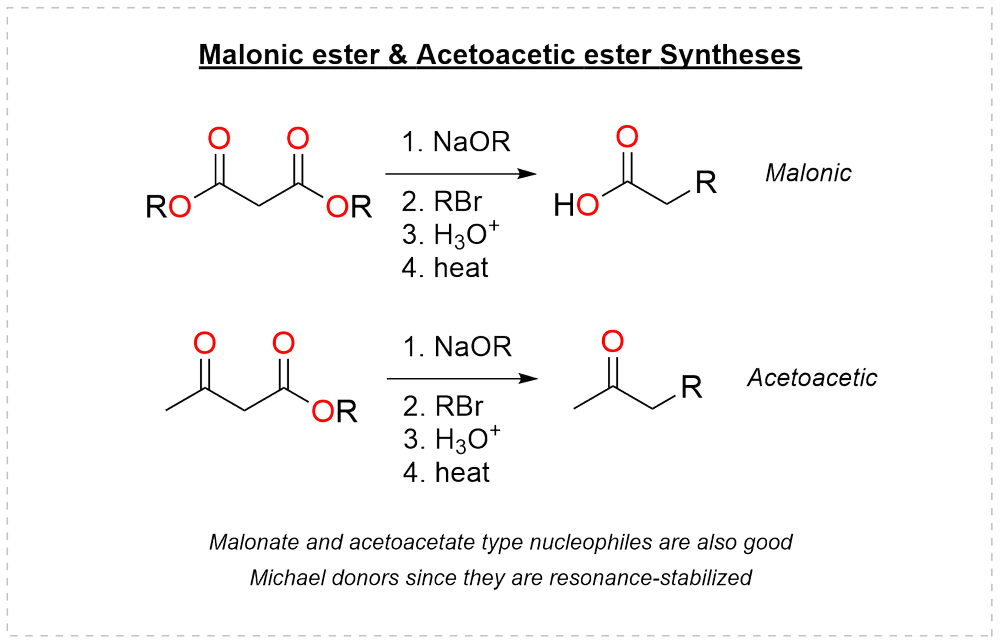
Alkylating a simple ketone enolate requires LDA and low temperature. A doubly stabilized enolate is far easier to produce, and both of these named syntheses exploit that. Diethyl malonate has a central hydrogen with a pKa near 13 and ethyl acetoacetate near 11, so an ordinary alkoxide base deprotonates either one completely. The resulting enolate is stable enough to sit in solution and is alkylated cleanly by a methyl or primary halide by SN2.
The extra ester has served its purpose once the alkyl group is attached, and it is removed in the last two steps. Aqueous acid hydrolyzes the ester to a carboxylic acid, and heating the resultant β-keto acid or malonic acid drives loss of CO2 through a six-membered cyclic transition state, passing through an enol that tautomerizes to the carbonyl product. Malonic ester therefore delivers a substituted acetic acid, and acetoacetic ester delivers a substituted methyl ketone. In each case the net result is an α-alkylated carbonyl compound made without the need for using a very strong amide base.
Alkylating twice in between the two carbonyls of the starting 1,3-dicarbonyl substrate, with two different halides before the hydrolysis, gives a disubstituted product, and a dihalide used here results in a cycle. The same stabilized enolates are also the standard Michael donors of the previous section, they are resonance-stabilized and weakly basic enough to undergo conjugate addition to an enone rather than deprotonate it. Recognizing the four-step sequence; base, halide, hydrolysis, heat, is usually enough to work backwards from the target.
Reference
Reaction summary
Each transformation is listed here. Read it right to left when planning a synthesis.
Self-check
Six questions before you move on
Try to work out an answer on paper, then reveal to check. If your reasoning is right but the answer is wrong, you are closer than you think.
Why are keto and enol forms called tautomers rather than resonance structures?
Resonance structures differ only in where electrons are placed; the atoms are in identical positions. Keto and enol forms differ in the position of a hydrogen atom and of a π bond, so they are distinct compounds in equilibrium with one another. Interconversion requires an actual proton transfer, which is why it needs acid or base catalysis.
An α-hydrogen of a ketone has a pKa near 19 while an ordinary C–H is near 50. Account for the difference.
Removing an α-proton gives an enolate in which the negative charge is delocalized onto the carbonyl oxygen, and oxygen carries charge far better than carbon. That resonance stabilization of the conjugate base is worth roughly thirty pKa units. A β-keto ester, flanked by two carbonyls, drops further still to about 11.
You need the enolate at the less hindered α-carbon of 2-methylcyclohexanone. What conditions do you use?
LDA in THF at −78 °C, one equivalent. The base is strong and bulky, so it removes the more accessible proton and the deprotonation is irreversible, giving the kinetic enolate. An alkoxide dissolved in its parent alcohol would set up an equilibrium and deliver the more substituted thermodynamic enolate instead.
Why does an aldol condensation need heat while the addition step does not?
The addition gives a β-hydroxy carbonyl and it works in cold, dilute base since a pi bond is swapped for sigma. Losing water requires deprotonation at the α-carbon and expulsion of hydroxide by an E1cb pathway, which is uphill until the conjugated enone forms. Heating supplies that energy, and the resulting conjugation makes the condensation effectively irreversible.
A Claisen condensation must be run with at least one full equivalent of alkoxide. Why?
Every step before the last is reversible and unfavourable, so the reaction is only driven forward when the β-keto ester product, whose central C–H has a pKa near 11, is deprotonated by the base. That final deprotonation is the thermodynamic sink, so a stoichiometric amount of alkoxide is consumed. An acidic workup returns the neutral β-keto ester.
Both a Grignard reagent and cyanide react with an enone. Why do they give different products?
A Grignard reagent is strongly nucleophilic and hard, so it attacks the carbonyl carbon directly and gives the 1,2-addition product, an allylic alcohol. Cyanide is softer and less reactive, so it adds at the β-carbon reversibly. The enolate that results is protonated on workup to give the thermodynamically favoured saturated ketone with a new β-alkyl group.