Ethers & epoxides
Synthesis and chemistry
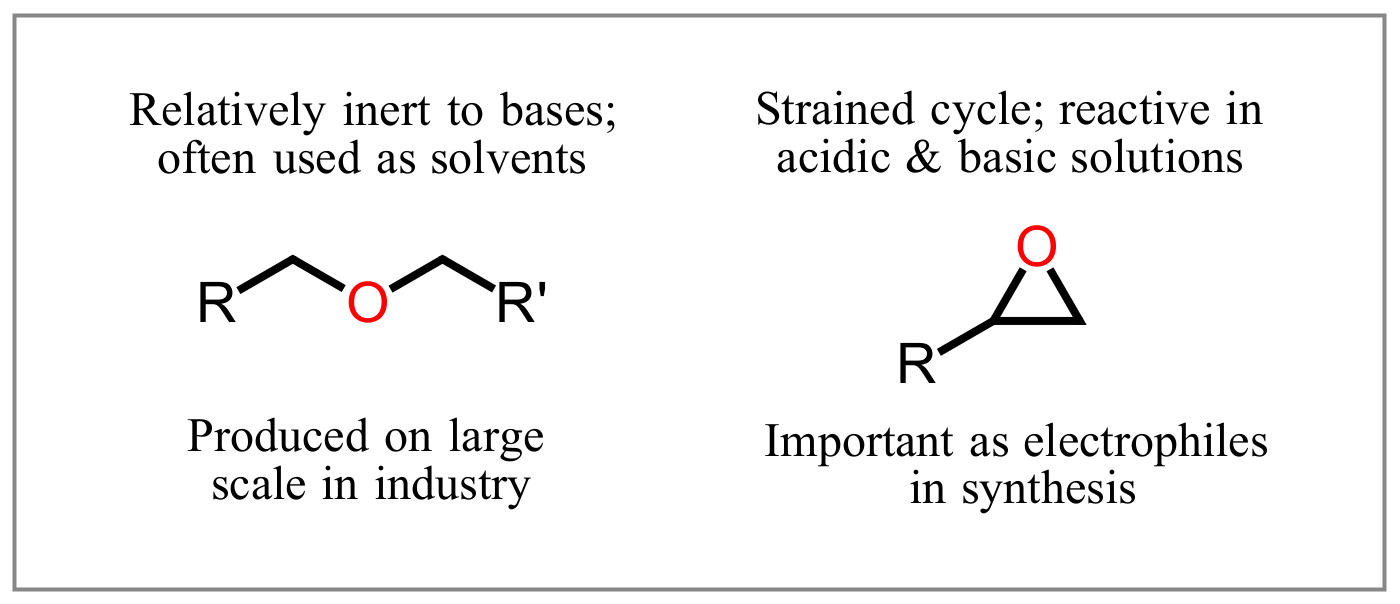
Ethers and epoxides are two functional groups with a common C–O–C linkage, yet they react quite differently. Simple ethers are relatively inert, which is why they are used as solvents. Put the oxygen atom into a three-membered ring and the strain makes it one of the most useful electrophiles in synthesis. The sections below work from the preparation of ethers to the stereochemistry of epoxide ring opening.
Preparation of ethers
Acid-catalyzed and base-promoted routes
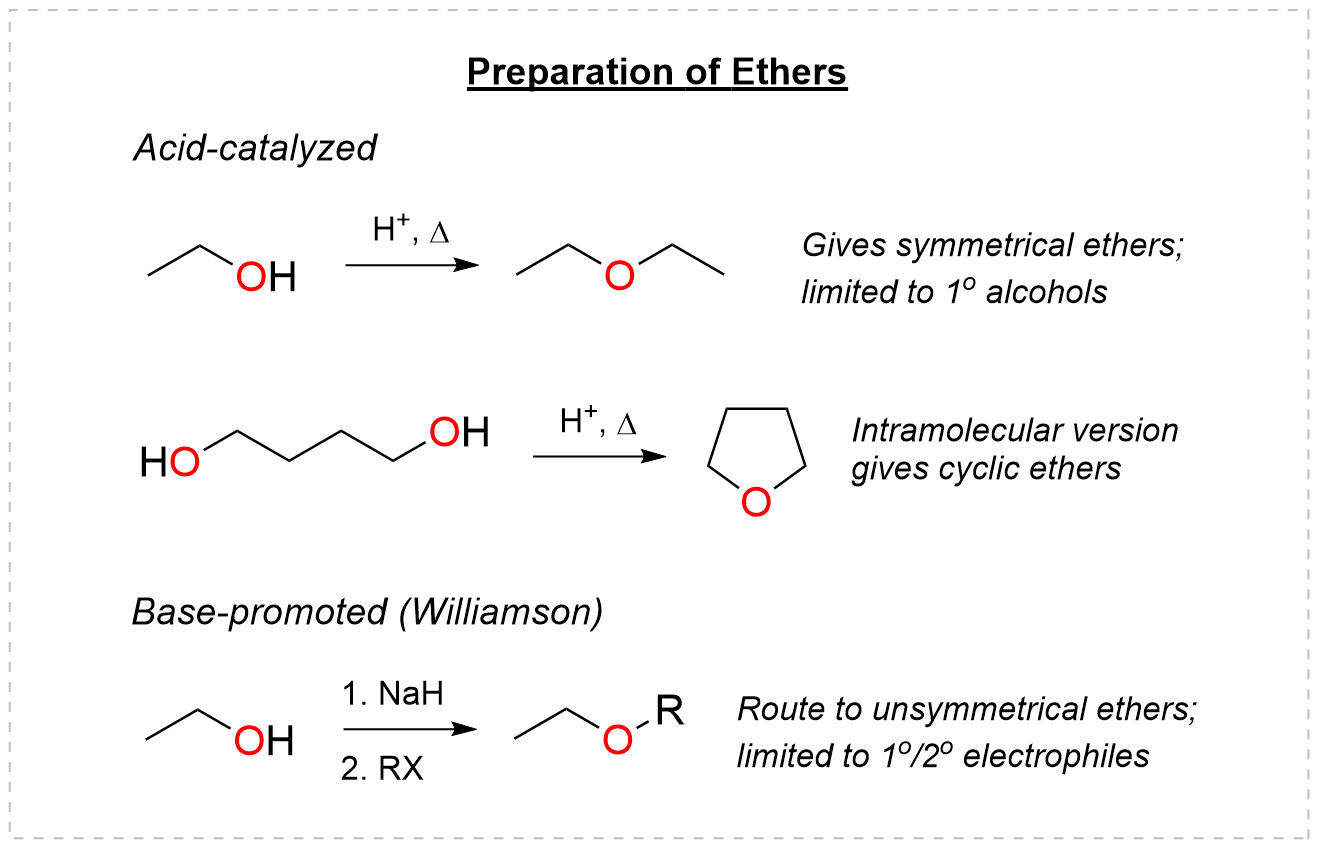
Heating a primary alcohol with acid condenses two molecules into an ether, but the two halves come from the same starting material, so only symmetrical ethers are available. The scope is narrow, however; secondary and tertiary alcohols eliminate to give alkenes instead. Running the same reaction with a diol causes intramolecular cyclization to give a cyclic ether such as tetrahydrofuran (THF).
The Williamson synthesis is a more general method. Deprotonation of the alcohol with a base such as NaH gives the alkoxide, then adding an alkyl halide allows the alkoxide to displace the halide by SN2. Because the alkoxide and the electrophile may be different, unsymmetrical ethers are possible. The SN2 step is an obvious limitation with primary and secondary electrophiles working, while tertiary substrates undergo elimination.
Reactions of ethers
Cleavage and autooxidation
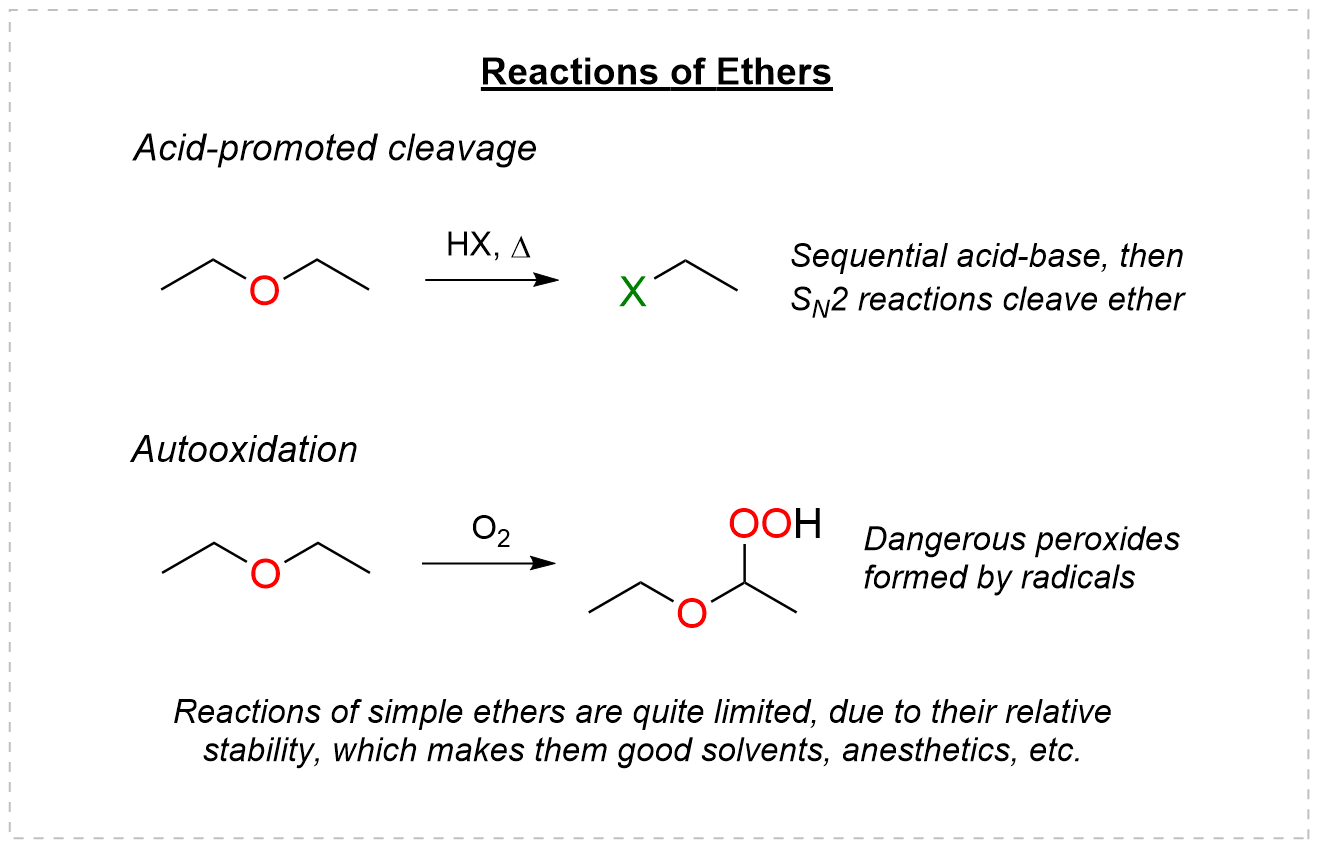
Simple ethers have very little chemistry, since they are neither strong electrophiles or nucleophiles. Their stability is what makes them good solvents and, historically, anesthetics. The one reaction worth knowing is cleavage by hot HX. Protonation of the ether oxygen is a sequential acid–base step that converts a poor leaving group into a good one, and the halide then displaces the alcohol by SN2.
The second reaction is a practical hazard rather than a synthetic tool. On standing in air, ethers undergo radical autooxidation at the carbon next to oxygen to give hydroperoxides. Those peroxides concentrate as the solvent evaporates and are explosive, which is why old bottles of ether and THF are treated with caution.
Preparation of epoxides
Peroxyacids and halohydrins
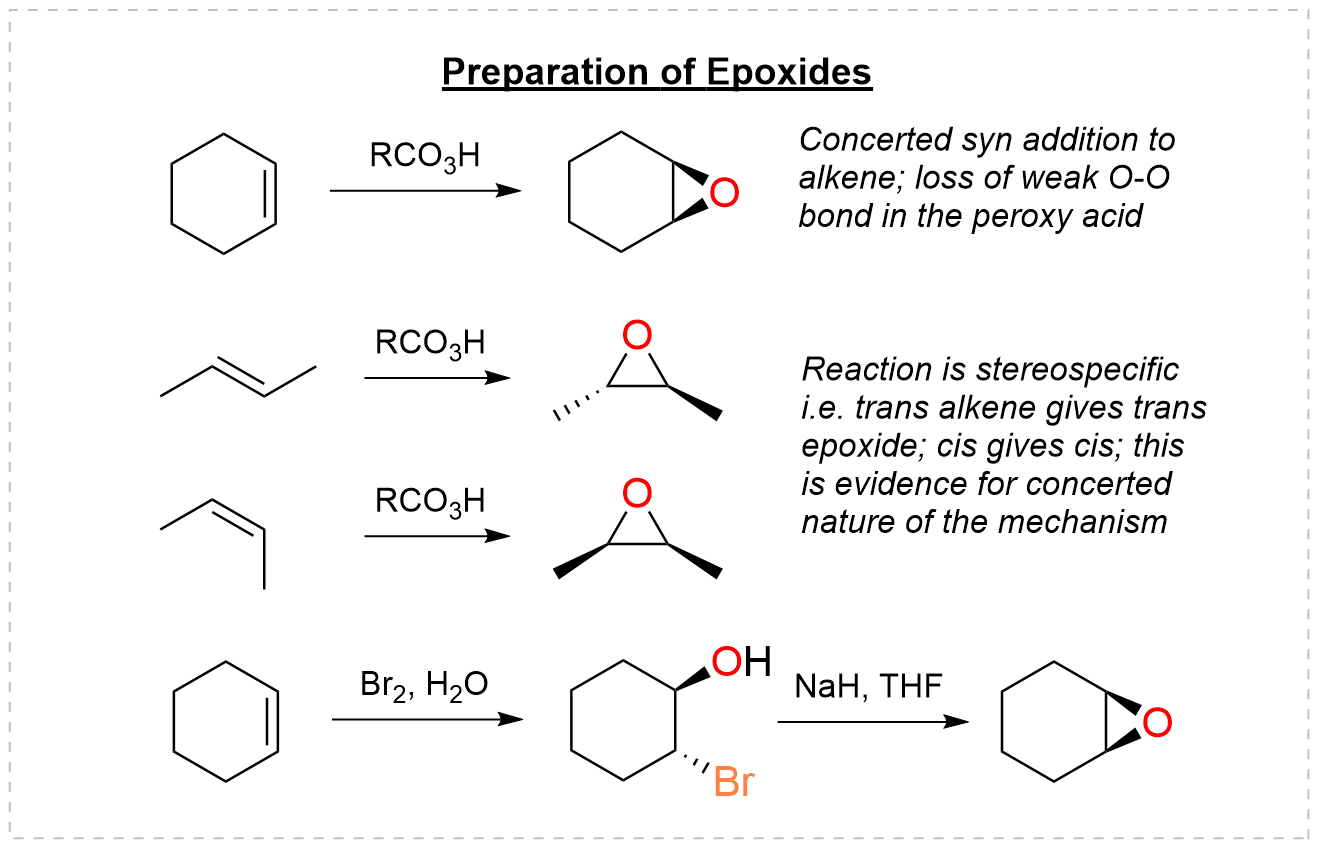
A peroxyacid, RCO3H, delivers a single oxygen atom to an alkene in one concerted step; the driving force being loss of the weak O–O bond in the peroxyacid. Both new C–O bonds form on the same face at the same time, the addition is a syn addition and the reaction is stereospecific. A trans alkene gives the trans epoxide and a cis alkene gives the cis epoxide, which is evidence that the mechanism is actually concerted. A stepwise process would involve an intermediate species, in which bonds would be free to rotate, and the alkene stereochemistry from the starting material would be lost.
A two-step alternative for making epoxides goes through a halohydrin. Br2 in water adds across an alkene in an anti fashion to give a bromo alcohol. A strong base such as NaH (in THF) then deprotonates the hydroxyl and the alkoxide displaces the bromide intramolecularly. That closure is for all intents and purposes an SN2 (it's actually unimolecular), so it requires the two groups to be aligned anti, which is actually the result in the first step.
Ring opening under basic conditions
SN2 control, pH above 7
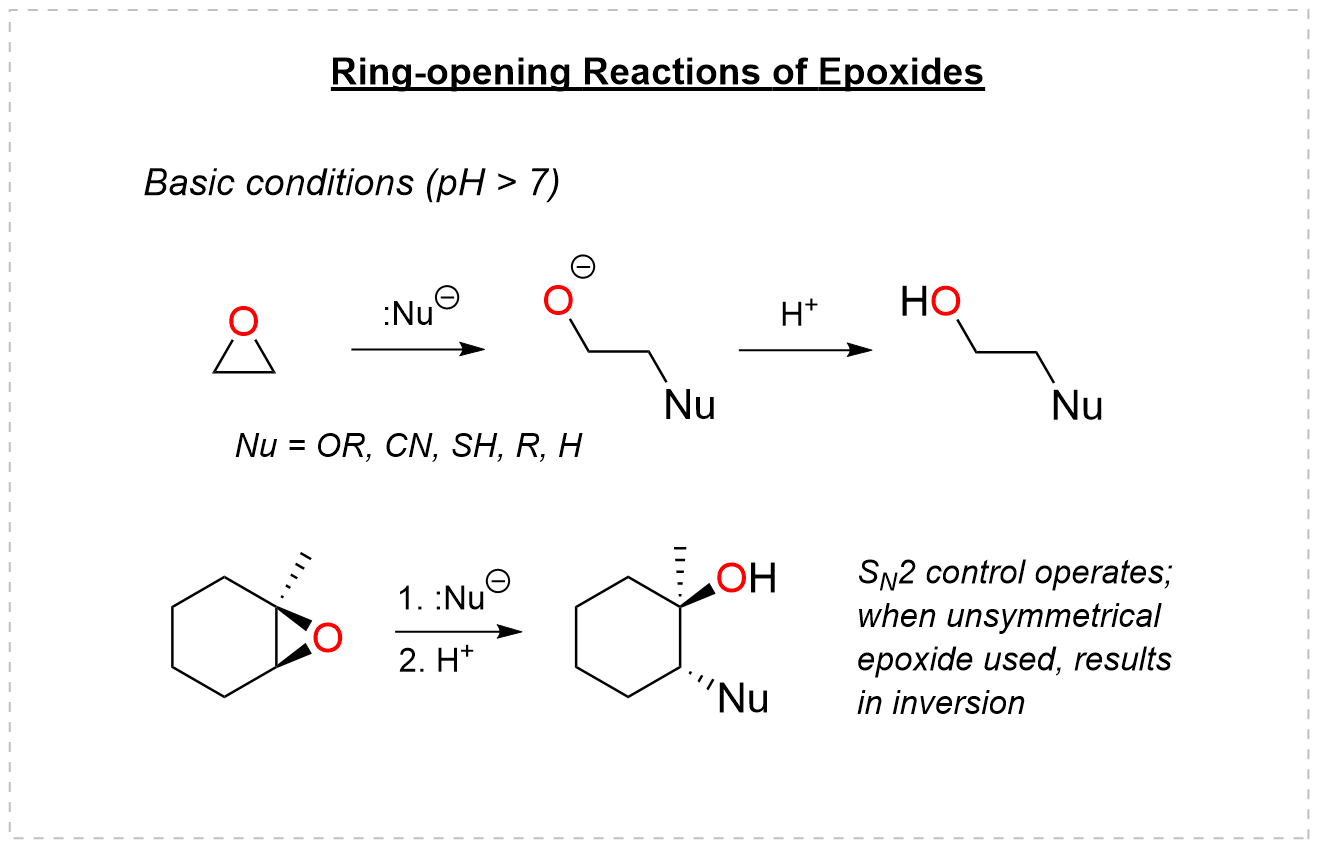
Above pH 7 the epoxide is not protonated, but a strong nucleophile can attack the strained ring directly. Ring strain is enough to make the cycle reactive, and the nucleophile opens the epoxide to give an alkoxide. In a separate acidic workup a protonation gives the alcohol product. Note the order of the two steps here, because it reverses under acid. A wide range of basic nucleophiles work here, including OR, CN, SH, R and H.
With an unsymmetrical epoxide, steric environment dictates which carbon is attacked, so the nucleophile goes to the less hindered end under SN2 control. The attack is from the back side, so the product shows inversion at that carbon. As a consequence, the nucleophile and the new hydroxyl that results end up trans to one another.
Ring opening under acidic conditions
SN1 control, pH below 7
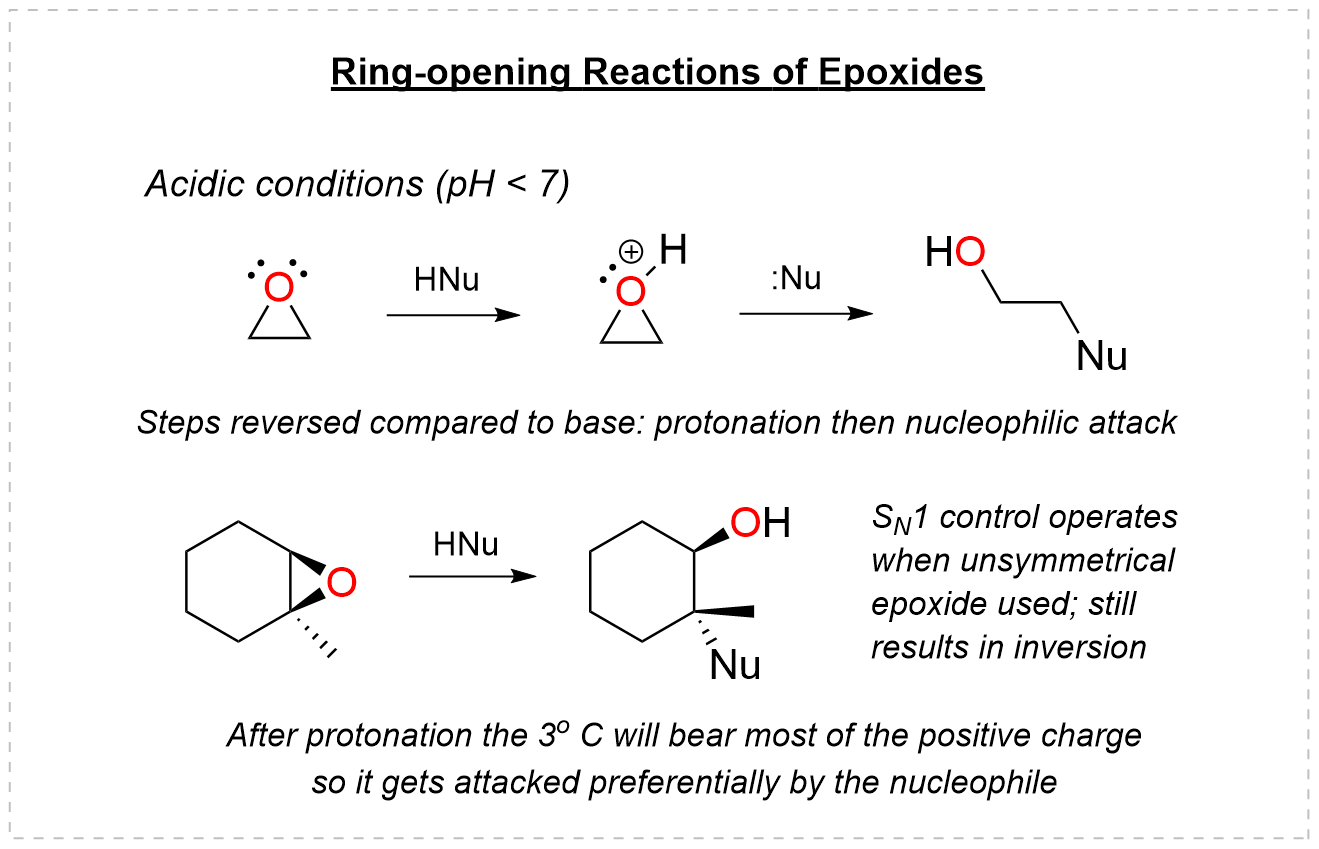
Below pH 7 the same two events happen but in the opposite order: protonation of the epoxide first, then a weak neutral nucleophile attacks. Protonation of the oxygen makes the ring more electrophilic and reactive, which is what allows a poor nucleophile such as an alcohol or water to open it up. Since the ring oxygen was already protonated, the hydroxyl appears directly in the product, and there is no need for a separate quench step.
Regiochemistry flips as well. Once protonated, the more substituted carbon carries most of the positive charge, so that is where the nucleophile attacks; this is SN1-like control. The attack is still from the opposite face, so the product shows inversion at the attacked carbon. Acidic and basic conditions therefore give two complementary regiochemical outcomes from the same epoxide.
Reference
Reaction summary
Each transformation is listed here. Read it right to left when planning a synthesis.
Self-check
Six questions before you move on
Try to work out an answer on paper, then reveal to check. If your reasoning is right but the answer is wrong, you are closer than you think.
You need ethyl isopropyl ether. Why will acid-catalyzed condensation not give it, and what will?
Acid condensation of alcohols only works efficiently for symmetrical ethers. Use the Williamson synthesis: make one alkoxide with NaH and add the other halide as the electrophile.
In a Williamson synthesis you may choose which partner is the alkoxide and which is the halide. When does the choice matter?
Whenever one partner is tertiary. The electrophile has to be capable of reacting in an SN2 reaction, so put the hindered group on the alkoxide side and keep the halide primary or secondary.
A cis alkene treated with RCO3H gives only the cis epoxide. What does that tell you about the mechanism?
It is concerted. Both C–O bonds form on the same face in a single step, so the alkene geometry is carried straight through to the product; a stepwise route would scramble it.
Why must the halohydrin route to an epoxide start with an anti addition of Br2 and water?
The ring closure is an intramolecular SN2. The alkoxide has to reach the backside of the C–Br bond, which is only possible if the OH and the Br are anti to each other.
2-Methyl-1,2-epoxypropane is opened by methanol, in one reaction using NaOMe and in another using H2SO4. Do the two products differ?
Yes; the products are regioisomers. Methoxide attacks the less hindered CH2 under SN2 control; in acid the protonated epoxide puts more of the positive charge on the tertiary carbon, so methanol attacks there instead.
Simple ethers are mostly inert, yet epoxides react with both acids and bases. Same C–O–C linkage, so what is different?
Ring strain. The three-membered ring has enough potential energy that opening it is favourable even without activation, so a nucleophile alone can do it. An open-chain ether has no such driving force and needs strong acid and heat.