Organometallics
Synthesis and chemistry
A bond between carbon and a metal puts electron density onto carbon and turns it into a nucleophile. This polarization is what makes organometallic reagents highly useful tools for building carbon–carbon bonds, and the choice of metal is what decides how reactive and how selective the reagent will be.
Bonding and polarity
Why a carbon–metal bond makes carbon nucleophilic
An organometallic compound has a bond between carbon and a metal, and everything about its reactivity follows from the polarity of that bond. Carbon is more electronegative than most metals, so the shared electrons sit closer to carbon and the carbon carries partial negative charge. That is the reverse of the situation in an alkyl halide, and it is what makes these reagents so useful; they supply a nucleophilic, effectively carbanionic carbon that can attack an electrophile and create a new carbon–carbon bond.
How carbanion-like the carbon behaves depends on the metal. Lithium and magnesium differ enough from carbon in electronegativity that the bond is very polarized, and organolithiums and Grignard reagents behave as very strong bases as well as strong C-nucleophiles. Zinc, copper, tin, and boron are all closer to carbon in electronegativity, so their bonds are more covalent and the reagents are much milder and far more selective. Choosing the metal is therefore how you select the reactivity of the organometallic reagent.
The strongly basic reagents are destroyed by any acidic hydrogen, which is why they must be prepared and then used in dry, aprotic solvents such as ether or THF, usually under an inert atmosphere. Water, alcohols, carboxylic acids, terminal alkynes, and even amines will simply protonate the carbanion and give the alkane back. Any of those groups elsewhere in the molecule has to be protected first, or a milder organometallic used instead.
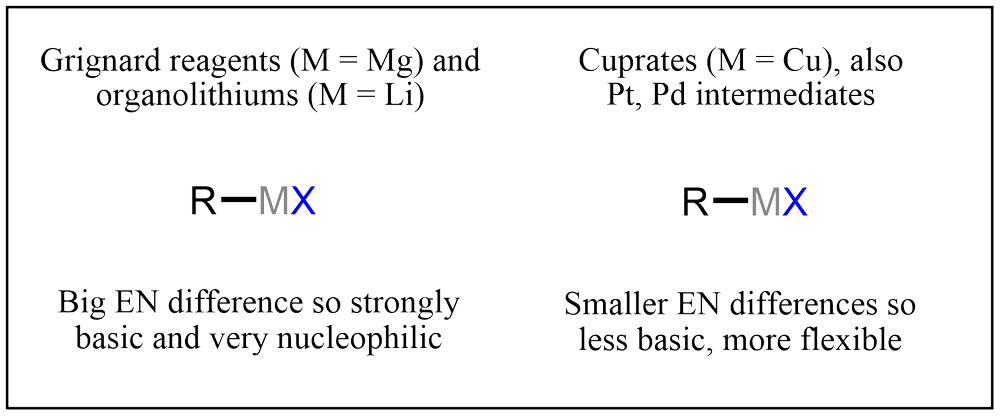
Organolithium, Grignard, and cuprate reagents
Preparation, carbonyl addition, and conjugate addition
A Grignard reagent is made by stirring an alkyl, vinyl, or aryl halide with magnesium metal in dry ether; the metal inserts into the carbon–halogen bond to give R–Mg–X. Organolithiums are made the same way but with two equivalents of lithium, or more often by deprotonating a suitably acidic C–H with an existing alkyllithium, or by halogen–metal exchange with n-butyllithium at low temperature.
These reagents add to most carbonyl electrophiles. An aldehyde gives a secondary alcohol and a ketone gives a tertiary alcohol after aqueous workup, because the tetrahedral alkoxide formed on addition has no leaving group and simply needs to be protonated. Formaldehyde gives a primary alcohol one carbon longer than the organo-metallic precursor. Carbon dioxide gives a carboxylic acid, and an epoxide opens at the less hindered carbon to give an alcohol extended by two carbons.
An ester or an acid chloride needs two equivalents of reagent. The first addition gives a tetrahedral intermediate that can expel an alkoxide or chloride, regenerating a ketone that is also reactive, so a second equivalent adds at once and the product is a tertiary alcohol carrying two identical new groups. A nitrile adds only once, since the resulting metalated imine is not electrophilic, and hydrolysis of it gives a ketone.
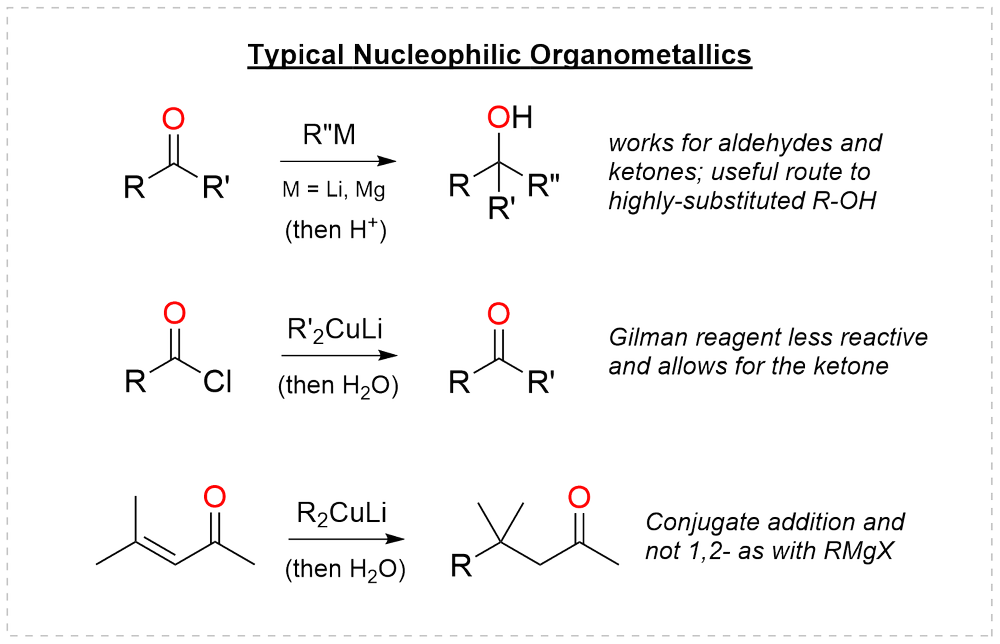
The high reactivity that makes organolithiums useful also makes them unselective. Transmetalating to a less electropositive metal tames them. For example, treating two equivalents of an organolithium with copper(I) iodide gives a lithium dialkylcuprate, R2CuLi, the Gilman reagent, which is a good nucleophile but a much weaker base.
The most valuable consequence of taming reactivity is regiochemical control. An α,β-unsaturated ketone offers two electrophilic sites, the carbonyl carbon and the β-carbon. A Grignard reagent or organolithium attacks the carbonyl directly and gives the 1,2-addition product, however a cuprate adds to the β-carbon and gives the 1,4-product after tautomerization. Having both options means a single enone can be elaborated in either direction by changing only the metal.
Cuprates are also the reagents of choice for coupling with an alkyl halide, where they displace halide cleanly on methyl and primary substrates, and for opening epoxides. Organozinc reagents, made from an α-halo ester and zinc in the Reformatsky reaction, are mild enough to tolerate an ester in the same molecule, which no Grignard reagent would allow.
Carbenes and cyclopropanation
A DIVALENT CARBON, AND A ZINC CARBENOID
A carbene is a neutral carbon with two bonds and two non-bonded electrons, it is an electron-deficient species that reacts with anything electron rich. Dichlorocarbene is generated by treating chloroform with a strong base such as potassium tert-butoxide; deprotonation gives the trichloromethyl anion, which then expels chloride. Diazomethane and diazo esters lose N2 on photolysis or metal catalysis to give the corresponding carbene.
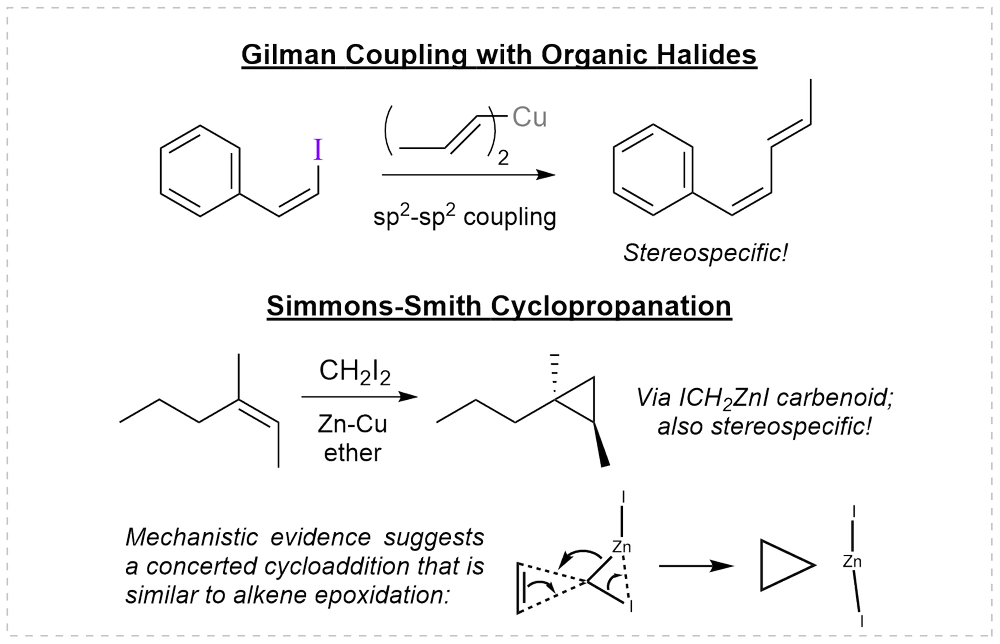
A characteristic reaction of carbenes is addition across a double bond to give a cyclopropane. A singlet carbene adds in a single concerted step, so both new bonds form on the same face and the stereochemistry of the alkene is carried into the product unchanged. This stereospecificity is the diagnostic test for a concerted addition.
Free carbenes are difficult to control, so the Simmons–Smith reaction is often used instead. Diiodomethane and a zinc–copper couple give iodomethylzinc iodide, a carbenoid that then delivers CH2 to an alkene with the same stereospecificity but without the side reactions of a free carbene, and with useful tolerance of nearby functional groups. A hydroxyl group adjacent to the alkene even accelerates the reaction and directs it to one face.
Palladium-catalyzed cross-coupling
ONE CATALYTIC CYCLE EXPLAINS A FAMILY OF REACTIONS
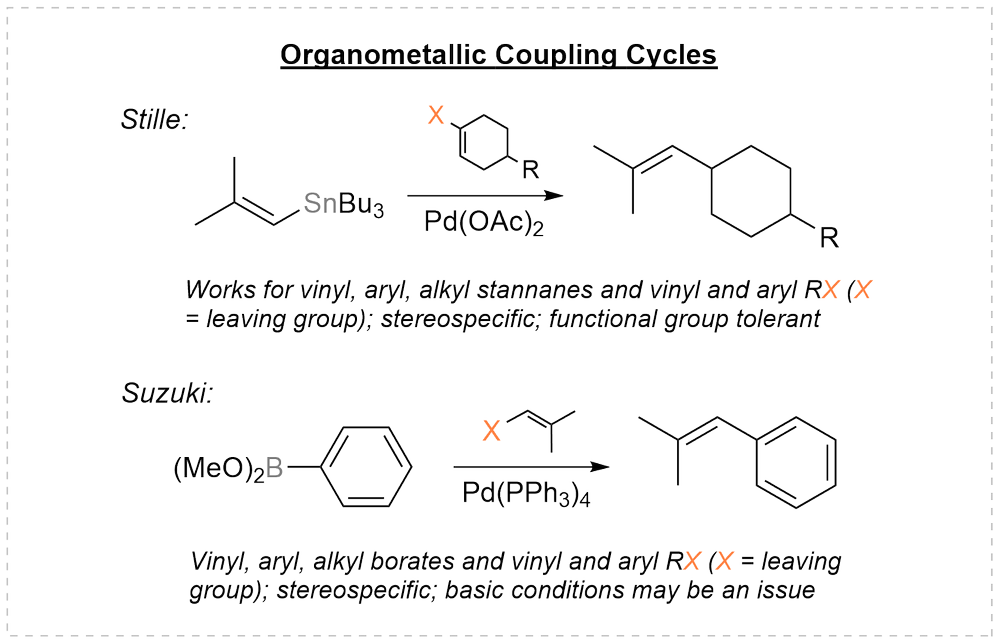
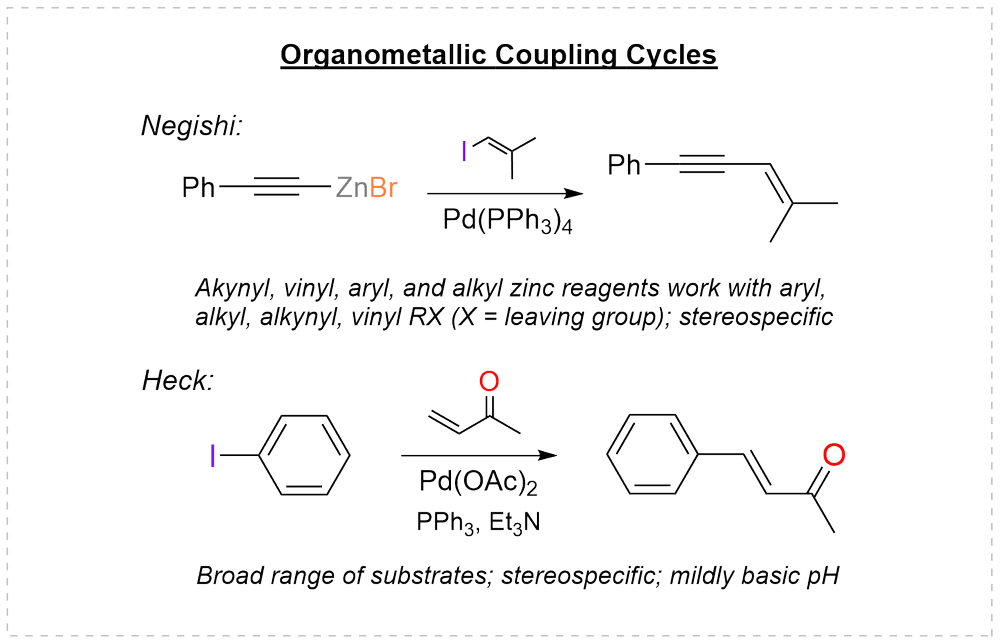
Organometallic cross-coupling joins two fragments, one carrying a halide or triflate and the other a metal, using a palladium catalyst that is regenerated at the end. The cycle has three steps. Firstly, oxidative addition inserts palladium(0) into the carbon–halogen bond to give a palladium(II) species. Next, transmetalation transfers the organic group from the second partner to palladium, displacing the halide. Finally, reductive elimination joins the two organic groups creating the new C–C bond, releases the product, and returns palladium(0) to the cycle.
The named reactions differ mainly in the second partner that is used. Suzuki coupling uses a boronic acid with aqueous base, and its stability and low toxicity make it particularly attractive. The Stille coupling uses an organostannane, tolerant of almost every functional group but limited by the toxicity of tin. Negishi coupling uses an organozinc, which is more reactive but less tolerant. Sonogashira coupling joins a terminal alkyne with copper(I) as co-catalyst, and Heck coupling uses an alkene directly, inserting it into the palladium–carbon bond and then eliminating to give a substituted alkene.
Because oxidative addition happens without touching the carbon skeleton, these couplings form bonds between sp2 carbons that no classical reaction is capable of, which is why biaryls and substituted alkenes are now routine targets. The stereochemistry of a vinyl halide is retained throughout the cycle, so a defined alkene geometry survives into the product.
Metathesis and other metal-mediated reactions
Rearranging alkenes, and reactions worth recognizing
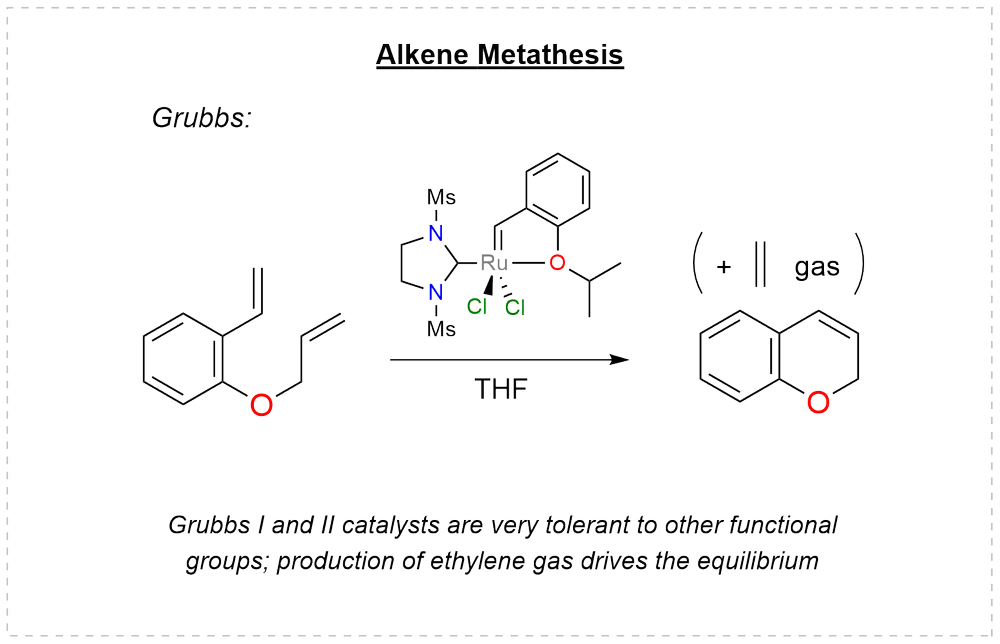
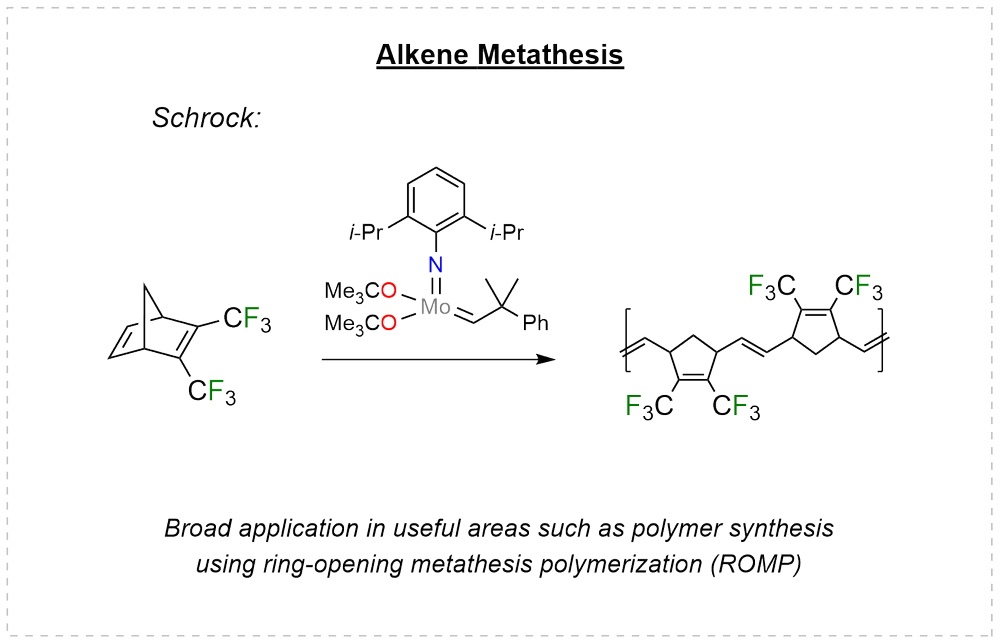
Alkene metathesis exchanges the two ends of two double bonds. A metal carbene catalyst, most often used is a ruthenium Grubbs catalyst, reacts with an alkene to form a metallacyclobutane that opens in the other direction, so the alkene carbons are redistributed and gaseous ethylene is released as the volatile by-product that drives the equilibrium forward. In the intramolecular case on a diene, the same reaction closes a ring, and ring-closing metathesis is now one of the standard ways to make a medium or large ring.
Several older metal-mediated reactions remain in general use. Catalytic hydrogenation adds H2 across an alkene on the surface of palladium, platinum, or nickel, delivering both hydrogens to the same face. The Lindlar catalyst stops at the cis-alkene from an alkyne, while dissolving sodium in ammonia reduces the same alkyne to the trans-alkene through a radical anion intermediate. Hydroboration adds boron and hydrogen across an alkene with anti-Markovnikov regiochemistry and gives the alcohol on oxidation.
Reference
Reaction summary
Every transformation in this chapter, in the order the sections introduce them.
Self-check
Six questions before you move on
Try to work out an answer on paper, then reveal to check. If your reasoning is right but the answer is wrong, keep going.
Why is the carbon of a Grignard reagent nucleophilic, when the carbon of an alkyl bromide is electrophilic?
Polarity. Carbon is more electronegative than magnesium, so in C–Mg the electron density sits more on carbon and it behaves like a carbanion. In C–Br the halogen is more electronegative, so carbon is electron poor. Making the Grignard reagent inverts the polarity of that carbon.
You need a tertiary alcohol with two identical ethyl groups starting with a carboxylic ester. How many equivalents of ethylmagnesium bromide to use, and why?
Two. The first addition gives a tetrahedral alkoxide that can expel the ester alkoxide, so a ketone is formed in the flask. That ketone is more electrophilic than the ester was, so the second equivalent adds immediately and cannot be stopped. Workup gives the tertiary alcohol with two new ethyl groups.
You want to add a methyl group to the β-carbon of cyclohexenone, not to the carbonyl. What do you use?
A cuprate: Me2CuLi, made from two equivalents of methyllithium and CuI. The softer, less basic copper nucleophile adds 1,4 to give 3-methylcyclohexanone after tautomerization. Methyllithium or the Grignard reagent would attack the carbonyl directly and give the 1,2-addition product instead.
Cyclopropanation of cis-2-butene gives only the cis-disubstituted cyclopropane. What does that tell you about the mechanism?
That both new C–C bonds form in a single concerted step, on one face of the alkene. If a discrete intermediate existed and rotation about the former double bond were possible, both diastereomers would appear. The stereospecificity is the evidence for concerted addition, and the Simmons–Smith carbenoid behaves the same way.
Name the three steps of a Suzuki coupling cycle, and say what changes at the metal in each.
Oxidative addition: Pd(0) inserts into the aryl–halide bond and is oxidized to Pd(II). Transmetalation: the aryl group is transferred from the boronate to palladium, displacing halide; the oxidation state does not change. Reductive elimination: the two organic groups join and leave as the product, returning the metal to Pd(0), ready for the next cycle.
A synthesis calls for a Grignard addition to a ketone, but the molecule also has a free hydroxyl group elsewhere. What goes wrong, and what do you do to make it work?
The Grignard reagent is a strong base and is quenched by the O–H proton, giving the alkane and the magnesium alkoxide, so nothing adds to the ketone. Either protect the alcohol first, as a silyl ether, or use a milder organometallic. Adding an extra equivalent works in principle but is wasteful and the alkoxide can complicate the addition.