Polymers
Synthesis and properties
Polymers are made by reactions already covered, mostly additions and condensations, occurring thousands of times over. Polymer chain length, regularity, and cross-linking, rather than functional groups alone, determine the properties of the material.
Monomers, chains, and molecular weight
WHAT MAKES A POLYMER DIFFERENT FROM A LARGE MOLECULE?
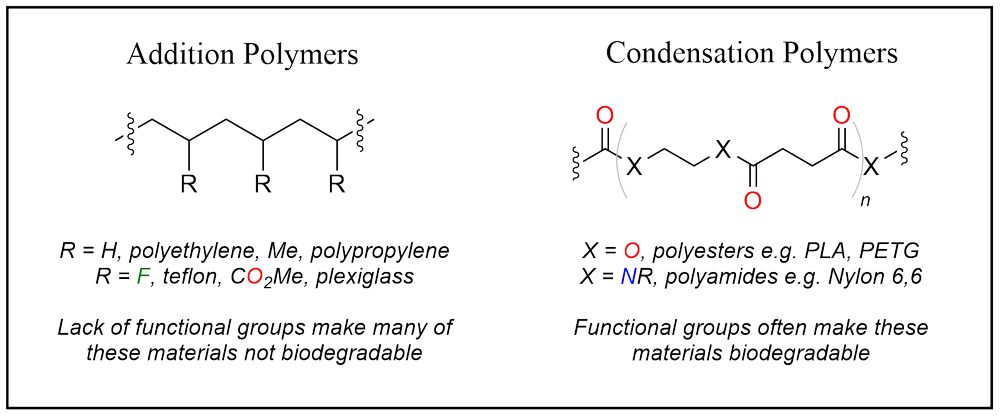
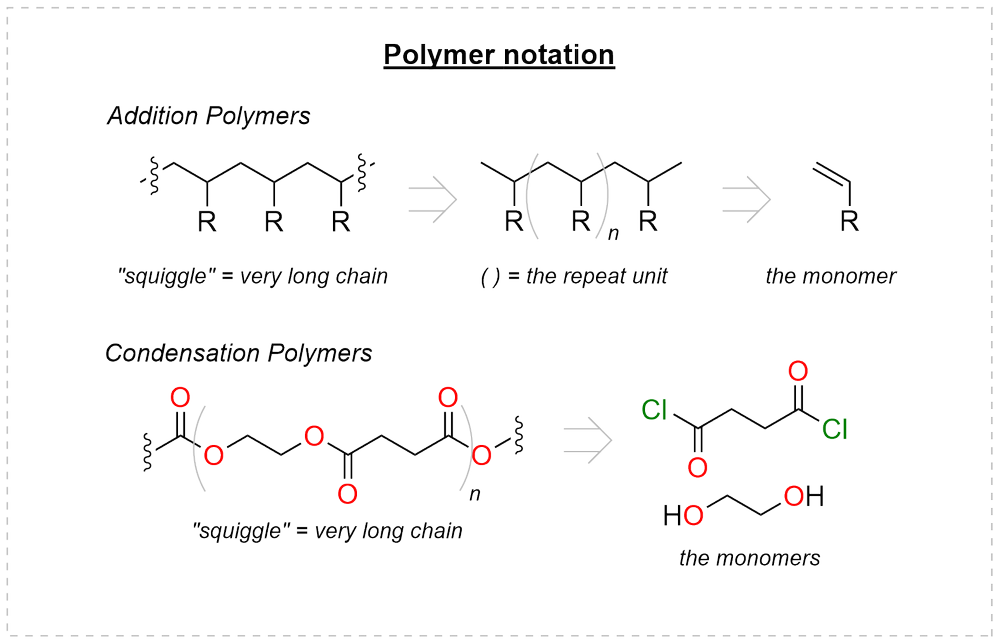
A polymer is a long chain built by joining many copies of a small molecule, the monomer, and the properties of the chain have little to do with the properties of the monomer. Ethylene is a gas; polyethylene is a solid tough enough for pipe and packaging applications. The reason is chain length; a molecule of several thousand carbons has enough surface for London forces to add up to something substantial.
That means a polymer sample is never one homogeneous compound. Chains stop growing at different points, so the product is a distribution of molecular weights, described by an average and by how broad the distribution is. The degree of polymerization, the number of monomer units per chain, is what most governs physical properties, and a synthesis that gives long chains and a narrow distribution is considered a better synthesis.
Two structural questions decide almost everything else. First, are the chains linear, branched, or cross-linked? Branching stops chains from packing closely, and cross-linking ties them into a more rigid network. Second, how regularly are the substituents arranged along the backbone, because a regular chain can crystallize and an irregular one cannot. Regularity and cross-linking explain the different properties of various polymers.
Chain-growth polymerization
Radical, cationic, and anionic addition to alkenes
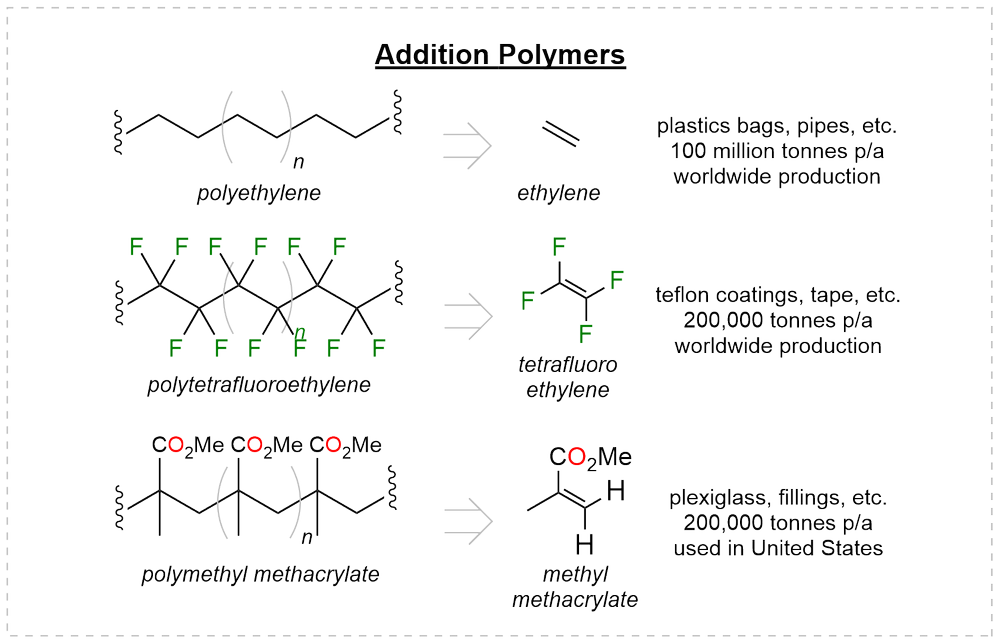
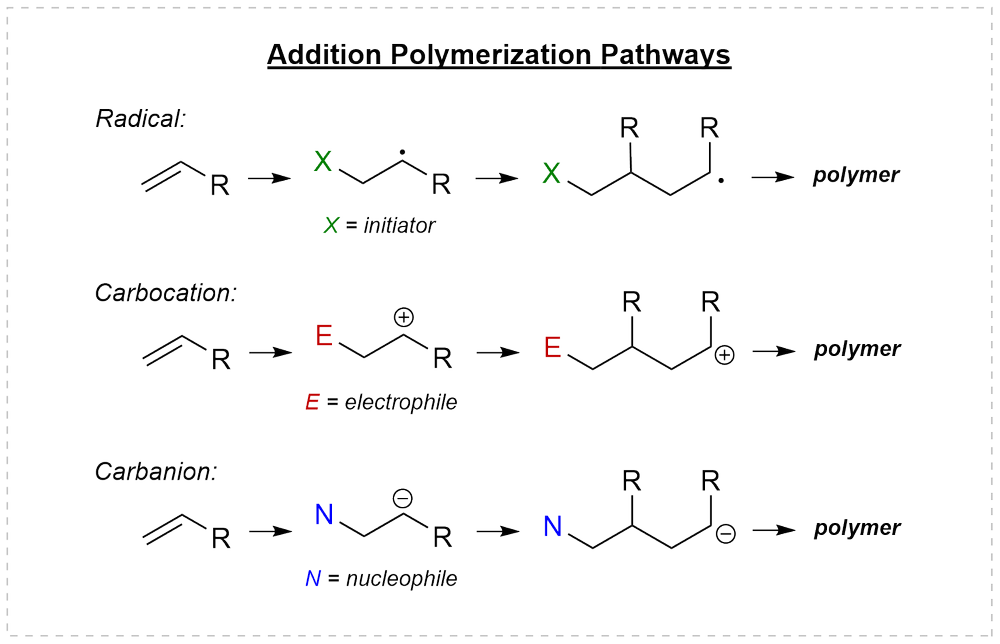
Chain-growth polymerization adds monomer to the end of a growing chain one unit at a time. The chain carries a reactive centre from initiation, which propagates rapidly, and which eventually terminates. Many industrial polymers are made this way from a substituted ethylene, and the mechanism follows alkene addition chemistry studied previously.
Radical polymerization is the most general appraoch. A peroxide or azo initiator fragments on heating to give radicals, each of which adds to a monomer. The new radical adds to another monomer, and this propagation continues until two radicals combine or one abstracts a hydrogen. Radical chains add head-to-tail because addition puts the radical on the more substituted, better-stabilized carbon, and the same regiochemistry appears in each propagation step.
Ionic routes work when the substituents cooperate. A monomer featuring an electron-donating group, such as isobutylene, polymerizes cationically because the carbocation intermediate formed is stabilized. A monomer with an electron-withdrawing group, such as acrylonitrile or methyl acrylate, polymerizes better anionically because the carbanion is stabilized. Anionic polymerization with no termination step gives a living polymer that grows while monomer remains, which is how narrow molecular-weight distributions and block copolymers are made.
Step-growth polymerization
Polyesters, polyamides, and polyurethanes from condensations
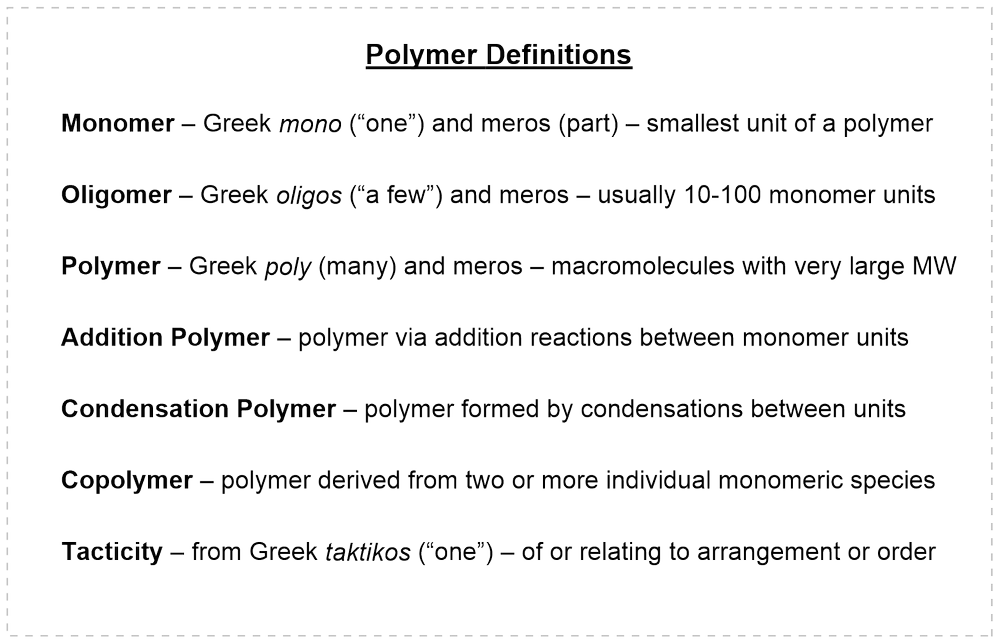
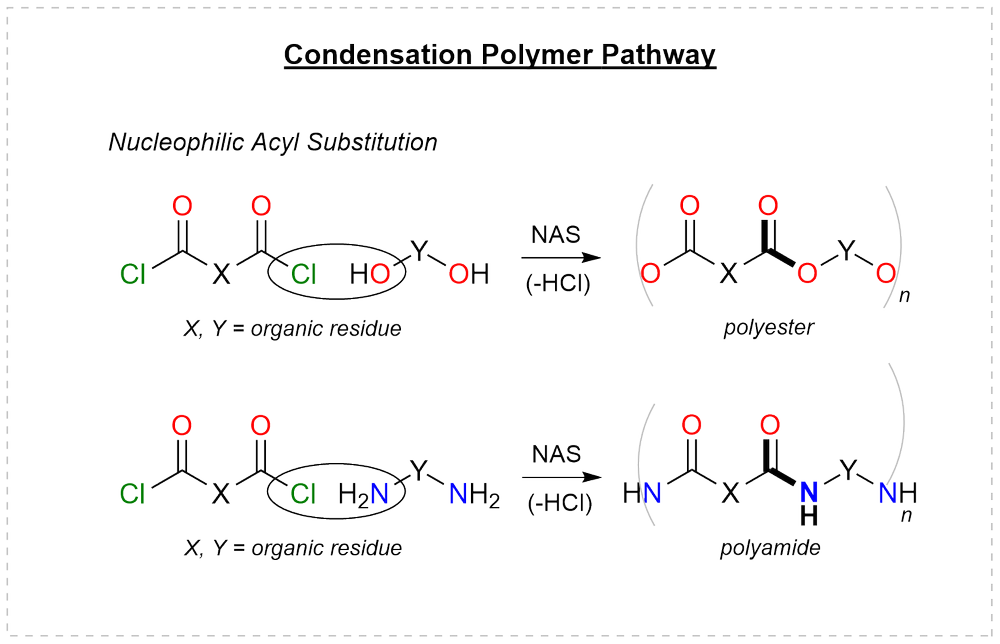
Step-growth polymerization joins any two precursor molecules with complementary pair of functional groups, so monomers, dimers, and oligomers all react with one another and long chains appear grow gradually. High conversion is essential, and the two monomers must be present in equal amounts.
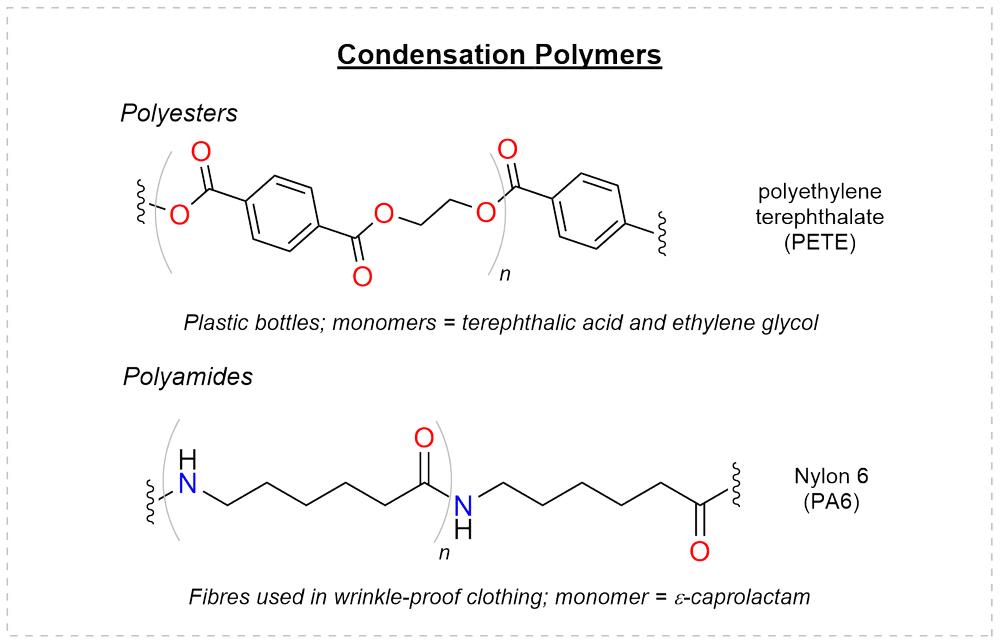
The reactions themselves are the condensations from earlier chapters. A diacid or diester plus a diol gives a polyester, as in poly(ethylene terephthalate); a diacid plus a diamine gives a polyamide, as in nylon [6,6]. The amide N–H groups hydrogen bond between chains, which is why nylon makes a strong fibre. A lactone or lactam can polymerize by ring opening instead, which is how nylon [6] is made from caprolactam.
Polyurethanes come from a diisocyanate and a diol, and no small molecule is lost: the alcohol adds across the C=N of the isocyanate to give a carbamate. Using a triol instead of a diol turns the same chemistry into a cross-linked network, and this is the general method for step-growth polymerization. A monomer with two reactive groups gives a chain, and a monomer with three gives a network.
Stereochemistry and copolymers
Tacticity, Ziegler–Natta catalysis, and mixed monomers
Every substituted carbon along a vinyl polymer backbone is a stereocentre, so the arrangement of those centres along the chain matters. An isotactic chain has all substituents on the same side, a syndiotactic chain alternates them regularly, and an atactic chain has them at random. Only regular chains can pack into crystalline domains, so isotactic polypropylene is a strong, high-melting material while atactic polypropylene is a soft amorphous one.
Radical polymerization has no control over that arrangement and gives atactic material. Stereocontrol comes from a Ziegler–Natta catalyst, a titanium halide with an aluminium alkyl, which binds each monomer and inserts it into the growing chain in one fixed orientation, giving high tacticity and unbranched chains at low pressure. Metallocene catalysts do the same with a single well-defined active site and even finer control.
Mixing monomers gives a copolymer, and how they are arranged is an additional design variable. A random copolymer disrupts regularity and lowers crystallinity. An alternating one is regular; a block copolymer joins long iterations of each monomer so that the two blocks diverge into separate domains, which is how a thermoplastic elastomer combines rubbery and rigid regions in one material. Grafting side chains of one monomer onto a backbone of another is the fourth arrangement, used to toughen brittle polymers.
Structure and physical properties
Crystallinity, glass transition, and thermosets
A polymer is rarely fully crystalline. Regular chain segments pack into ordered crystallites while the rest stays amorphous, and the fraction that crystallizes sets the stiffness, the opacity, and the melting behaviour. High-density polyethylene is a linear chain that packs well and is rigid and translucent; low-density polyethylene is branched, packs poorly, and is soft and clear.
The amorphous regions have their own characteristic temperature. Below the glass transition temperature the chains cannot move past one another and the material is a hard glass; above it they are able to, and the material becomes leathery or rubbery. Whether a polymer is a plastic or an elastomer at room temperature is largely a question of where its glass transition sits, and plasticizers work by lowering it.
Cross-linking changes the category entirely. A thermoplastic has separate chains, so heating lets them slide and the material can be melted and reshaped; a thermoset is one covalent network, so heating decomposes rather than melts it. Lightly cross-linked networks are elastomers, which stretch as the chains uncoil and snap back because the cross-links prevent permanent flow, and vulcanizing rubber with sulfur is exactly this; enough cross-links to give elasticity, but not enough to give rigidity.
Degradation and recycling
WHY THE BACKBONE DECIDES WHAT IS POSSIBLE
Stability and degradability are related to the types of bonds in the polymer backbone. A polyalkene backbone is all carbon–carbon single bonds, with nothing electrophilic to attack, so polyethylene and polypropylene persist for a very long time. A polyester or polyamide backbone contains hydrolyzable linkages, so those polymers can be broken down by water with acid, base, or an enzyme, which is why poly(lactic acid) is compostable and PET can be chemically depolymerized.
Environmental breakdown is usually oxidative rather than hydrolytic. Ultraviolet light allows for abstraction of a hydrogen or cleaves a bond to give a radical, oxygen traps it as a peroxy radical, and the resulting chain reaction cuts the backbone and introduces carbonyl groups. This is why plastics left outdoors become brittle and chalky. Antioxidants and UV stabilizers are added to intercept those radicals.
That distinction defines how polymers are recycled. Mechanical recycling melts and reforms a thermoplastic, which works only for clean single-polymer streams and degrades chain length each cycle. Chemical recycling reverses the polymerization; a polyester or polyamide can be hydrolyzed or transesterified back to monomer and repolymerized without loss of quality, while a polyalkene has no such handle and must be cracked at high temperature. A thermoset cannot be reprocessed at all, which is a consequence of that cross-linked network.
Reference
Reaction summary
Each polymerization and structural relationship in this chapter.
Self-check
Six questions before you move on
Try to work out an answer on paper, then reveal to check. If your reasoning is right but the answer is wrong, keep going.
Ethylene is a gas at room temperature, yet polyethylene is a tough solid. What accounts for the difference?
Chain length, acting through London forces. Each interaction between two chain segments is weak, but a chain of several thousand carbons has an enormous contact surface, so the total attraction between chains is large. Long chains also entangle physically. Neither effect is available to a two-carbon molecule, which is why the monomer is a gas and the polymer is a solid.
Why does radical polymerization of styrene add monomer head-to-tail rather than at random?
Because each addition puts the radical where it is best stabilized. The growing radical adds to the CH2 end of the next styrene, which places the new radical on the carbon bearing the phenyl group, where it is benzylic and delocalized into the ring. The alternative addition would give a primary radical. Since every propagation step makes the same choice, the whole chain is regular.
Isobutylene polymerizes readily under cationic conditions, but vinyl chloride does not. Why, and what would you use instead?
Because cationic propagation runs through a carbocation at the chain end, so the monomer must stabilize positive charge. Isobutylene gives a tertiary carbocation stabilized by two electron-donating methyl groups, so each addition is fast. Vinyl chloride would give a carbocation next to an electron-withdrawing chlorine, which is destabilized, so propagation stalls. Vinyl chloride is polymerized by a radical initiator instead, and monomers with strongly electron-withdrawing groups, such as acrylonitrile, are polymerized anionically.
Isotactic and atactic polypropylene are made from the same monomer, yet one is a rigid engineering plastic and the other a soft gum. Explain, and say how you make the isotactic form.
Tacticity controls crystallinity. In the isotactic chain every methyl group is on the same side, so chains pack into ordered crystallites, giving stiffness, a high melting point, and strength. The atactic chain has methyls at random, cannot pack, and stays amorphous. A radical initiator gives atactic material; a Ziegler–Natta or metallocene catalyst inserts each monomer in a fixed orientation and gives the isotactic chain.
Why can a thermoplastic be melted and remoulded while a thermoset cannot?
Because of what holds the material together. A thermoplastic is separate chains held by intermolecular forces; heating overcomes those and the chains flow past one another, so it can be melted and reshaped. A thermoset is a single covalent network in which the chains are cross-linked, and there is nothing to melt. Heating supplies enough energy to break covalent bonds, so the material decomposes or chars instead of flowing.
PET bottles can be depolymerized back to monomer, but polyethylene cannot. What in the structure decides that?
The backbone bonds. PET’s backbone contains ester links, which are electrophilic at the carbonyl carbon and therefore cleavable by hydrolysis or transesterification, so the polymer can be taken apart to terephthalate and ethylene glycol and rebuilt with no loss of quality. Polyethylene’s backbone is nothing but C–C and C–H bonds, with no electrophilic site and no leaving group, so there is no mild way to cleave it and it must be cracked thermally.