Radical Chemistry
1
Structure & Stability
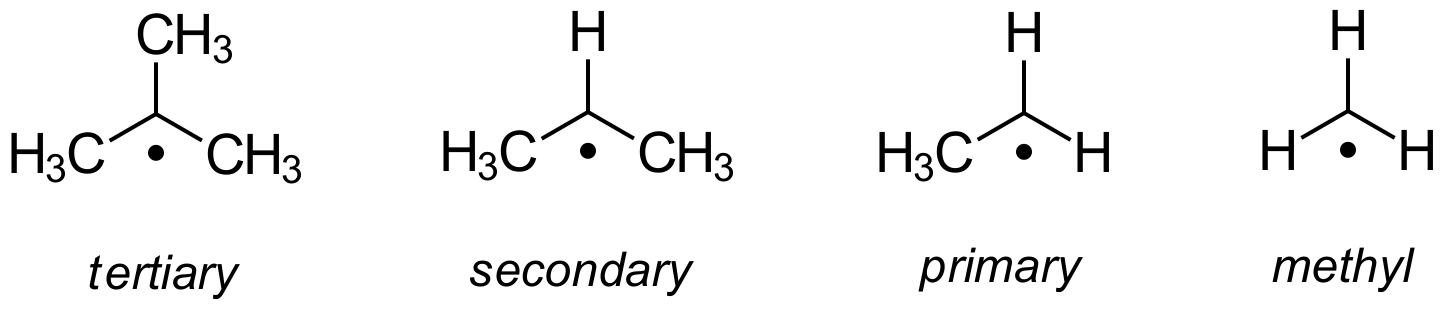
Carbon radicals feature an sp2 hybrid carbon so they are flat (trigonal planar) with the single radical electron being housed in a p orbital that is orthogonal to the three sigma bonds attached. Like carbocations, radicals are stabilized by neighbouring alkyl groups through electron donation (hyperconjugation). This leads to the same stability/reactivity pattern as carbocations, with tertiary > secondary > primary > methyl. Conversely, any groups attached that are electron-withdrawing will destabilize the radical. Carbon radicals are 7-electron species so they are reactive and generally only formed as intermediates.
2
Formation
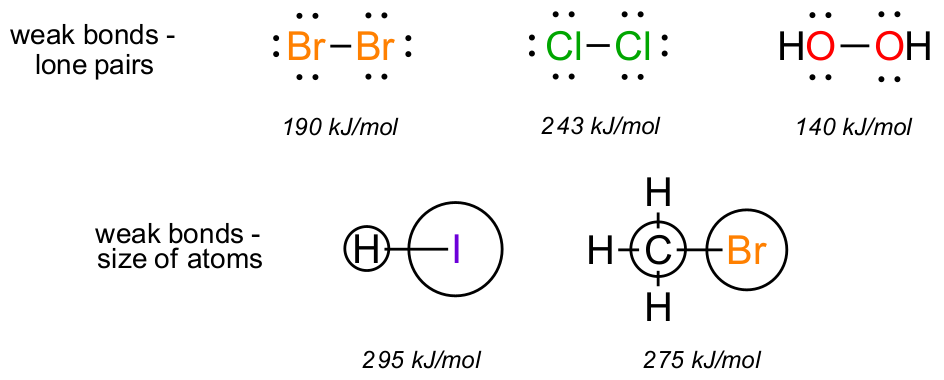
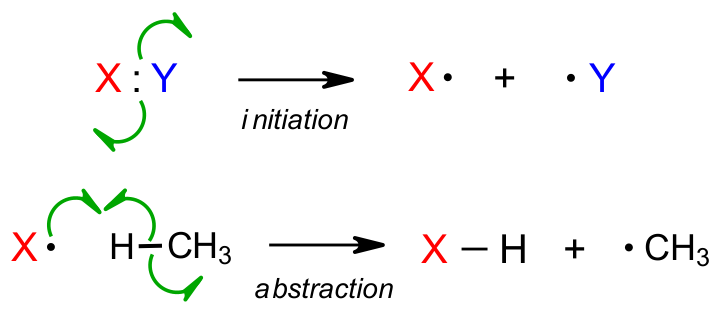
Radicals are formed when single bonds are broken such that each contributing atom gets one electron. Carbon radicals are usually formed as the result of abstraction of a hydrogen by a reactive species such as a halogen or hydroxyl radical, which is formed first by cleavage of a weak bond. Some typical bond energies of weak bonds are given below. When alkanes react with bromine or chlorine, usually by being heated or exposed to UV light, the weak halogen-halogen bond breaks first in an initiation step. Those radicals then chase atoms to abstract from the organic substrate and the mechanism continues.
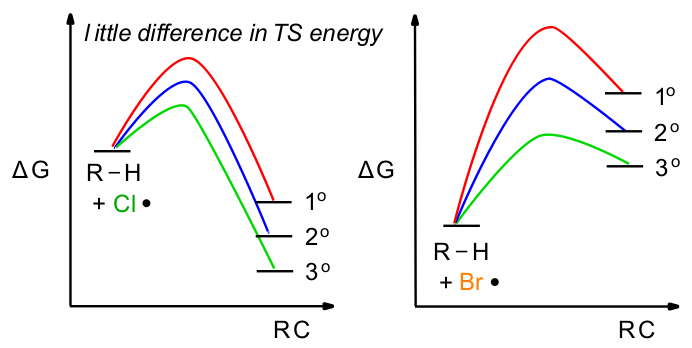
The most common use of radicals in synthesis is the halogenation of alkanes to give alkyl halides (full mechanism in the video below). The abstraction step after initiation (i.e. the first propagation step) is known to be regioselective with the level of regioselectivity depending on the halogen used. As shown in the graphs below, while both chlorine and bromine both favour the more substituted product, formed via the more stable radical, the much more reactive chlorine radicals generally give less selectivity than the less reactive bromine radicals.
3
Reactions
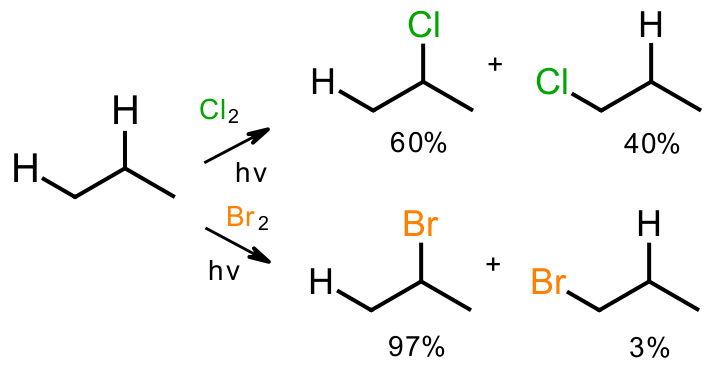
Treating an alkane with molecular chlorine or bromine (fluorination is dangerously exothermic and iodine is endothermic) results in alkyl halide products and is still the best way to activate alkanes with a functional group. Chlorination of alkanes is less selective (details above) and gives substantial amounts of regioisomeric alkyl chlorides, however since chlorine is cheap this is used in industry. The products are separated and sold as commodity chemicals. On smaller scales, the use of liquid bromine is preferred and this reaction shows much higher regioselectivity (see above for explanation). With propane (below) the outcome heavily favours the tertiary product via the better tertiary radical.
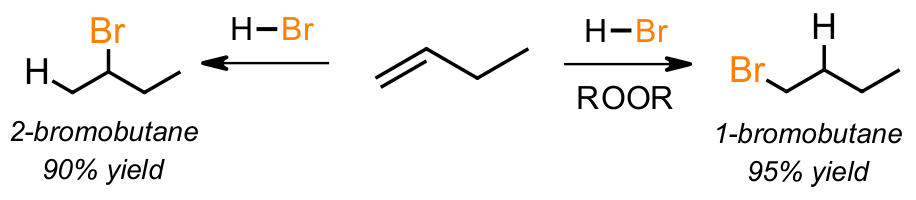
When prochiral alkenes are reacted with HBr they convert to alkyl halides with Markovnikov regioselectivity (below, left). This pathway is known to be ionic with the major product being formed via the most stabilized carbocation. However, when a radical precursor such as a peroxide is added to the reaction mixture, alkyl bromides are still formed but with the opposite (anti-Markovnikov) regioselectivity. This has been proven to be a radical-based pathway, with bromine radical added first to the alkene to give the more stabilized carbon radical. This type of radical addition is also useful in forming polymers from alkene monomers.