Substitution and Elimination Reactions
Basics of SN and Elimination Reactions
SN2
Consider the following reaction between a secondary alkyl halide and powerful azide nucleophile. When kinetic experiments are run, the rate of reaction is found to depend on concentration of both the nucleophile and the electrophile, i.e. the rate-determining step is bimolecular. Starting with only the pure (R)-isomer of the bromide, only the (S)-isomer of the azide is produced. How do these clues lead to a mechanism? Remember there are only 4 arrow-pushing moves allowed in polar mechanisms: H+ transfer, nucleophilic attack, loss of leaving group, rearrangement.
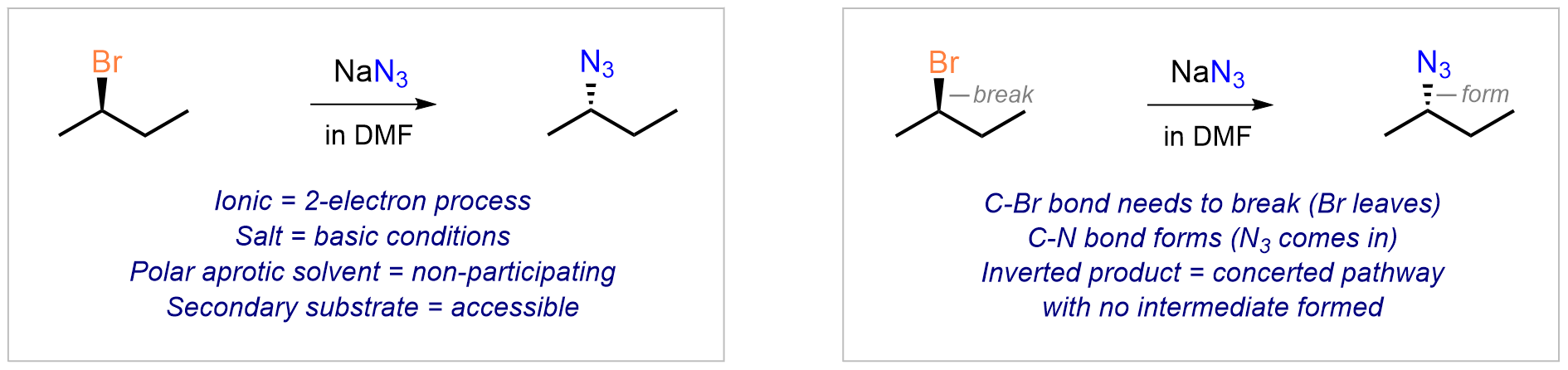
Since we know the pathway is based on 2-electron processes (ionic species are involved) and also bimolecular, we are ready to consider how the C-Br bond will be broken and how the C-N bond will be formed. It may only be concerted or stepwise, there is no third option. If the C-Br bond were to break first in a stepwise process, a prochiral carbocation would be formed, which would lead to a racemic mixture. This does not happen in this reaction so the pathway must be concerted with C-Br breaking and C-N forming at the same time. The inversion is explained by the nucleophile having to attack the C-Br anti-bond, which is located behind the carbon electrophile. All these clues lead to a one-step mechanism, which we call the SN2 in which the bond-forming and bond-breaking events occur simultaneously.

E2
The next reaction features a tertiary alkyl halide reacting with sodium methoxide, which may act as a nucleophile or a base. Compared to the first example, the methoxide anion is much more basic (pKa for HCN = 10, for CH3OH = 16), and the substrate alkyl halide is much more crowded. This slows down the approach of the nucleophile to the alpha carbon and increases the chance of attack at a beta hydrogen. Kinetic experiments show the rate of reaction to depend on the concentrations of both the nucleophile/base and substrate, which points to a concerted process. The elimination pathway wins, and an alkene product is formed as the major result. How do we push arrows to show this mechanism?
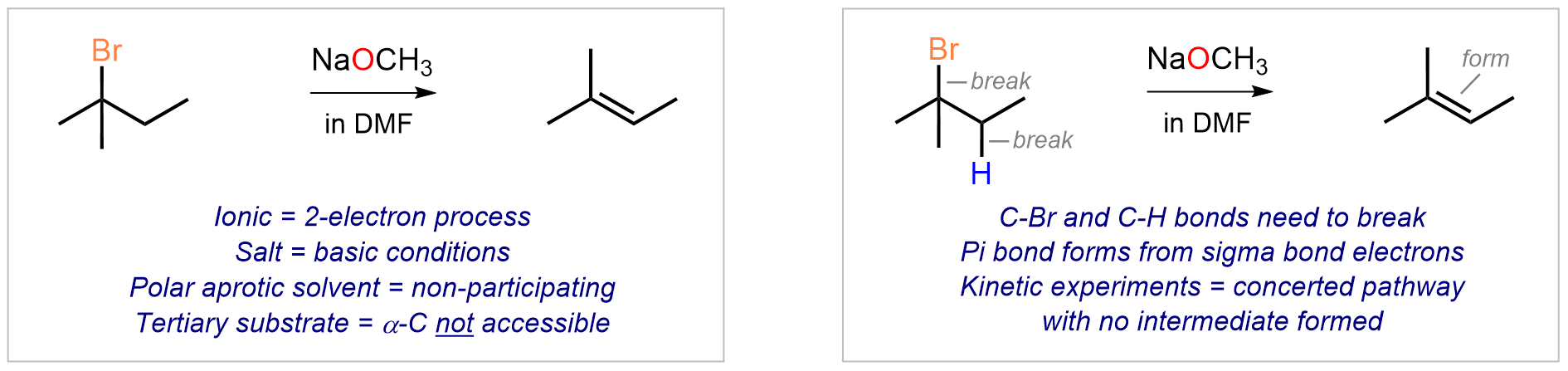
Knowing that the rate-determining step for this reaction is bimolecular, and only a small number of bonds need to form and break, it will be possible to accomplish everything in one step. With the overall goal of transferring the negative charge from the less stable oxygen anion to the more stable bromide, the base overlaps with a beta hydrogen, which causes the C-H bond to break, with those electrons forming the pi bond and the bromide leaving group being forced out of the substrate. With a small base, Zaitsev regioselectivity is usually observed due to its lower-energy transition state. The Hofmann product may be obtained through use of a sterically crowded base.

SN1
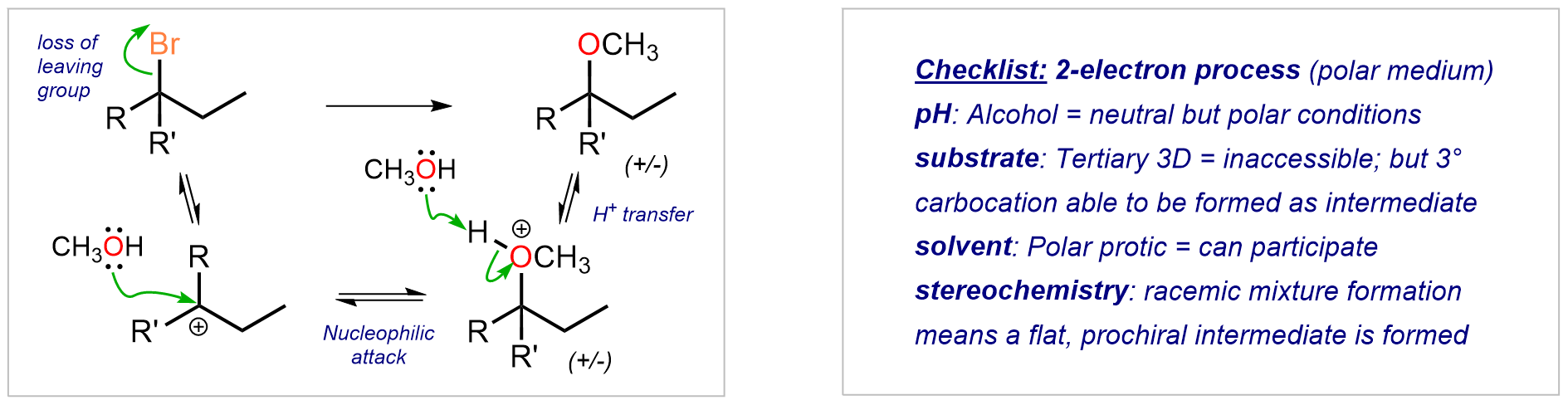
While the SN2 and E2 most often occur under basic conditions, the switch to neutral or acidic environments allows for carbocations to be formed and the creation of products via unimolecular pathways. In the example below the tertiary alkyl halide reacts with methanol under essentially neutral conditions to give a racemic mixture of ether products. The formation of enantiomers means that a flat, prochiral, intermediate must formed, which is understood to be the carbocation generated by loss of the bromide leaving group.
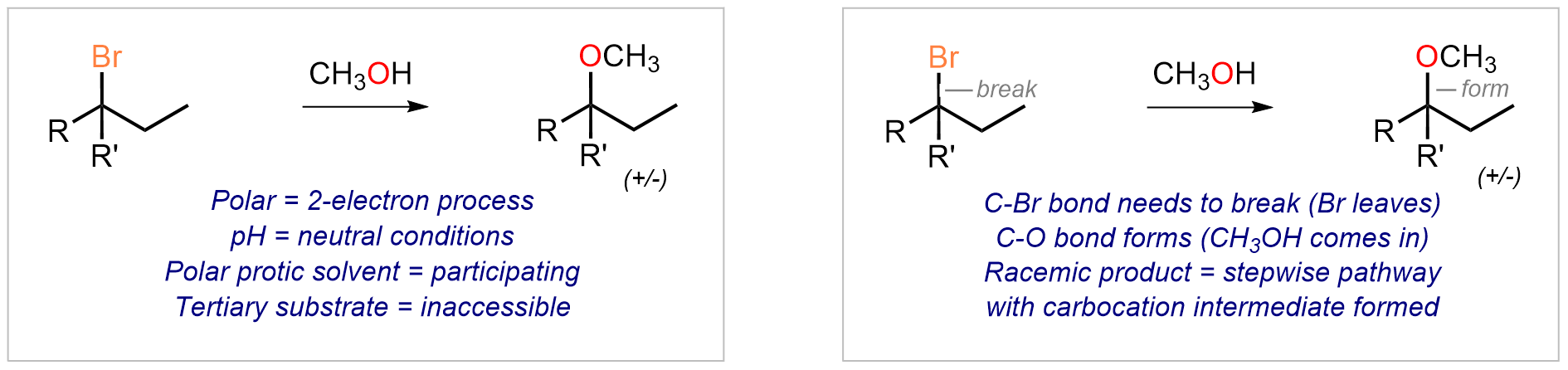
Since a weak nucleophile/base is employed, the crowded system is unlikely to undergo bimolecular reactions so the substrate is able to undergo unimolecular reactions in which the leaving group breaks away in the first step of a stepwise process. The resulting carbocation will be flat and prochiral, which allows for equal recruitment of the nucleophilic solvent from either face to generate a racemic mixture.
E1
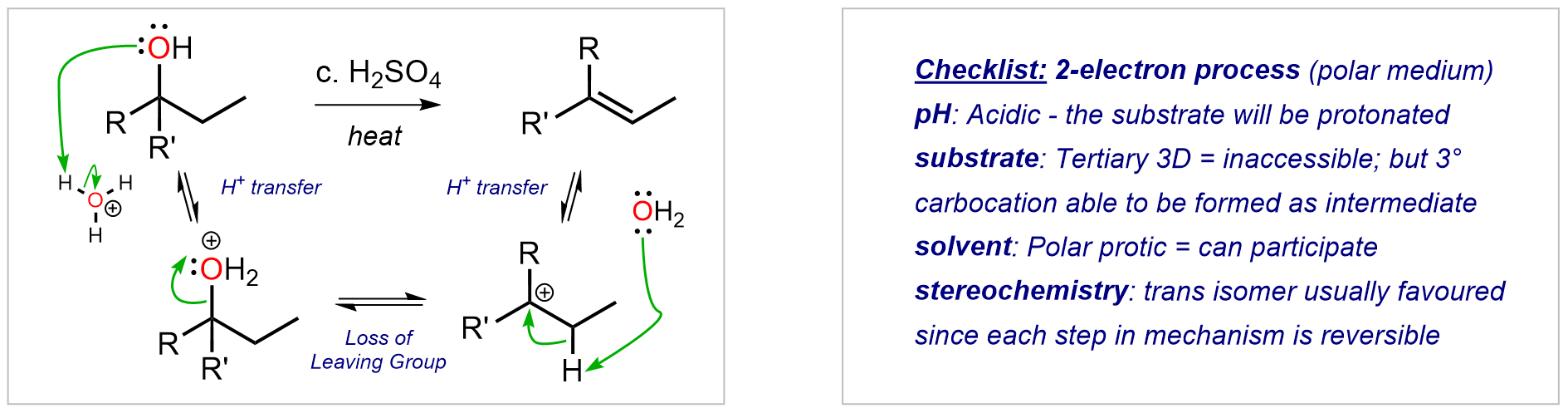
Under strongly acidic conditions, secondary and tertiary alcohols undergo an elimination process in which the rate-determining step is known to be unimolecular. Equilibrium is established, with the more stable alcohol being favoured, however the alkene may be isolated in high yields if it is removed from the reaction mixture by distillation. Two bonds need to break, and two need to form to generate the alkene, so a stepwise process is deduced from the evidence. The trans stereochemistry and Zaitsev regiochemistry are favoured when possible.
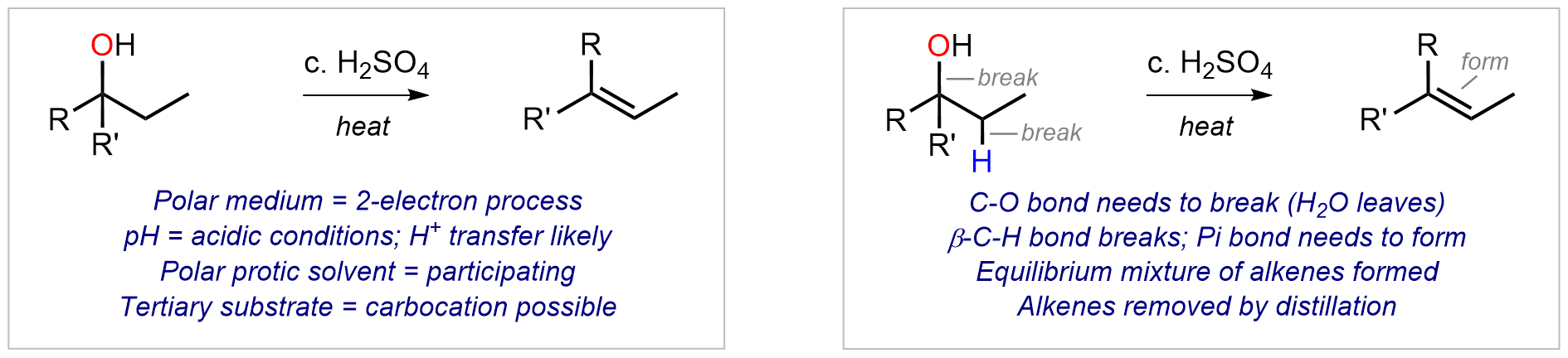
The acid is known to catalyze the process by first protonating the OH group to create an excellent leaving group in the form of water. This will break off in the slow, rate-determining step, which is known to be unimolecular. The resultant carbocation may then trap water, and go back to the alcohol in an SN1 pathway, or be deprotonated at the beta position to give the alkene and regenerate the acid catalyst.