Thiols & sulfides
Synthesis and chemistry
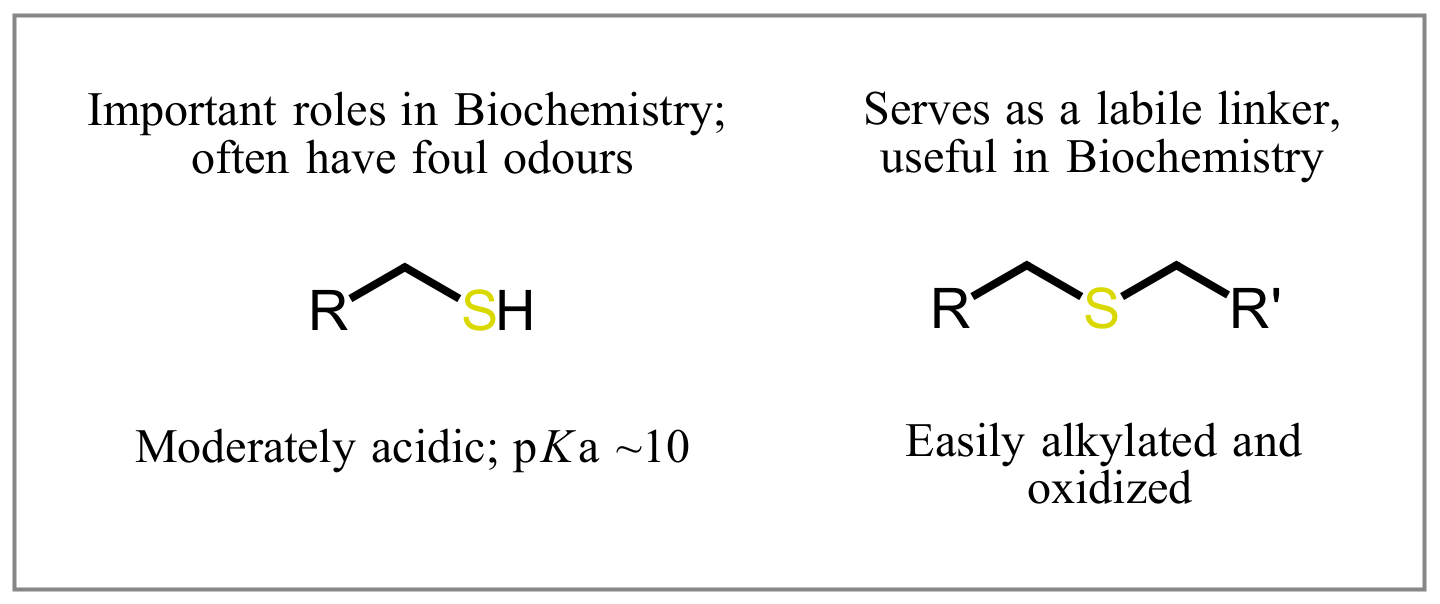
Thiols and sulfides are the sulfur analogues of alcohols and ethers, respectively, and the simple comparison extends to their chemistry. Sulfur sits below oxygen on the periodic table, so it is larger, more polarizable and doesn't hold its electrons as tightly. That single difference makes thiols more acidic than alcohols, makes sulfur a better nucleophile than oxygen, and opens up oxidation chemistry that has no counterpart in the alcohol series.
Preparation and acidity of thiols
SN2 with hydrosulfide, and the pKa comparison
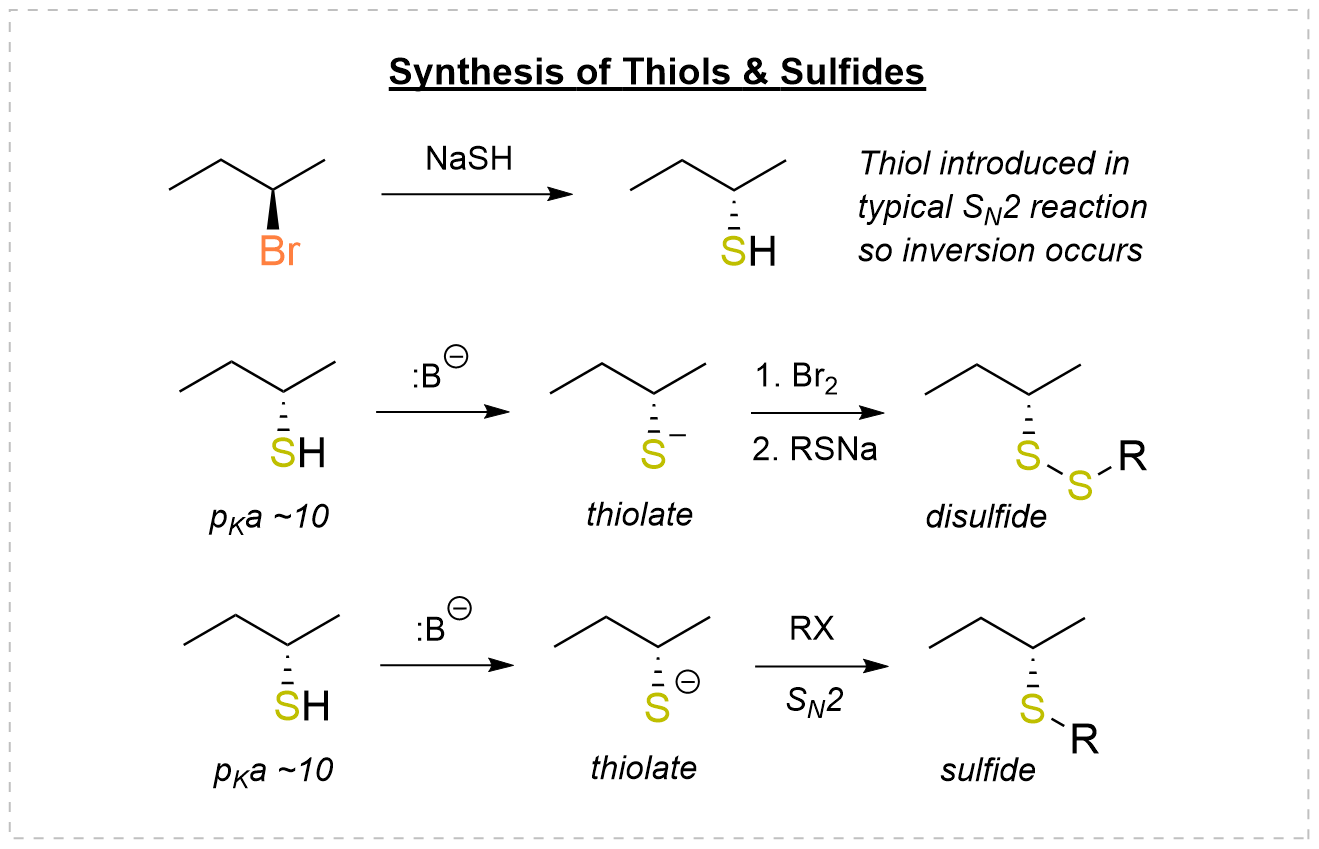
The straightforward route to a thiol is an SN2 reaction between an alkyl halide and hydrosulfide ion, HS−. There is a complication, however. The thiol product is itself easily deprotonated, and the resulting thiolate is a better nucleophile than HS−, so it competes for the remaining alkyl halide and gives a sulfide as a by-product. Running the reaction with a large excess of HS− keeps the statistics in favour of the thiol. The cleaner alternative uses thiourea as the sulfur nucleophile; alkylation gives a salt that cannot be alkylated a second time, and hydrolysis with aqueous base then releases the thiol.
Thiols are noticeably more acidic than the corresponding alcohols, with a pKa near 10 against roughly 16 for an alcohol. The reason is the size of sulfur. Its valence electrons occupy a larger, more diffuse shell, so the negative charge on the thiolate is spread over a greater volume. The S–H bond is weaker than an O–H bond to begin with. The practical consequence is that bases such as hydroxide, or even an amine, can convert a thiol quantitatively to its thiolate, whereas an alcohol needs something as strong as NaH.
Oxidation of thiols to disulfides
A versatile S–S bond
Two thiols are coupled by a mild oxidant such as I2, Br2 or simply air to give the disulfide, RS–SR. There is no analogous reaction for alcohols; a peroxide, RO–OR, is a high-energy species, while the S–S bond of a disulfide is reasonably stable. The transformation is also reversible. A reducing agent such as zinc in acid, or an excess of a small thiol, cleaves the disulfide back to two thiols.
That reversibility is why the functional group is important beyond the lab. Disulfide bridges between cysteine residues hold proteins in three dimensions, and because they can be formed and broken without disturbing the rest of the structure, they act as a switch that responds to the oxidizing or reducing environment of the cell.
Sulfides and sulfonium salts
Sulfur as the nucleophile
Sulfides are made the same way as ethers, by a Williamson-type SN2 reaction. Deprotonating a thiol gives the thiolate, and the thiolate then displaces halide from a primary or secondary alkyl halide. The step is easier than its oxygen counterpart because a thiolate is both a stronger nucleophile and, being the conjugate base of a weaker acid, less basic; so there is correspondingly less competing elimination.
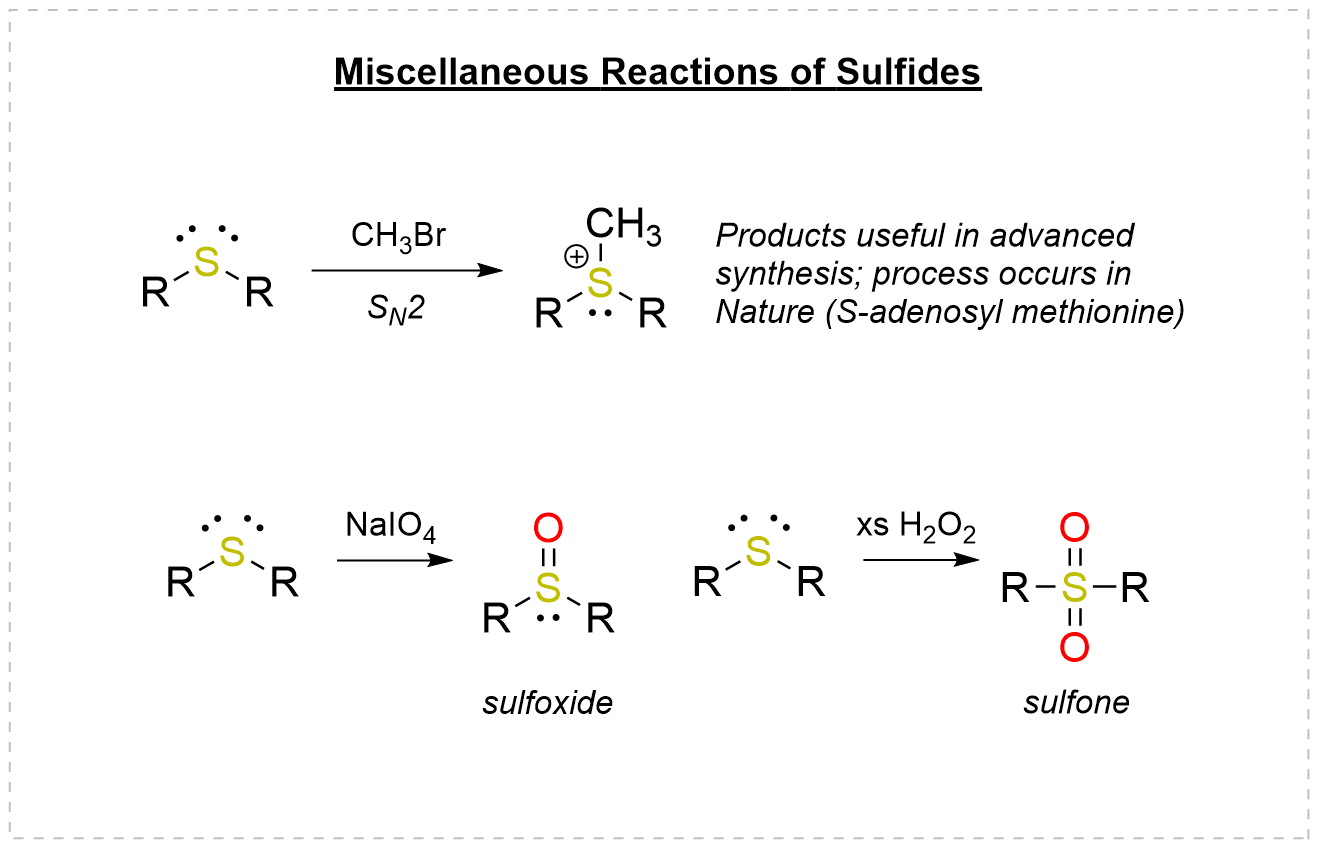
Where sulfides diverge sharply from ethers is that the sulfur atom of a sulfide is still nucleophilic. Treating a sulfide with an alkyl halide gives a trialkylsulfonium salt, R3S+. An ether will not do this to any useful extent. The sulfonium salt is a good electrophile, since a neutral sulfide is an excellent leaving group, so a nucleophile displaces one of the three groups by SN2. Nature uses the same chemistry: S-adenosylmethionine (SAM) is a sulfonium salt that acts as a biological methylating agent.
Oxidation to sulfoxides and sulfones
Controlling how far the oxidation goes
Sulfur is also easily oxidized. One equivalent of hydrogen peroxide, or a peroxyacid, converts a sulfide to a sulfoxide; a second equivalent, or a stronger oxidant, carries it through to the sulfone. The two stages can be separated in practice, so the oxidation state of the product is set by stoichiometry rather than by any change of reagent. Dimethyl sulfoxide, the familiar polar aprotic solvent, is simply the sulfoxide of dimethyl sulfide.
A sulfoxide is worth a second look. Sulfur carries a lone pair and three different substituents once the oxygen is counted, and the lone pair does not invert at room temperature. A sulfoxide with two different alkyl groups is therefore chiral at sulfur and its enantiomers can be separated. Oxidize once more to the sulfone level and that stereocentre is lost, since the two oxygens are identical.
Reference
Reaction summary
Each transformation is listed here. Read it right to left when planning a synthesis.
Self-check
Six questions before you move on
Try to work out an answer on paper, then reveal to check. If your reasoning is right but the answer is wrong, you are closer than you think.
Ethanethiol has a pKa near 10 and ethanol near 16. Explain the six-unit gap.
Sulfur is larger than oxygen, so the negative charge of the thiolate is spread through a bigger, more diffuse orbital and is better stabilized. The S–H bond is also weaker than O–H, so it is easier to break.
1-Bromobutane and one equivalent of NaSH gives a poor yield of 1-butanethiol. What is the by-product, and how do you avoid it?
Dibutyl sulfide. The thiol is deprotonated as it forms and the thiolate is alkylated by a second molecule of the halide. Use a large excess of HS−, or use the thiourea salt, which cannot alkylate twice.
Thiols are oxidized to disulfides by air, yet alcohols are not converted to peroxides. Why the difference?
The S–S bond is stable, so the oxidation is energetically downhill. An O–O bond is weak and a dialkyl peroxide is a high-energy, unstable product, so the reaction with alcohols has no thermodynamic driving force.
A sulfide reacts with CH3I to give a salt; an ether does not. What does that say about the nucleophilic nature of oxygen and sulfur?
Sulfur is bigger and more polarizable, so its lone pairs are held loosely and are genuinely nucleophilic. Oxygen holds its lone pairs tightly, and an oxonium salt formed this way would be far less stable.
Why is a sulfonium salt a good methylating agent, in the lab flask and in the cell?
The positive sulfur makes the attached carbons electrophilic, and displacement expels a neutral sulfide, which is an excellent leaving group. In Biochem, S-adenosylmethionine works on the same principle.
Methyl ethyl sulfoxide can be resolved into enantiomers; the corresponding sulfone cannot. Why?
In the sulfoxide the sulfur carries four different groups; methyl, ethyl, oxygen and a lone pair that does not invert at room temperature, so it is a stereo-centre. The sulfone has two identical oxygens and no lone pair, so the molecule is symmetrical.